A representative from EVNHCMC stated that the drills aim to ensure proficient response capabilities in disaster prevention, search, and rescue operations across all activities. This includes command and control, coordination among units and rapid response teams, and ensuring safety for the power grid, community, and labor. The corporation mobilizes supplies, equipment, rescue vehicles, and ensures plans for restoring power supply to the community.
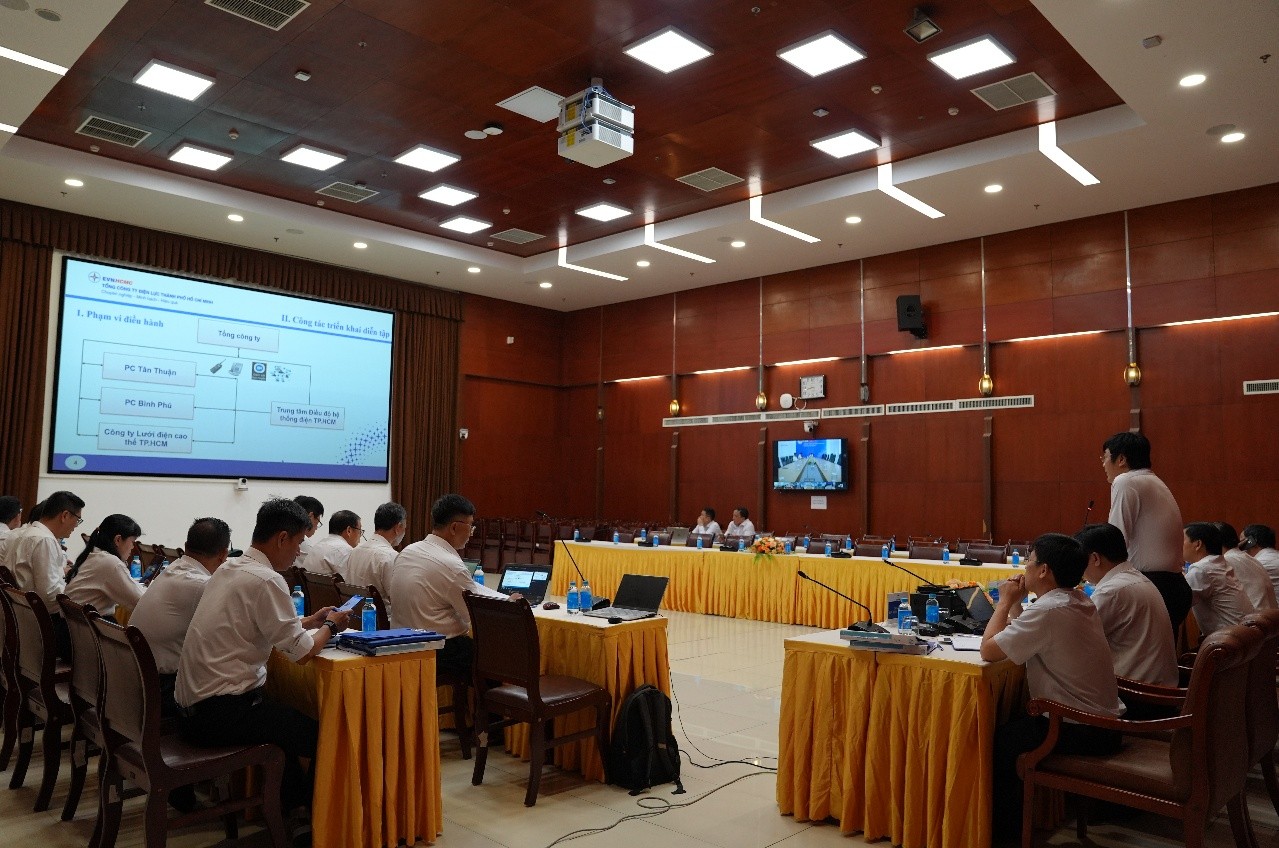 |
Nguyen Huynh Dang Khoa, Head of Safety Department and Standing Member of the Civil Defense Steering Committee of the Corporation, reports on drill preparations. Photo: EVNHCMC |
Nguyen Huynh Dang Khoa, Head of Safety Department and Standing Member of the Civil Defense Steering Committee of the Corporation, reports on drill preparations. Photo: EVNHCMC
The drills involved the corporation's Civil Defense Steering Committee, leaders of specialized departments overseeing online drills, and participation from all affiliated units. Four units hosted the simulated field scenarios: the Power System Dispatch Center, Tan Thuan Power Company, Binh Phu Power Company, and High Voltage Grid Company. These units implemented four simulated situations: widespread collapse of utility poles; flooding of a distribution substation; flooding of a 110 kV substation; and subsidence of a 110 kV transmission line tower foundation.
Specifically, Tan Thuan Power Company's scenario involved the city being impacted by typhoon number 3. The typhoon, with strong intensity of level 9-10 (disaster risk level 3), showed complex developments, potentially affecting Nha Be, Hiep Phuoc, and An Thoi Dong communes. This caused significant damage to property, infrastructure, and materials, including the power system in Hiep Phuoc commune.
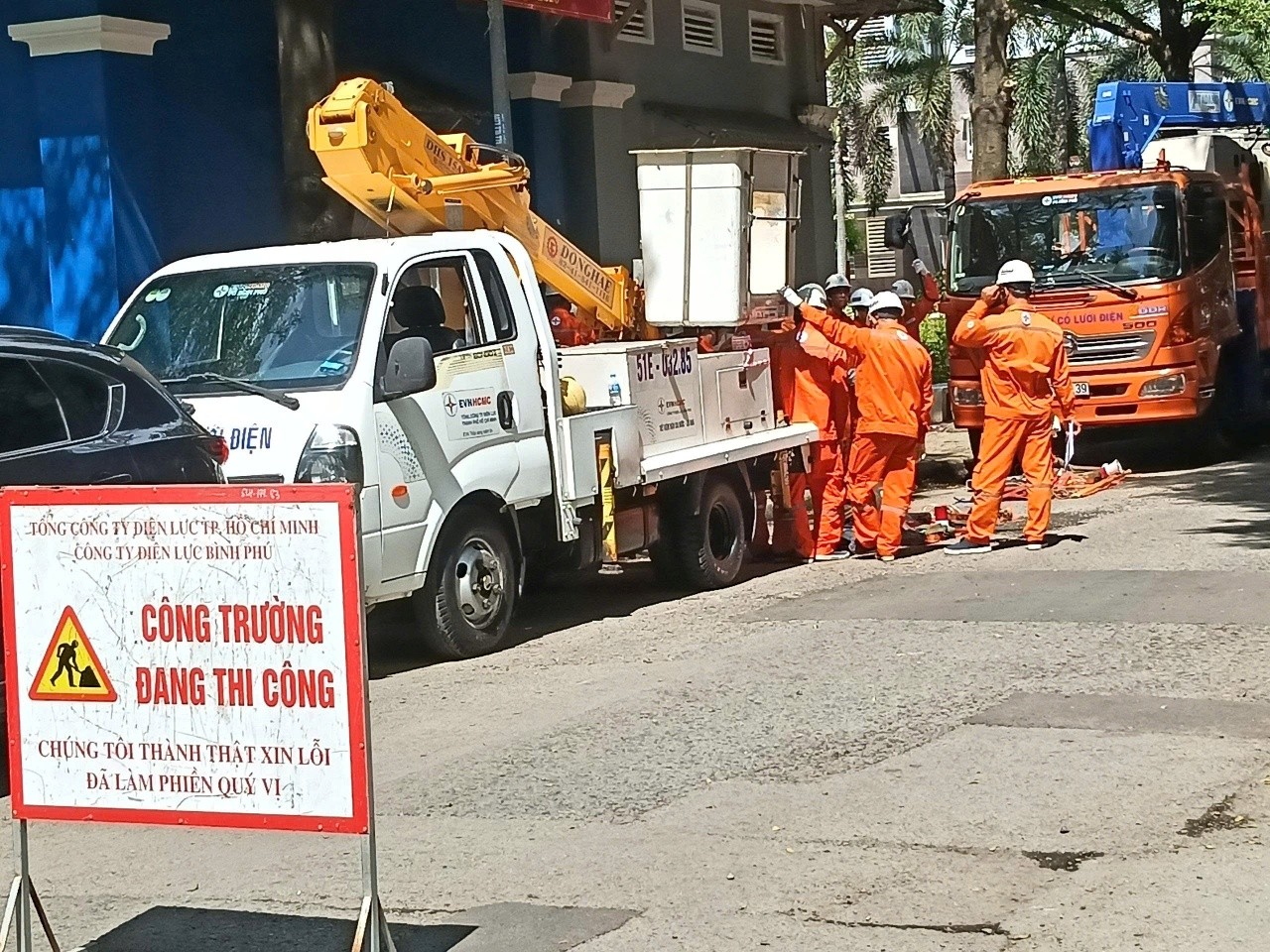 |
Binh Phu Power Company's drill in progress. Photo: EVNHCMC |
Binh Phu Power Company's drill in progress. Photo: EVNHCMC
The drill location was near Ba Sau bridge along the river in Hiep Phuoc commune, on the 22kV Nguyen Binh line at Nha Be substation. The specific situation involved multiple medium-voltage poles suffering foundation erosion, tilting, and collapsing, with broken medium-voltage lines, damaged low-voltage cables, and bent transformer platforms. Notably, the residential area near Ba Sau bridge experienced a complete power outage.
Binh Phu Power Company's simulated situation was prolonged heavy rain due to the typhoon. Water levels rose rapidly in the Ehome area - An Lac ward, causing flooding of 0,5-1,0 m, directly impacting the 110kV Binh Phu substation and traffic routes.
The High Voltage Grid Company presented a scenario involving prolonged heavy rain over several days. The soil around tower number 198 of the 110kV Go Dau - Phu Hoa Dong (Cu Chi) transmission line became saturated and softened, leading to severe erosion. This undermined the tower foundation, posing a risk to power grid operation safety and potential tower collapse. Additionally, the High Voltage Grid Company also conducted a drill to handle flooding at the 110kV Viet Thanh substation in Tan Thuan ward.
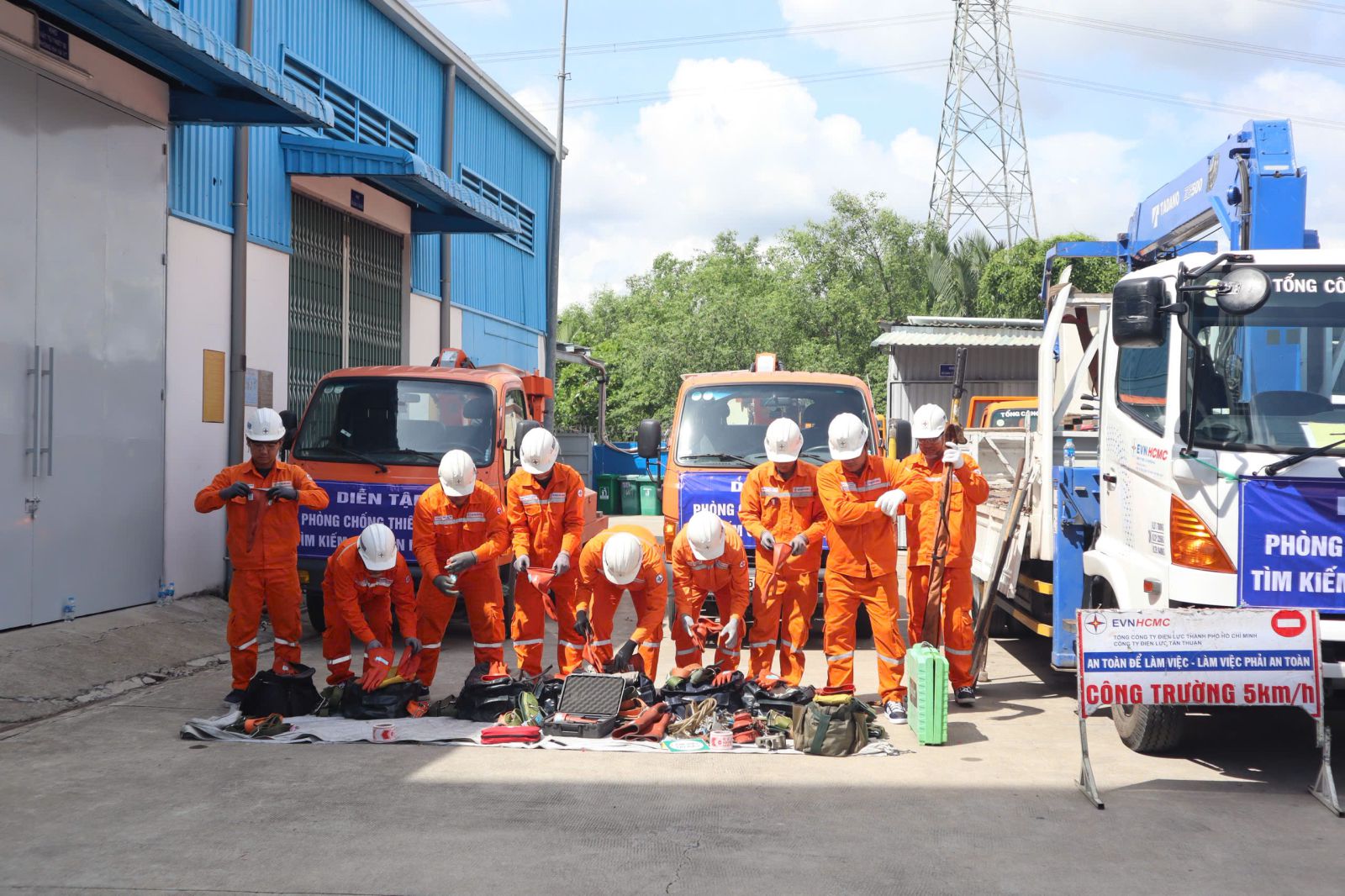 |
Tan Thuan Power Company's drill personnel. Photo: EVNHCMC |
Tan Thuan Power Company's drill personnel. Photo: EVNHCMC
Before the drills, units prepared detailed scripts with various specific response plans, adhering to the "four on-site" principle: on-site command, on-site personnel, on-site equipment, and on-site logistics. This aligns with the corporation's directive for timely response and urgent recovery. Besides field operations, units utilized digital workforce management software to observe and survey the actual terrain, and used two-way radios for command, situation assessment, and force mobilization. They also deployed solutions to ensure personnel and equipment safety, along with response strategies.
The drills were completed in approximately two to three hours, monitored by the corporation via video conference. Immediately after the drills, the corporation held a meeting to evaluate results and share lessons learned with all units.
Earlier, EVNHCMC issued its 2026 disaster prevention, safety risk, and power system security plan, which was distributed to units for implementation. The plan covers the power grid system under the electricity sector's management, including 110/220 kV, 22 kV, and 220/380 V transmission lines and substations.
The objective is to ensure command and control capabilities, enhance response, quickly restore power supply, and ensure safety and stability for the city's power system. It also aims to ensure absolute safety for people and property, minimizing damage from disasters to power grid infrastructure. Furthermore, it seeks to raise awareness and participation in preventing, responding to, and mitigating disaster consequences.
EVNHCMC requires affiliated units to disseminate the plan to relevant departments and employees. They must review and refine their unit's disaster prevention plans and organize drills appropriate to typical situations that may occur within their units.
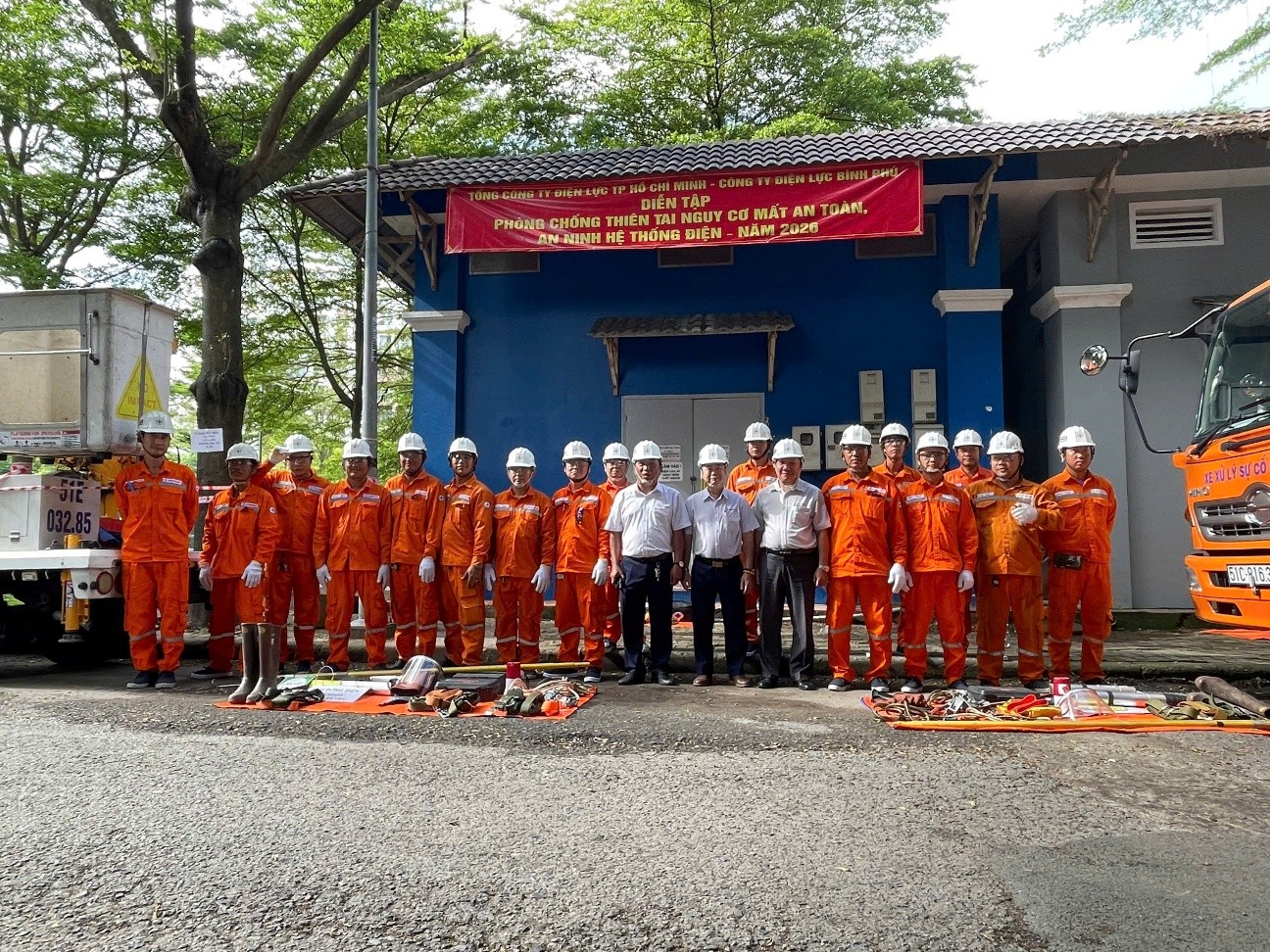 |
Workers from Binh Phu Power Company focus on the flooded Tien Hung 3 substation drill site. Photo: EVNHCMC |
Workers from Binh Phu Power Company focus on the flooded Tien Hung 3 substation drill site. Photo: EVNHCMC
For 110/220 kV power stations and headquarters with basements, EVNHCMC requires units to review and add flood prevention solutions from the site selection and design phases. Plans must consider the risk of water ingress from above, below ground, and surrounding areas.
Additionally, units need to install on-site drainage pump systems, prepare backup equipment, and be ready to mobilize search and rescue forces when necessary. For medium and low-voltage grids, the focus is on adhering to regulations for system design, arrangement, inspection, and maintenance. Units must regularly review areas prone to subsidence, erosion along rivers, canals, or flooding, and proactively trim trees to mitigate incidents.
For operational headquarters and substations, EVNHCMC requires strengthening and securing roofs, electrical structures, and solar power systems. The goal is to ensure the safety of employees, the community, and equipment during the rainy season and typhoons.
Since late april, Ho Chi Minh City Power Corporation has directed its affiliated units to develop plans to ensure electrical safety during the rainy season and typhoons. Concurrently, the corporation issued a plan for disaster prevention, risk mitigation, and power system security for 2026.
According to this requirement, units must strictly implement legal regulations and directives from state management agencies and Vietnam Electricity regarding disaster prevention and search and rescue. The Civil Defense Steering Committee and rapid response teams at each unit must also be reviewed and consolidated on time.
All forces are required to maintain a proactive stance following the "four on-site" principle: on-site command, personnel, equipment, and logistics. This organizational approach ensures immediate deployment when a disaster occurs.
The city's electricity sector also requires units to regularly conduct response and search and rescue drills. In the event of an incident, on-site forces must quickly cordon off the area, ensure safety, and focus on restoring power supply as soon as possible.
Resource mobilization will be based on the risk level and impact of each situation. Units must also carry out search and rescue tasks according to their established plans and participate in support when requested by competent authorities.
Hoang Dan