Nike's primary goal each World Cup season is not to sell shoes, but to win over fans. Recently, social media users in the West could hardly miss "Rip the Script", Nike's latest advertising campaign.
This is not merely a TV commercial, but a short film produced with Hollywood-level investment. The setting is a giant film studio where a crew is shooting a formulaic football advertisement, complete with instructions on tactics, data, and disciplined gameplay.
However, the football stars refuse to follow the script, breaking all boundaries to return to the spirit of street football and spontaneity. Over 6 minutes, viewers witness a series of entertaining performances from more than 30 football stars. Top global players who collaborate with Nike appear in the video, including Cristiano Ronaldo, Kylian Mbappe, Erling Haaland, and Vinicius. Legends like Eric Cantona, Zlatan Ibrahimovic, and Ronaldinho also make appearances.
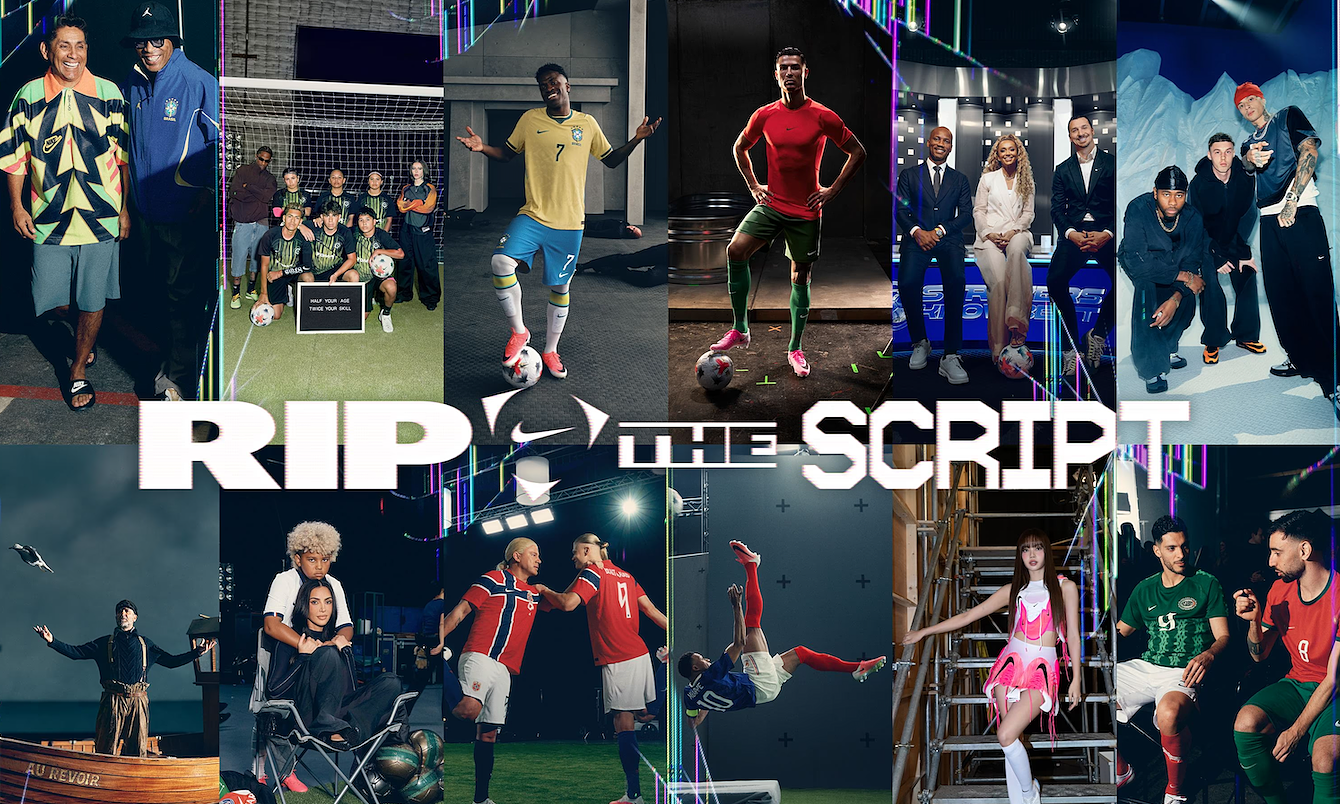 |
The stars featured in Nike's 2026 World Cup marketing campaign. Photo: Nike
Beyond football stars, Nike's media campaign also brings together famous figures from the sports and entertainment worlds, such as LeBron James, rapper Travis Scott, Kim Kardashian and her son, singer Lisa (Blackpink), and tennis player Serena Williams. The brand refers to the ecosystem within this marketing campaign as a "universe", a concept often associated with Marvel's superhero films.
Behind this entertaining campaign lies fierce competition between two giants in the sportswear industry: Nike and Adidas.
Since 1970, Adidas has been an official partner of FIFA. It is estimated that the brand has spent approximately 100 million USD for each four-year World Cup cycle. In return, Adidas supplies the official match balls and receives prominent visibility on advertising boards around the stadium.
Conversely, Nike has consistently refused to pay the huge sponsorship fees to FIFA for many years, and this year's World Cup is no different. Instead of becoming an official sponsor, the company allocates its budget to sign contracts with superstars and execute large-scale media campaigns.
According to sports marketing expert Frank van den Wall Bake, the two brands have completely different approaches. "Adidas can be proud to be a World Cup sponsor. However, appearing on advertising boards around the stadium is just a traditional form of sponsorship", he said.
He believes Nike proactively uses the money it would otherwise pay FIFA to create innovative campaigns capable of overshadowing Adidas. "Many might consider this campaign overly flashy or ambitious. However, I think Nike achieved what it wanted: capturing attention at the World Cup despite not being an official partner", Frank van den Wall Bake stated.
Marketing experts also note that a distinguishing feature of the campaign is Nike's approach beyond just football. Analysts suggest the American sports brand understands that today's younger generation no longer consumes content in traditional ways. Advertisements aired during halftime are no longer sufficient to captivate them, as young people constantly move between various platforms and communities on the Internet.
Therefore, Nike combines football with music, film, fashion, and pop culture within a single product. Experts say the brand's message is no longer about selling a pair of football shoes. Nike aims to build football's image as an integral part of modern lifestyle and global pop culture.
Dutch newspaper Parool assesses that Nike has gained an advantage on the media front. "Rip the Script" is a large-scale advertising campaign, seen as a challenge to FIFA and Adidas's traditional sponsorship model.
The effectiveness of this strategy is partly evident from a survey conducted by Parool at the start of the tournament. 32% of respondents believed Nike was one of the major World Cup sponsors, despite the company not having signed any sponsorship contracts with FIFA.
According to Business of Fashion, it has been a long time since the American sports brand created a World Cup marketing campaign with such widespread impact as the one for this year's tournament hosted in three North American countries.
However, analysts suggest that this effect may not be immediately reflected in Nike's Q IV or full fiscal year financial results. This is because the company's fiscal year financial report concludes on 31/5, before the World Cup begins.
Chief Executive Officer Elliott Hill recently told the Financial Times that the process of bringing Nike back to its growth trajectory has been slower than expected, partly due to external factors such as US tariff policies and rising oil prices.
Business of Fashion estimates that investors will only be able to clearly verify whether Nike's plan to regain its leading position truly yields results by 2027. The 2026 World Cup helps Nike attract global attention, but to convert media buzz into revenue and profit growth, the company still needs more time.
Tu Anh (according to Parool/Business of Fashion)