FPT Shop previously focused on retailing digital products like phones, laptops, accessories, and SIM cards. The chain only entered the home appliance segment two years ago, at a time when Dien May Xanh already had over 2,000 stores and revenue of nearly 60,000 billion dong. Last year, the chain intensified efforts to convert over 130 stores from the conventional model to "FPT Shop Dien may".
At the annual meeting on 17/4, some shareholders questioned the leadership of FPT Retail, the entity owning FPT Shop, about the reasons and plans for deeper involvement in the home appliance segment, given the significant gap with the market leader.
Explaining this, Nguyen Viet Anh, deputy general director of FPT Retail, stated that the home appliance segment has a development method and scale similar to phones and mobile devices (ICT), ranging from 5-6 billion USD annually. While the ICT segment is almost saturated, home appliances still offer room for growth, as penetration rates for key products like air conditioners and washing machines currently hover around 60-70%.
Additionally, the seasonality of these segments can be complementary: ICT sales typically peak at the beginning and end of the year, while home appliances often attract customers during the peak hot weather in Q2.
Without directly naming Dien May Xanh, Mr. Viet Anh referred to the leading chain as "the giant" with about 50% market share. However, he argued that apart from this competitor, no other entity in the home appliance segment holds a strong second position. The market's fragmentation, coupled with its remaining growth potential, presents an opportunity for a latecomer like FPT Shop.
According to Mr. Viet Anh, as a new and smaller player, they have the advantage of flexibility. The chain positions itself as an alternative destination for customers, focusing on optimizing the shopping experience.
While admitting they cannot directly compete with the industry leader, he stated they employ unique approaches to gradually strengthen their position. He cited an example: when FPT Shop first entered the market, the competitor already had an installation team of over 5,000 people. FPT Shop determined it couldn't rapidly build such a workforce, so it adopted a sharing economy model, developing an application to connect installers with customers. This allows the chain to ensure installation times within one to two days, even during peak sales periods when the competitor might struggle to meet demand.
"This approach previously helped many tech-driven ride-hailing companies overtake traditional taxi businesses in just a few years", Mr. Viet Anh shared.
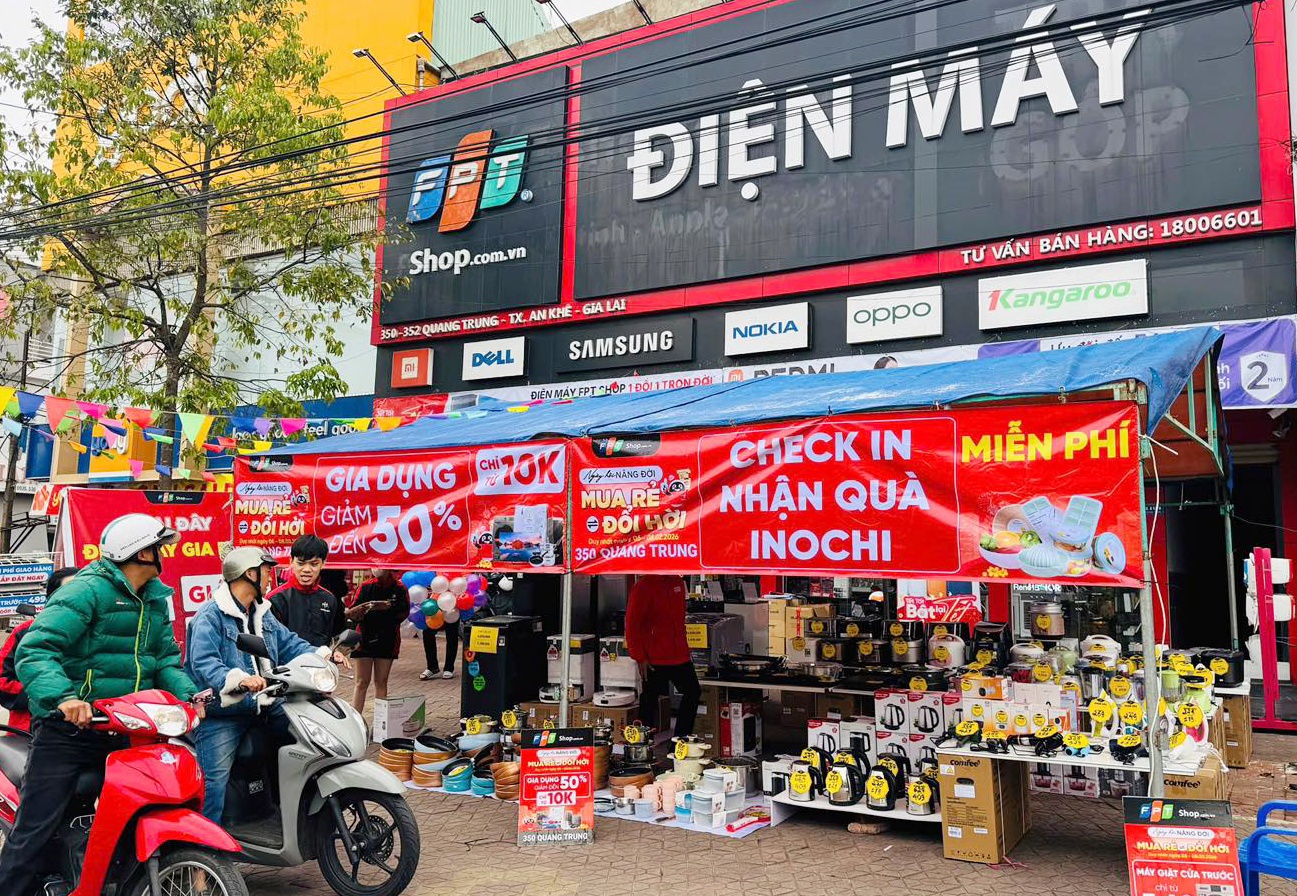 |
An FPT Shop store after converting to the home appliance retail model in An Khe, Gia Lai. Photo: FPT Shop Facebook Fanpage |
Speaking to VnExpress on the sidelines of the annual meeting, company leadership stated that home appliances contributed about 8% of FPT Shop's revenue last year, approximately 1,400 billion dong. This segment helped improve the business performance of each store; consequently, despite a reduction in the number of sales points, last year's revenue still increased by 11% to over 16,800 billion dong. Mr. Viet Anh added that 2025 is a year for restructuring and rapid expansion, but this segment is not expected to incur losses.
In this year's plan, FPT Retail announced it will strongly develop home appliances and installed household goods by diversifying product categories and introducing more brands to Vietnam.
In addition to FPT Shop, FPT Retail's primary growth drivers come from the Long Chau pharmacy chain and vaccination centers. The company leads in the pharmaceutical segment with over 2,400 pharmacies and 220 vaccination centers. This segment generated over 34,500 billion dong last year, corresponding to 1,2 billion dong per store monthly.
FPT Retail aims for a 16% revenue increase this year, reaching 59,500 billion dong. Pre-tax profit is expected to reach 1,550 billion dong, an increase of 27% compared to last year.
Leadership estimates that Q1 revenue this year increased by 30% and profit by 70% compared to the same period last year. They also forecast difficult conditions in Q2, as negative factors such as rising interest rates and weak purchasing power directly impact performance. The company estimated an average borrowing interest rate of about 5% last year, but it was 6% in Q1 this year and is projected to reach 7% in Q2.
According to FPT Retail Chairwoman Nguyen Bach Diep, amidst escalating geopolitical tensions, rising inflation, and increasing interest rates, consumers are tightening spending and foregoing non-essential products. Therefore, the company must prepare a series of scenarios for adverse situations, including temporarily halting some non-essential investment projects, negotiating rental fees, and discussing debt extensions with suppliers. The company also maintains a policy of not recruiting additional personnel, even for replacements, despite increasing the number of stores.
"When the market fluctuates, our top priority is to protect business efficiency, customer traffic, growth quality, and cash flow rather than expanding at all costs", Ms. Diep said.
By Phuong Dong