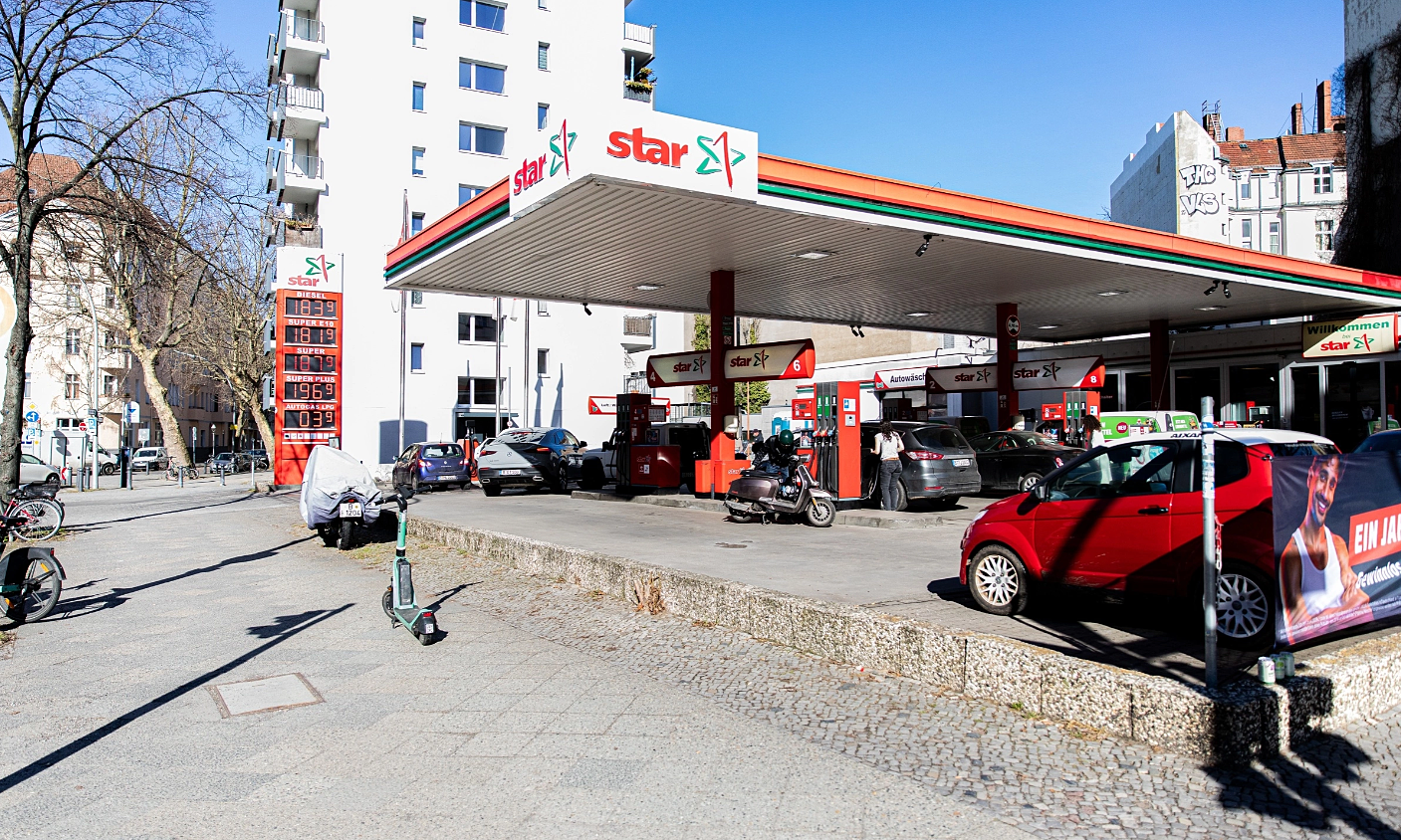
Since early April, fuel prices have been continuously adjusted downwards. During the latest adjustment period on 16/4, the Ministry of Industry and Trade - Ministry of Finance announced that retail diesel prices decreased by 1,920 dong per liter, to 31,040 dong; mazut oil decreased by 2,280 dong per kg, to 20,330 dong. Over three consecutive adjustment periods, diesel has fallen by a total of 13,740 dong per liter, equivalent to 44%, while mazut oil has decreased by 4,260 dong per kg compared to its peak on 3/4.
For gasoline, RON 95-III prices increased slightly by 220 dong, reaching 23,760 dong per liter; E5 RON 92 increased by 250 dong, to 22,590 dong. However, current prices remain significantly lower than the peak on 24/3, down nearly 30% for RON 95-III and about 25% for E5 RON 92.
This trend contrasts sharply with commodity prices. Observations since early April indicate that many eateries continue to raise their prices. For example, a vegetarian banh mi stall on Au Co street, Tan Phu ward (TP HCM) increased prices by 3,000-4,000 dong per sandwich, and coffee prices rose by 3,000-5,000 dong per cup.
Similarly, a large banh canh eatery on Van Kiep street recently increased its price from 37,000 dong to 40,000 dong per bowl (after a 2,000 dong increase a few months prior). A bun bo stall on Le Van Tho street, Thong Tay Hoi ward, after raising prices by 5,000 dong per bowl late last year, has now added another 5,000 dong, bringing a regular bowl to 50,000 dong, a mixed bowl to 60,000 dong, and a special bowl to 70,000 dong.
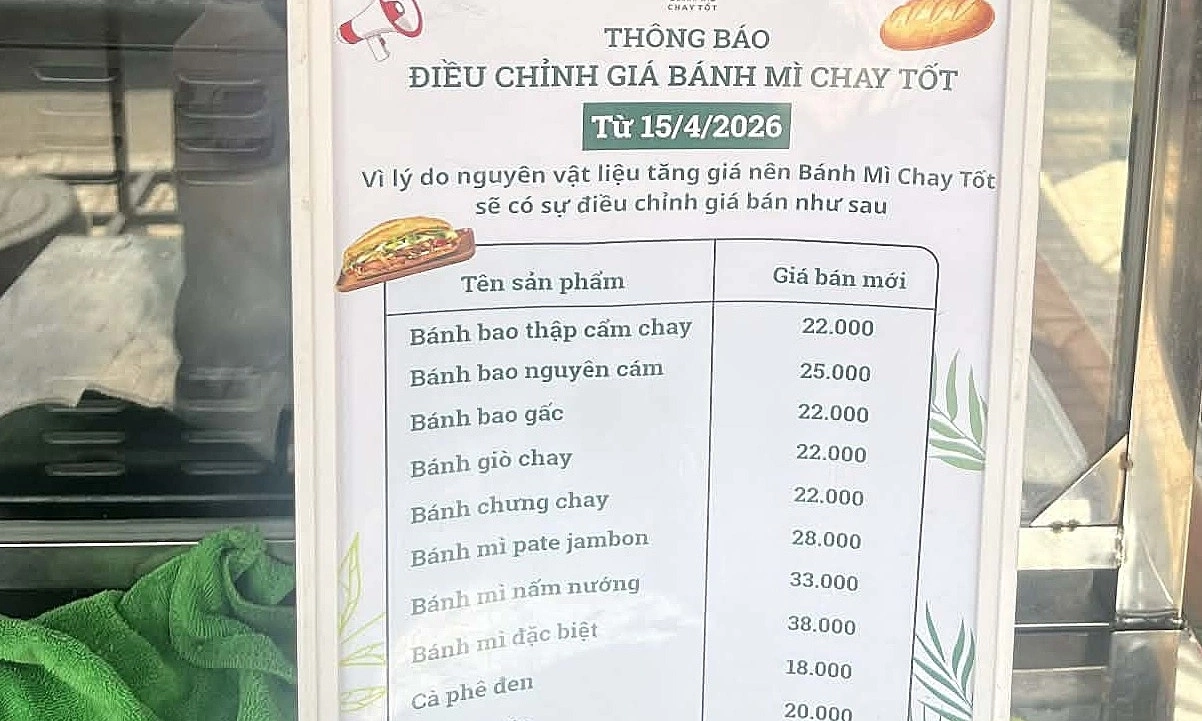 |
A vegetarian banh mi stall on Au Co street, Tan Phu ward (TP HCM) adjusted prices due to escalating ingredient costs. Photo: Thi Ha |
A restaurant specializing in chicken dishes on Ba Huyen Thanh Quan street, Nhieu Loc ward, also increased prices by 5,000 dong per serving, reaching approximately 55,000 dong for noodle and pho dishes.
Most owners explain that the primary reason for these increases is the continuous rise in input material costs, with many items now 5-15% higher than a few months ago.
Ms. Hoa, owner of a bun pho stall in Nhieu Loc ward, stated that ingredient prices have been rising continuously for four months, making it impossible for her to maintain old prices. "While gasoline prices have decreased, transportation costs have established a new baseline, and suppliers continue to maintain high prices. Meat and spices have both increased by 5-7%," she explained.
Additionally, despite recent reductions, gas prices remain about 40% higher than before the Middle East conflict (late February), while labor costs have also increased by about 5%. According to Ms. Hoa, these price adjustments aim not only to offset costs but also to maintain portion quality and avoid cutting back on ingredients.
Another important factor is the lag in price adjustments. Restaurant owners typically calculate selling prices based on average costs over several weeks or months, rather than reacting immediately to short-term fluctuations. Previously, they faced significant pressure from material costs, rent, staff salaries, utilities, and packaging. When some input factors cool down, the reduced costs are primarily used to offset previously narrowed profit margins.
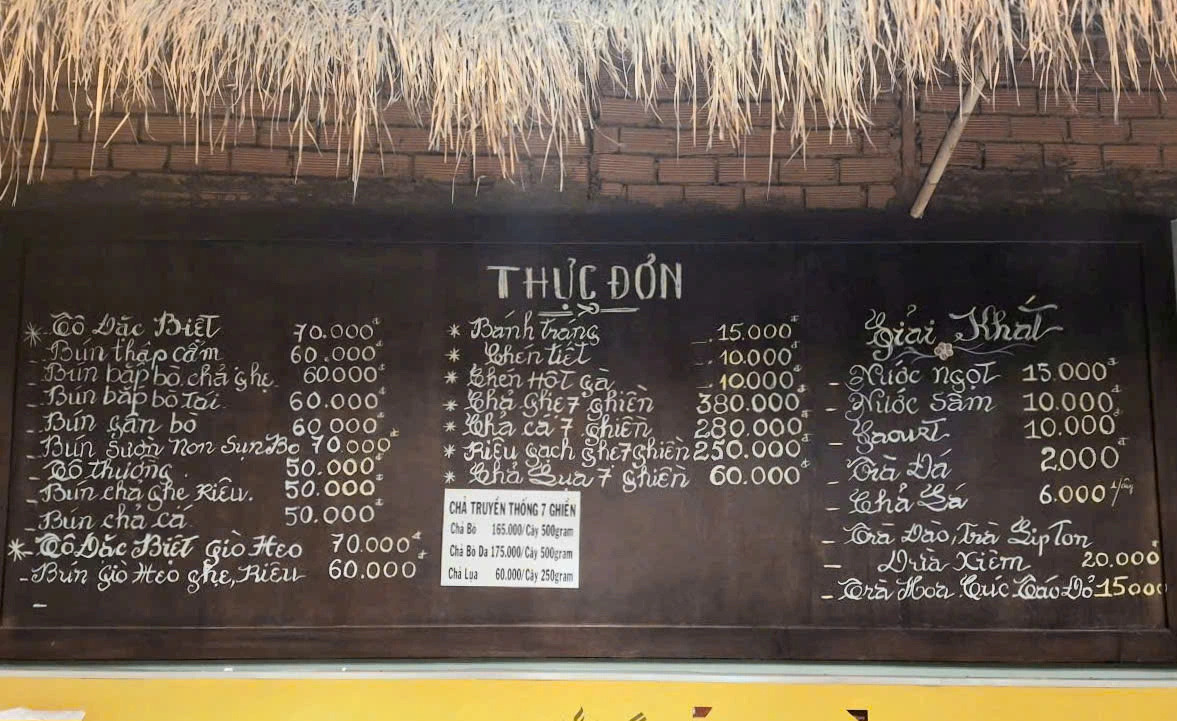 |
New price list at a bun bo stall on Le Van Tho street, Thong Tay Hoi ward (TP HCM). Photo: Thi Ha |
From a business perspective, Ms. Ly Kim Chi, Chairwoman of the Ho Chi Minh City Food and Foodstuff Association (FFA) and Vice Chairwoman of HUBA, noted that the recent cooling of fuel prices has helped food businesses reduce pressure, particularly in logistics and transportation.
Given the continuous transportation from raw materials to distribution, lower fuel prices lead to reduced costs for transport, cold storage, warehousing, and delivery. This contributes to easing cost pressures across the entire supply chain, especially in TP HCM, where logistics costs are consistently high.
However, Ms. Chi emphasized that fuel is only one component of total costs, so this reduction is insufficient to significantly alter product prices. In the current structure, the most dominant factor remains input materials—from agricultural and aquatic products to packaging and imported raw materials—which are volatile and have at times increased far more than fuel costs. Additionally, financial costs, cash flow pressure, and an unrecovered purchasing power also make it difficult for businesses to lower selling prices.
According to Ms. Chi, the savings from fuel primarily help offset previous cost increases rather than creating immediate room for price reductions. Simultaneously, market psychology also helps stabilize expectations and limit chain price increases.
Looking ahead, Ms. Chi predicts that food and beverage prices are more likely to stabilize than to see significant drops. Decreasing fuel prices alleviate cost pressures, thereby helping businesses curb price increases and maintain supply. For prices to noticeably decrease, other favorable conditions are needed, especially a cooling of raw material prices and market purchasing power.
Furthermore, many costs remain largely unchanged. The Vietnam F&B Market Report 2025, recently published by iPOS.vn and Nestle Professional, indicates that eateries continue to face substantial pressure from personnel costs, premises, cautious purchasing power, and compliance requirements such as e-invoices and taxes. This suggests that operational pressures extend beyond just raw materials or fuel.
Beyond cost factors, store owners state that selling prices are also tied to brand positioning. Once prices have been adjusted upwards, lowering them is not simply "giving back" to customers; it also affects brand image and market expectations. Many owners are concerned that lowering prices only to raise them again would make customers feel a lack of stability, thus they tend to maintain current prices or adjust to new cost baselines.
Thi Ha