Global gold prices experienced their most volatile week in 6 years. A mid-week failure to maintain the 5,000 USD mark triggered consecutive selling waves. Spot gold fell from 5,023 USD to 4,490 USD an ounce, a 10,5% decrease.
The precious metals market declined amid reports of increased US troop deployment to the Middle East. This fueled concerns about rising oil prices, potentially leading to inflation and higher interest rates. Gold typically becomes less attractive in high-interest rate environments because it does not offer fixed returns.
Furthermore, gold prices faced pressure as the US Federal Reserve (Fed) signaled a more cautious approach to policy easing, leading to increased bond yields. Profit-taking after a period of rapid gains and tightening market liquidity also contributed to the precious metal's decline.
A pessimistic trend is likely to continue this week. In Kitco's weekly survey of 18 Wall Street experts, 12 forecast a gold price decline this week. Most believe gold will fall in the short term due to unsupportive macroeconomic factors, particularly the potential for central bank interest rate cuts. Only three experts anticipate a more positive trend, while the remaining three expect a sideways market.
From the perspective of individual investors, a cautious sentiment has emerged after several months of continuous optimism. In an online survey of 309 votes, about 34% predicted a gold price drop this week, 19% expected a sideways movement, and 47% believed in a recovery scenario.
Marc Chandler, chief executive officer of Bannockburn Global Forex, is among the experts leaning towards a less positive scenario. He warned that if prices breach the early February low (around 4,400 USD), the downward trend could extend to 4,100 USD an ounce.
Sharing a similar view, Alex Kuptsikevich, an analyst at FxPro, suggested that gold could continue its deep correction, potentially reaching the 4,000 USD range. He emphasized that breaking crucial technical thresholds, such as the 50-day moving average, has reinforced the signal of a reversal from an uptrend to a downtrend.
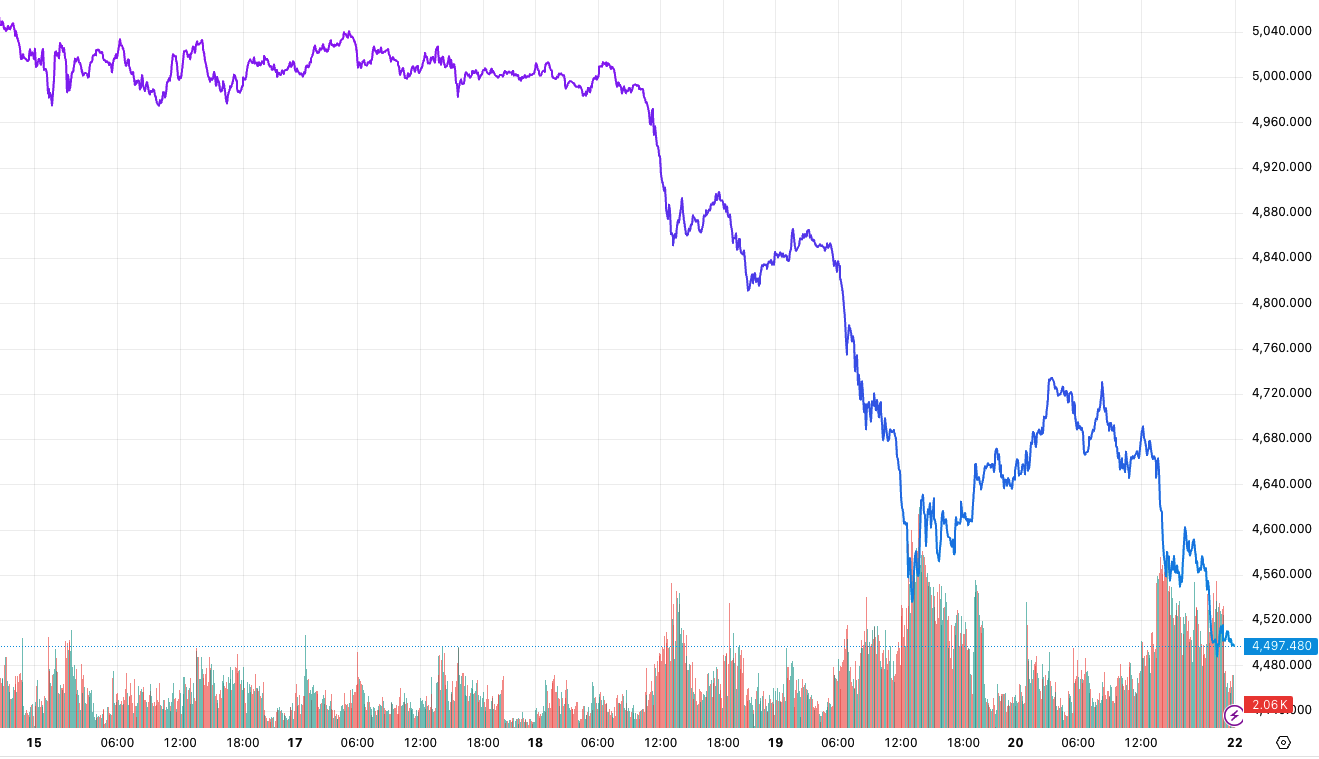 |
Global gold price chart last week (15/3-20/3). Photo: Tradingview |
From a more neutral perspective, some experts view last week's sharp decline as merely a technical correction following a period of rapid gains.
"Market sentiment has shifted to focus on negative factors, including central banks' increasing reluctance to cut interest rates amid escalating oil prices. However, in my opinion, this is only temporary," commented Adrian Day, president of Adrian Day Asset Management.
According to Day, if the US economy faces a recession risk, the Fed will be compelled to ease monetary policy, leading to a gold price recovery. He emphasized that the drivers for gold purchases in recent years persist, so despite the current weakness of the precious metal, a long-term uptrend will return once conflicts subside. He also suggested that the current decline reflects the "buy the rumor, sell the news" phenomenon, as gold prices had risen sharply before the conflict escalated.
Darin Newsom, an expert at Barchart, considers the view that gold's trend is reversing to be short-sighted. He believes that inflation and geopolitical instability will ultimately continue to support the precious metals market as a safe-haven asset.
This week's economic data release schedule is sparse, featuring only preliminary purchasing managers' index (PMI) and US jobless claims. Therefore, experts anticipate the precious metals market will fluctuate based on the Middle East conflict and be particularly sensitive to crucial technical levels such as 4,500, 4,400, and 4,000 USD.
Domestically, each tael of gold bars closed last week around 168-171 million dong. The precious metal's price decreased by 12 million dong over the past week, equivalent to 6,5%. Compared to its peak, gold bar prices are currently 20 million dong lower.
By Phuong Dong (according to Kitco)