Deputy Prime Minister Bui Thanh Son signed the steel industry development strategy until 2030, with a vision to 2050, on 9/2. The strategy aims for the steel industry to progressively shift towards high-value, environmentally friendly products. Manufacturers will focus on meeting domestic demand, boosting exports, and integrating deeply into the global value chain.
The industry will transform its product structure to gradually replace imported goods, particularly alloy steel, tool steel, and specialized products for domestic manufacturing.
By 2030, domestic steel products are projected to meet 80-85% of local demand, with average annual consumption reaching 270-280 kg per person. This share is set to increase to 85-90% by 2035, with the industry aiming for complete domestic self-sufficiency by 2050.
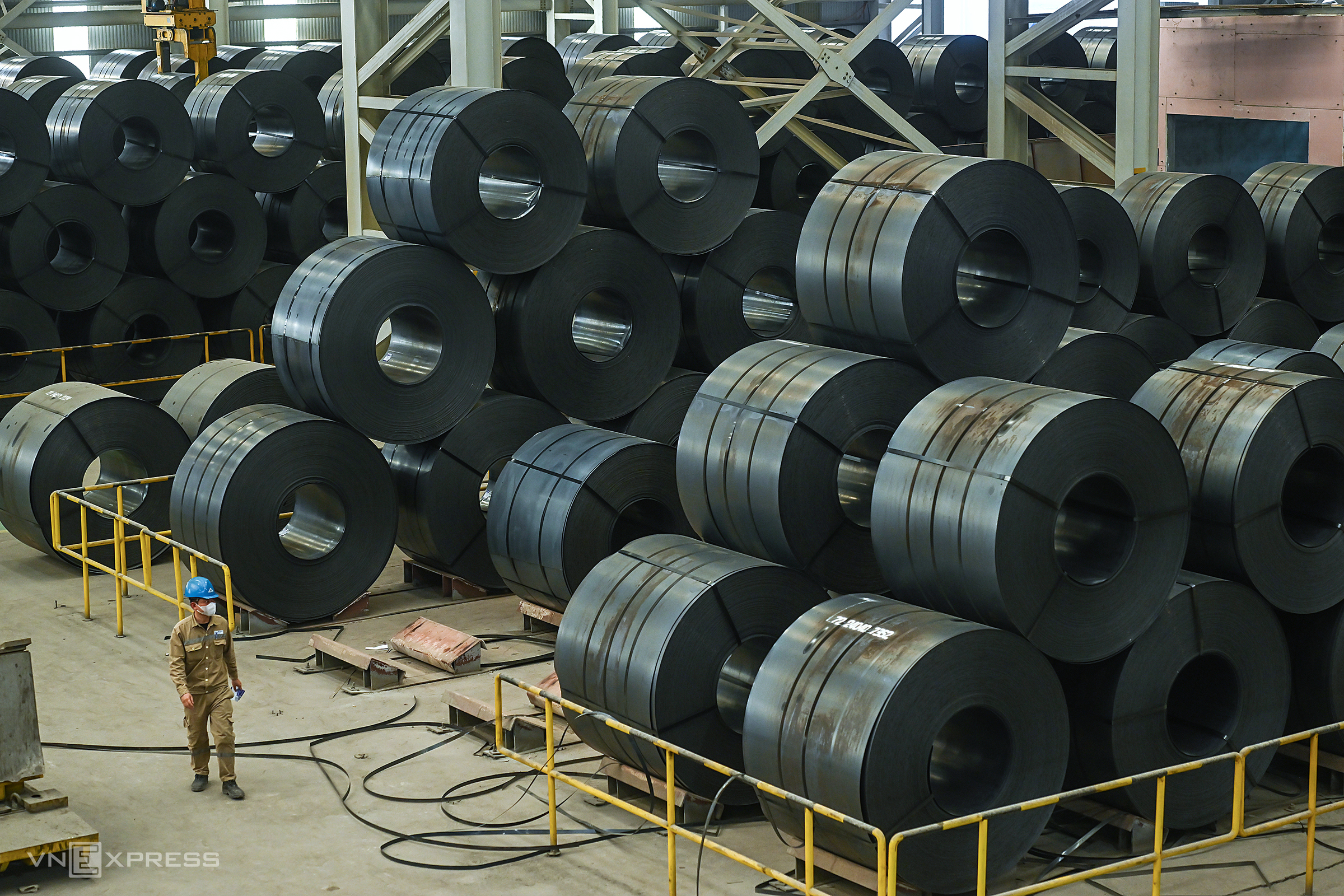 |
Steel products at Hoa Phat Dung Quat factory, 8/2024. Photo: Giang Huy
To achieve these objectives, the industry will continue investing in modern technology and equipment. This investment aims to enhance production capacity and product quality, focusing on items like high-strength steel plates, prestressed steel, corrosion-resistant stainless products, and ultra-lightweight steel.
The strategy also directs research and production of steel products essential for developing energy infrastructure, high-speed railways, liquefied natural gas (LNG) transportation, shipbuilding, and defense-security industries. Key products include rail steel, cast pipes, seamless steel pipes, wind turbine towers, and specialized manufacturing steel, all contributing to the economy's self-reliance. Furthermore, large-scale projects will be strategically located in areas possessing deep-water ports, renewable energy advantages, and robust production resources.
According to the Vietnam Steel Association (VSA), Vietnam imported over 16,1 million tons of steel in 2025, valued at over USD 11,1 billion. Of this total, 9,2 million tons originated from Trung Quoc, representing 57-58% of imports. Conversely, domestic steel production demonstrated significant improvement, with crude steel output reaching 24,66 million tons (a 12,2% increase) and finished steel products totaling 32,26 million tons (up 9,6%).
Meanwhile, finished steel exports reached just under 5 million tons, a 37,9% decrease. Hot-rolled coil (HRC) exports alone saw a decline of over 60%.
Phuong Dung