At the conference announcing the establishment of the international financial center in Vietnam on 21/12, the Ministry of Finance affirmed that the policy of building an international financial center is one of the institutional breakthroughs and policy decisions aimed at unleashing resources and transforming the growth model linked to economic restructuring. This initiative seeks to enhance productivity, efficiency, and national competitiveness.
"The government affirms its commitment to building a stable, transparent, safe, and investor-friendly financial environment. Vietnam is ready to accompany, cooperate, and share development opportunities," stated the Ministry of Finance's press release.
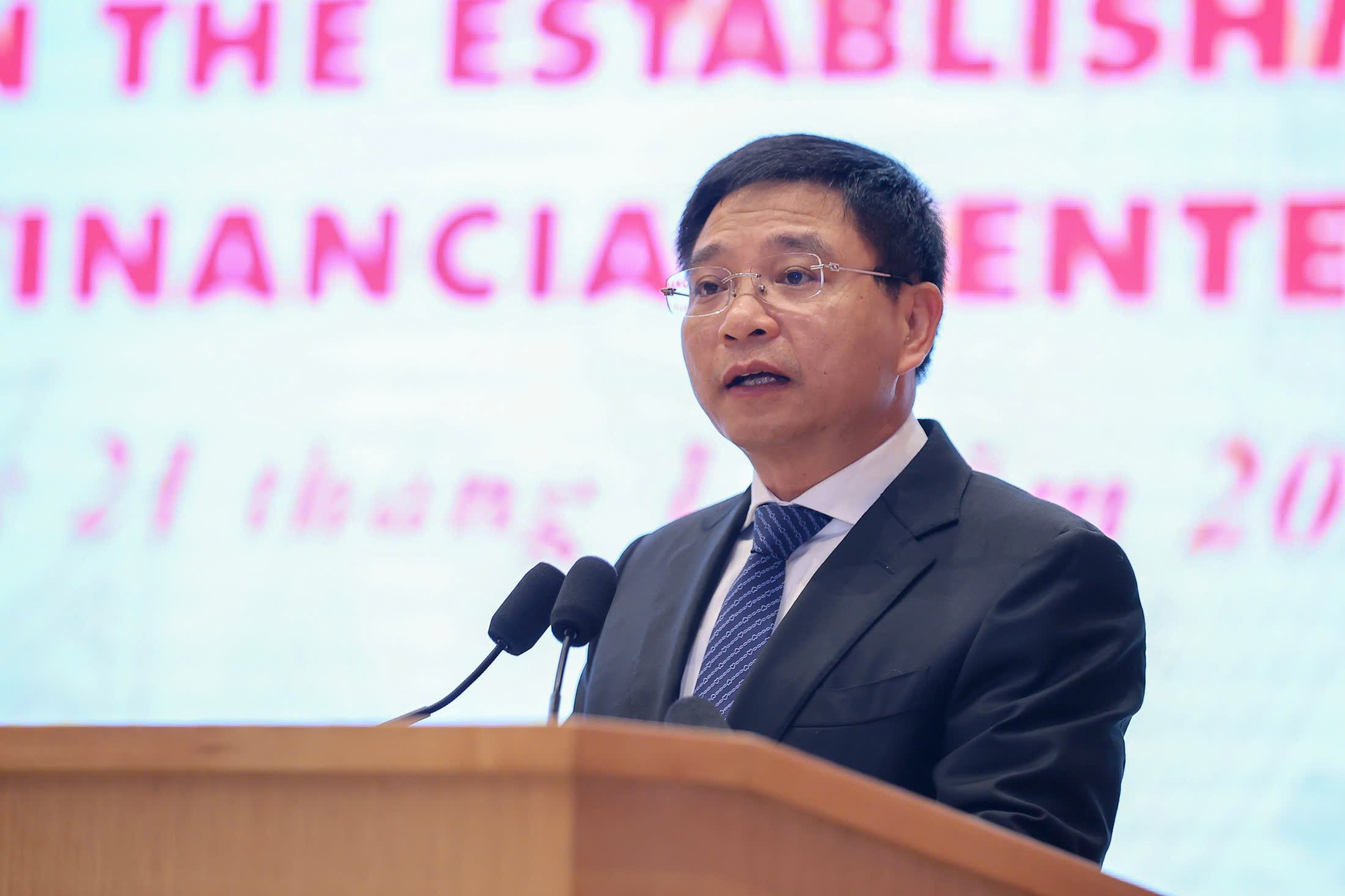 |
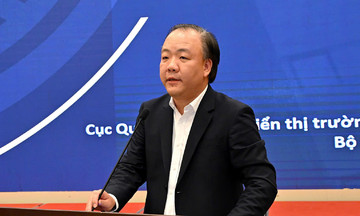
Minister of Finance Nguyen Van Thang spoke at the conference on 21/12. Photo: MOF
At the conference, Minister of Finance Nguyen Van Thang announced the Prime Minister's decision to establish the International Financial Center Operating Council. The council's chairman is Permanent Deputy Prime Minister Nguyen Hoa Binh.
The deputy chairmen of the operating council include: Minister of Finance Nguyen Van Thang; Governor of the State Bank of Vietnam Nguyen Thi Hong; Chairman of the Ho Chi Minh City People's Committee Nguyen Van Duoc; and Chairman of the Da Nang City People's Committee Pham Duc An.
Members of the Operating Council are: Deputy Minister of Justice Nguyen Thanh Tinh; Deputy Minister of Home Affairs Nguyen Manh Khuong; Deputy Minister of Industry and Trade Nguyen Sinh Nhat Tan; and Deputy Minister of Agriculture and Environment Nguyen Hoang Hiep.
The international financial center in Vietnam was established under a National Assembly Resolution on 27/6. On 18/12, the Government issued Decree 323 on the establishment of the international financial center in Vietnam.
The center operates under a "one center, two destinations" model, located in Ho Chi Minh City and Da Nang. Ho Chi Minh City will serve as a large-scale financial hub, focusing on the stock market, bonds, banking, fund management, and listing services. Da Nang will concentrate on developing financial services related to logistics, maritime, free trade, and industrial-agricultural supply chains. The center's area in Ho Chi Minh City is projected to be 899 ha, and in Da Nang, 300 ha.
According to the Government's Decree, the operating regulations, approved by the International Financial Center Operating Council, will be applied uniformly across both locations. Similarly, all standards, regulations, procedures, rules, operational forms, and licensing criteria will be applied simultaneously at both sites.
Within 5 years, the International Financial Center Operating Council will lead a preliminary review, evaluation, and report to the Government on the center's operational results. If necessary, it will propose a restructuring plan towards a streamlined, unified approach, provided that safety and efficiency conditions are met, and ensuring uninterrupted operational activities at both locations.
Concurrently, the People's Committees of Ho Chi Minh City and Da Nang will integrate and update concurrently into regional and city planning content to ensure land funds are allocated for the establishment and operation of the international financial center within their jurisdictions.
Phuong Dung