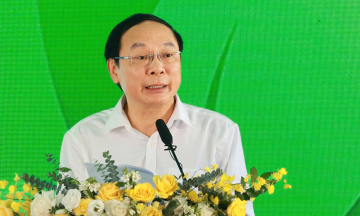
On March 24, Nguyen Duc Lenh, Deputy Director of the State Bank of Vietnam, announced that green credit accounted for nearly 4,2% of the economy's total outstanding loans last year. This figure encompasses loans for renewable energy, agriculture, transportation, and waste treatment.
While still a small proportion, green credit shows a consistent upward trend and strong growth, Lenh observed. The scale of green credit expanded by 9,5% in 2024 and 14,6% in 2025.
Lenh attributed the acceleration of green credit to new policies, including the classification of green categories. These policies provide a legal framework for credit institutions to identify eligible projects for disbursement. They also enable green production businesses to access transparent and swift funding, such as the credit package supporting one million hectares of high-quality, low-emission rice.
He highlighted a mechanism allowing businesses to borrow up to 70% of a project's total investment without collateral. This is considered the most practical support for agricultural businesses and cooperatives.
From a business perspective, Dinh Hong Ky, Chairman of the Ho Chi Minh City Green Business Association (HGBA), stated that the competitive landscape has changed. Previously, business advantages were measured by cost, delivery time, output, or processing scale.
Global supply chains are being reshaped by climate change goals and the roadmap towards Net Zero emissions by 2050, Ky explained. A clear system of green barriers is also emerging, including the European Union's Carbon Border Adjustment Mechanism (CBAM) and green standards slated for adoption by the US and Japan in the 2026-2027 period.
Pham Van Viet, Vice Chairman of the Ho Chi Minh City Textile, Garment, Embroidery and Knitting Association (AGTEK), noted that the industry faces immense pressure for "green transformation amidst a storm." This comes as the EU maintains its deadlines for sustainable standards like extended producer responsibility (EPR), CBAM, and digital product passports (DPP). He added, "We are simultaneously paying high shipping costs due to the Middle East conflict and investing heavily in green transition."
Despite these pressures, 90% of Vietnamese businesses lack a clear green transition strategy, according to HGBA. Dinh Hong Ky commented that small and medium-sized enterprises (SMEs) struggle due to insufficient capital, a lack of carbon emission data, and limited specialized human resources in environmental, social, and governance (ESG) areas.
To enhance access to green capital, Nguyen Duc Lenh announced that the State Bank is developing a scheme to provide interest rate support of approximately 2% for SMEs and individual business households operating in the green economy sector.
Vien Thong