A recent Reuters survey indicates that economists have lowered growth forecasts for many Gulf Cooperation Council (GCC) nations. Several countries in the region have seen their economic outlook shift from growth to contraction.
The ongoing conflict in the Middle East has disrupted energy markets, which are the economic lifeblood for many nations in the region, causing a historical supply shock. Recovery from this energy crisis may not occur until next year.
Qatar's gross domestic product (GDP), Kuwait's, and Bahrain's are projected to fall by 6%, 4,4%, and 2,9% respectively this year. These figures stand in stark contrast to estimates from January, which predicted growth of 3-5%. Meanwhile, the United Arab Emirates' (UAE) economic growth is likely to remain almost stagnant, a significant change from the 5% growth anticipated earlier this year.
Historically, Gulf economies have largely benefited from energy exports during periods of accelerating oil prices. However, this time, Iran's near-blockade of the Strait of Hormuz—a crucial shipping lane responsible for transporting 20% of global crude oil and liquefied natural gas (LNG)—has led to fuel supply shortages. Numerous energy infrastructure facilities across the region, including in Saudi Arabia, the UAE, Kuwait, and Qatar, have been attacked, destabilizing these economies. Crude oil prices have increased by about 40% compared to before the conflict.
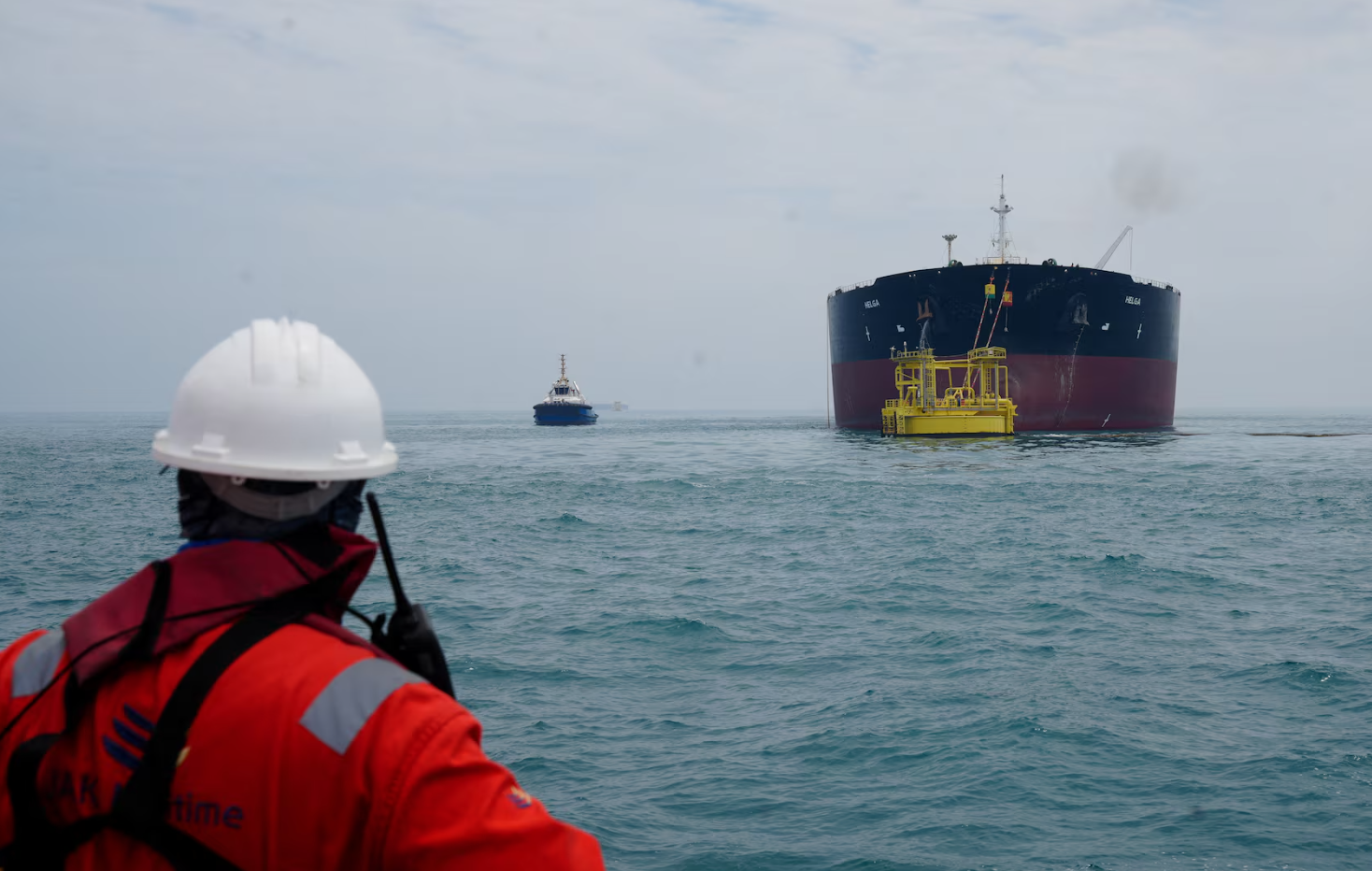 |
The oil tanker HELGA anchored at one of the offshore oil ports south of Iraq. Photo: Reuters |
"We do not believe GDP can easily return to its previous growth trajectory. Over the next few years, GDP will remain low despite a rapid recovery. These nations will require the latter half of this year to rebuild their supply chains," stated Ralf Wiegert, an economist at S&P Global Market Intelligence.
On CNBC, Ryan Sweet, chief economist at Oxford Economics, also characterized the conflict in Iran as a "game-changer" for Gulf nations. "Beyond its impact on oil and gas revenue, the conflict also affects tourism and foreign direct investment (FDI) flows into the Middle East," he noted.
Earlier this month, the Economist estimated that Gulf nations have incurred tens of billions of USD in losses due to the conflict. These losses stem from reduced oil and gas revenue, damage to essential infrastructure, and costs for air defense interception systems. The reputational damage is even greater, as the conflict has exposed the Middle East's geographical and geopolitical vulnerabilities. This is a challenge that Gulf countries will find difficult to overcome, the magazine commented.
Saudi Arabia, the world's largest crude oil exporter, and Oman are considered more resilient to this shock. These two economies are still projected to grow by 2,6% and 2,2% this year. However, both figures are significantly lower than the January forecasts of 4,3% and 2,8% growth.
Rising oil prices are driving global inflation higher, and Gulf economies are no exception. Inflation in the region is projected to reach 2-3% this year, an increase from just 1-2% earlier in the year.
"The second wave of this shock will impact non-oil sectors, which is particularly important for Saudi Arabia, the UAE, and Qatar," stated Lluis Dalmau Taules, an economist at Allianz. The Middle East's tourism sector has been the fastest growing globally over the past few years. Consequently, the conflict significantly affects retail and many other industries.
Economists forecast that the Middle East will recover rapidly next year if the conflict concludes soon. Accordingly, Qatar, the UAE, and Kuwait could see growth rates of 7,8%, 5,4%, and 5% respectively next year. The GDP of Saudi Arabia, Bahrain, and Oman is expected to be between 2,8% and 4,5%.
Previously, the International Monetary Fund (IMF) also projected that energy production and transportation in the region would recover and normalize over the next few months.
Goldman Sachs believes this recovery will be uneven across Gulf economies. In the long term, analysts at the bank anticipate that economic activity will rebound strongly, supported by public capital resources, abundant government reserves, and a resurgence in oil and gas revenue.
Ha Thu (according to Reuters, CNBC)