Following news regarding the leadership of P-Lab, its diamond appraisal subsidiary, being linked to a smuggling ring, Phu Nhuan Jewelry Joint Stock Company (PNJ) affirmed that customers' warranties, buyback options, and all related rights under current policies remain fully honored.
Cao Thi Ngoc Dung, Chairwoman of PNJ's Board of Directors, stated that the company consistently maintains reserve financial resources to facilitate buybacks and meet customer needs.
 |
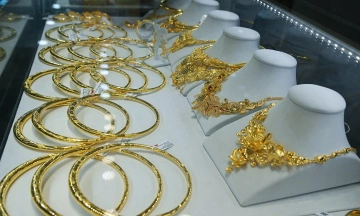
A PNJ diamond jewelry product. Photo: PNJ
PNJ stands as one of Vietnam's largest jewelry retailers and one of the few companies with a relatively detailed diamond buyback policy. Unlike many stores that only buy back by agreement or offer no buyback guarantee, PNJ publicly discloses its buyback rates based on product groups, diamond size, color, and clarity. This policy enhances the liquidity of products after sale and serves as a competitive advantage in the market.
Overall, the core principles determining PNJ's buyback rates are a product's originality, rarity, and independent market tradability. Products closer to the loose diamond state, possessing "golden" sizes for good liquidity (5-8,6 mm), and high clarity consistently retain optimal value with low depreciation, ranging only from 2-7%.
Conversely, smaller products, which depend heavily on crafting costs, incur a greater reduction in value, potentially losing 15-25% of their initial value.
However, exceptionally large diamonds – which often "discourage buyers" (are niche) and are harder to trade – are subject to stricter control by PNJ. For diamonds from over 8,6 mm to 10 mm, the buyback rate depends on the period of ownership. Within the first one year, PNJ buys back 93% of the value, but if purchased over one year ago, the rate drops to 90%.
Specifically, PNJ does not buy back diamonds over 10 mm. Customers owning stones of this size cannot resell them to the system.
Furthermore, customers upgrading to a higher-value product always receive a rate 2-10% higher than simply selling their item. The system consistently applies preferential pricing policies to encourage customers to continue shopping within its network.
Below is a table for reference on PNJ's buyback rates for loose diamonds.
Below is a table for reference on PNJ's buyback rates for diamond-set jewelry.
Speaking to VnExpress, Nguyen Thi Thu Huong, a financial advisor at FIDT, suggested that before assessing the rationality of selling diamonds, investors must answer a crucial question: Are we selling due to a genuine financial need or due to herd mentality?
Selling to restructure a portfolio, secure profits, or shift towards a pre-planned financial goal is a completely rational decision. However, if the reason stems from concerns about continued price fluctuations or observing many others selling diamonds and wanting to "exit the market," the expert advises investors to remain calmer.
"Investment history shows that decisions based on the herd effect often cause investors to miss opportunities or sell assets at suboptimal times," Huong stated.
According to the expert, investors should also note that the current diamond market is highly segmented. Natural diamonds with international certification, high quality, and large sizes still tend to retain their value well. Conversely, smaller diamonds, especially lab-grown diamonds, face significant price depreciation due to an increasingly abundant supply.
Tat Dat