Since the US and Iran signed a memorandum of understanding on 18/6, oil and gas shipments have gradually resumed from the Persian Gulf after months of stagnation. However, after three weeks, the strait is only partially reopened, with traffic reaching about one-third of normal levels.
According to Andy Lipow, President of Lipow Oil Associates, approximately 200 million barrels of oil have passed through the Strait of Hormuz during this period, equivalent to two days of global consumption. Meanwhile, transportation costs have sharply increased. Chartering a vessel to transport oil from inside the strait to Asia now costs USD 8-10 million, nearly double the cost of chartering a vessel that does not pass through this route to Asia (around USD 4-5 million).
This week, oil and gas flow tightened further. At least three ships successfully transited the Strait of Hormuz, but at least 4 oil and gas tankers turned back, avoiding Hormuz over the past three days, according to Reuters.
These included three vessels managed by QatarEnergy, which were bound for Ras Laffan port in Qatar to load liquefied natural gas (LNG). Additionally, an Indian-flagged vessel carrying 2 million barrels of Kuwaiti crude oil turned back off the coast of Oman on 8/7.
These movements followed damage to a Qatari LNG tanker and a Saudi Arabian-flagged oil tanker on 6/7, amid reports that Iran had launched missiles at vessels in the area. This development also prompted maritime authorities to raise the risk alert level for vessels transiting Hormuz to "severe".
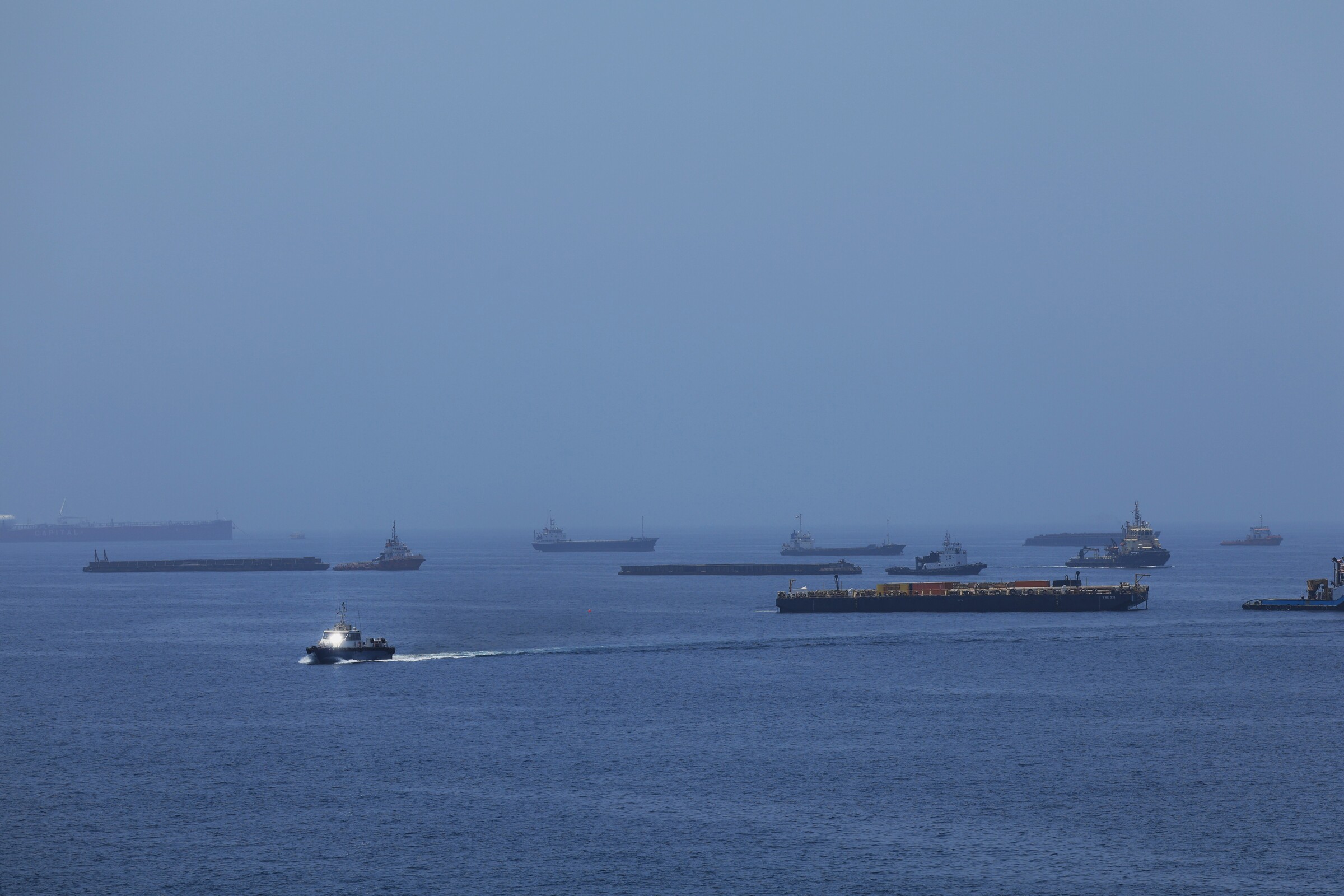 |
Commercial cargo ships and crude oil tankers are anchored in the Gulf of Oman on 21/6. Photo: AFP
Concurrently, the number of empty vessels awaiting cargo at Ras Laffan port is increasing. According to Laura Page, LNG market analysis director at Kpler, satellite images from 7/7 showed 14 LNG tankers anchored there, but only one was loading cargo.
Vortexa, an analytics firm, reports that more than 50 empty vessels managed by QatarEnergy and ADNOC are currently anchored around the Persian Gulf, India, and the Strait of Malacca. Some of these vessels have continuously switched off their AIS signals for more than 10 days.
Jorge Leon, head of geopolitical analysis at Rystad Energy, assesses that oil tanker traffic through the Strait of Hormuz has "essentially stopped". He stated, "This more clearly reflects the market's level of concern about current risks than any statements from Washington or Tehran."
On 7/7, US President Donald Trump reimposed sanctions on Iranian oil, giving customers only 10 days to receive this oil before transactions become prohibited again. India's Mangalore Refinery and Petrochemicals Limited canceled a contract to charter a vessel for Iraqi oil, according to Reuters sources.
A day later, on 8/7, Trump announced the "end" of the ceasefire with Iran. According to Jorge Leon, the "real test" will occur after the funeral of Iran's Supreme Leader Ayatollah Ali Khamenei this weekend, when the US and Iran will demonstrate whether both sides are still willing to seek a diplomatic solution.
Currently, the threatened flow of oil and LNG through the Strait of Hormuz is impacting many markets. The US Strategic Petroleum Reserve (SPR) has significantly decreased since the Iran conflict escalated, now standing at only 319,5 million barrels, a 23% reduction from before the conflict and the lowest level since 1983.
More importantly, commercial oil inventories are also at concerning levels. Oil stored at Cushing, Oklahoma, a hub connecting the US oil pipeline system, remains below the safe operating threshold.
According to the American Petroleum Institute, US crude oil inventories fell by 400,000 barrels last week. Inventories at Cushing, Oklahoma, the delivery point for WTI oil, saw a slight decrease of 100,000 barrels. The decline was more pronounced in refined products, with gasoline inventories dropping by 2,9 million barrels and distillate fuels (diesel, heating oil) by 1,8 million barrels.
ING noted that Ukraine's drone attacks on Russian refineries are increasing, causing a decline in Russia's diesel exports. This development further tightens the global supply of refined oil products.
Gas prices in Europe also rose sharply following the recent developments in the Persian Gulf. The benchmark TTF price is approximately EUR 49/MWh, near its one-month high. LNG imports into the bloc have also decreased, as many Asian customers are turning to the spot market to compensate for disrupted supplies from the Middle East.
"The renewed escalation of the conflict in the Middle East heightens concerns about supply shortages as Europe approaches the heating season", warned ING experts.
However, market analysts do not yet forecast oil prices returning above USD 100 per barrel, believing the global energy market is more resilient than initially feared. Brent oil is currently trading around USD 78 per barrel, reflecting the less smooth passage through the Strait of Hormuz but continued oil shipments, according to CNN.
Tamas Varga, an analyst at PVM Oil Associates, noted that the market has adapted well. He stated that the market once feared a blockade of the Strait of Hormuz could reduce global oil supply by about 20 million barrels per day.
However, Gulf countries have utilized alternative export routes and covert shipments to reduce the actual deficit to about 12,2 million barrels per day. Simultaneously, increased production from non-Gulf countries, US reserve releases, and sanctions waivers for Russian and Iranian oil have added approximately 9,1 million barrels per day to the global supply.
"This means the actual deficit is only about 3,1 million barrels per day, much lower than initial forecasts", he concluded.