According to data from the General Statistics Office, merchandise exports and imports in April reached 45.52 billion USD and 48.8 billion USD respectively. Both figures showed double-digit growth compared to the same period in 2025. Consequently, the trade balance recorded an import surplus of 3.28 billion USD, a contrast to the 1.63 billion USD export surplus reported in the same period last year.
The trade deficit had narrowed for three consecutive months prior, decreasing from 1.78 billion USD in January to 0.67 billion USD in March. However, it surged again last month, pushing the trade balance for the first four months into a 7.11 billion USD deficit. This contrasts with a 4.3 billion USD export surplus recorded during the same period in 2025.
Analysts, however, do not view this development as a concern. A new report from SSI Research states that this trend should not be interpreted negatively. The report assessed, "The current trade deficit reflects an investment cycle, not a decline in export strength."
This is primarily because production materials accounted for over 94% of import value over the past four months, estimated at 165.37 billion USD. This figure is "consistent with strong investment and expanded production capacity," according to the report. Meanwhile, export turnover for the first four months still increased by 19.7% compared to the same period in 2025, reaching an estimated 168.53 billion USD.
Earlier, when commenting on the Q1 trade balance, the General Statistics Office also suggested that the import surplus during this period was "not necessarily an unusual or negative sign" but rather "short-term, linked to production cycles and price factors."
Specifically, this trend reflects increased demand for machinery, equipment, and raw materials for production. It also indicates that businesses are increasing input inventories to mitigate risks from supply chain disruptions and volatile energy prices.
S&P Global's purchasing managers' index (PMI) survey for April recorded an improvement in the overall business conditions of Vietnam's manufacturing sector for the tenth consecutive month, with the PMI reaching 50.5 points. Output continued to increase, though at a slower pace.
According to the US data analytics firm, businesses reported escalating fuel costs in April, driving input prices up at their fastest rate in 15 years. This likely contributed to the rapid 32.5% increase in import turnover, widening the trade deficit last month, as energy costs and supply chain logistics faced pressure from the Middle East conflict.
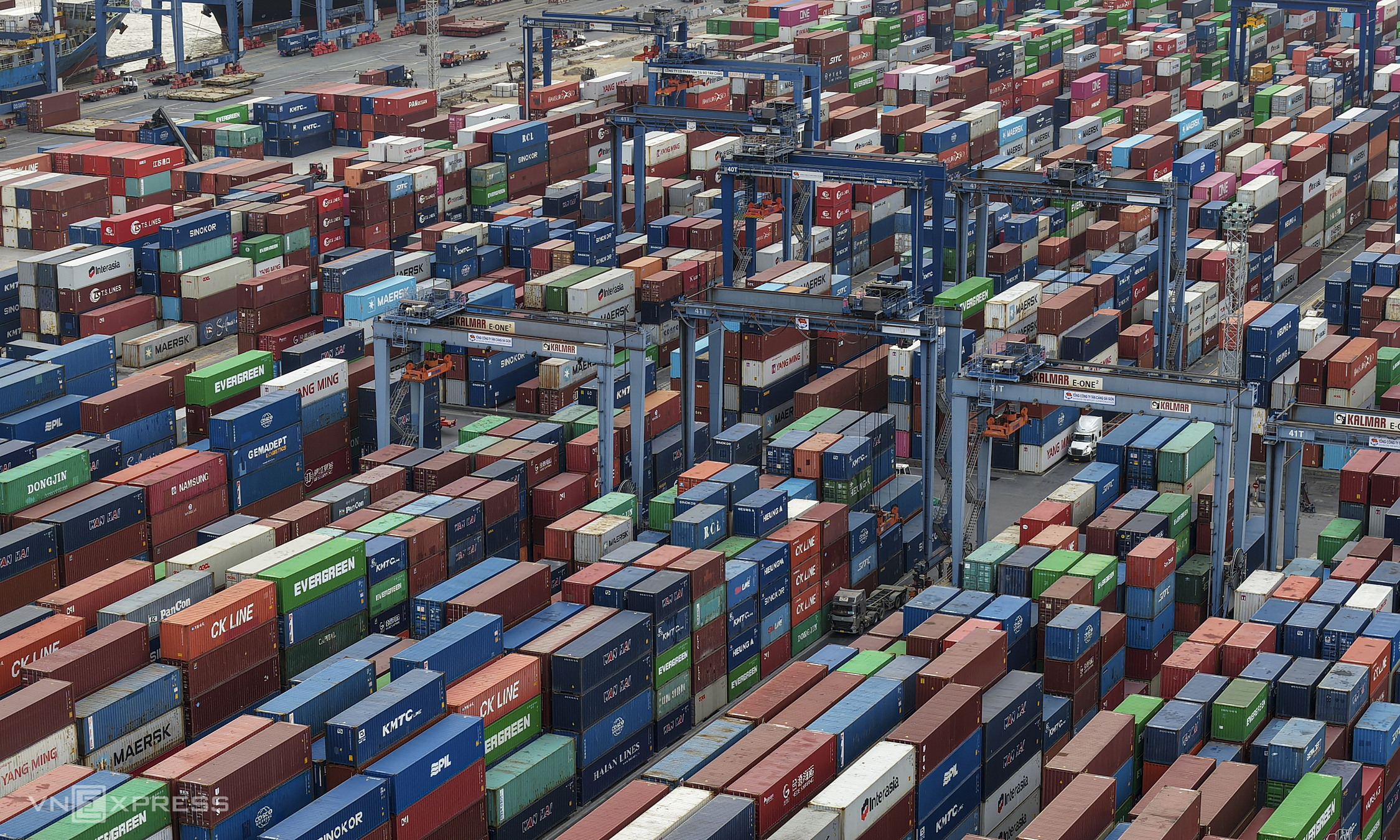 |
Cargo containers at Cat Lai Port, TP HCM on the afternoon of 4/2. Photo: *Thanh Tung* |
While the manufacturing and export sector remains robust, it faces challenges. Andrew Harker, Economics Director at S&P Global Market Intelligence, noted that prices and supply disruptions from the Middle East conflict continue to impact Vietnam's manufacturing growth. Rising fuel, oil, and transportation costs are pressuring both demand and supply.
The April survey indicated that businesses offset input costs by raising selling prices at their fastest rate in 15 years, which led to a decrease in new orders. Andrew predicted, "With new order volumes declining into contraction territory, output appears set to fall in the coming months, unless the pricing and supply environment improves soon."
The Q1/2026 Business Confidence Index (BCI) report from the European Chamber of Commerce in Vietnam (EuroCham) revealed that 90% of surveyed businesses identified cost pressures and global geopolitical volatility as key risks this year.
Despite this, the BCI remained significantly higher than the four-year average, reaching 72.7 points. EuroCham Chairman Bruno Jaspaert likened the current global economy to a voyage through turbulent seas. He stated, "While the external geopolitical 'weather' may be stormy, Vietnam's economic foundation remains resilient."
Vien Thong