


Ho Chi Minh City's ambition to boost rooftop solar power faces a significant hurdle: the exceptionally low price at which surplus electricity can be sold back to the national grid. This financial disincentive prolongs the return on investment, making rooftop solar less attractive for both households and businesses.
This concern was voiced by representatives of various associations and investors at a seminar titled "Ensuring Energy for Ho Chi Minh City's Two-Digit Growth Target". The event was organized by Nguoi Lao Dong newspaper in collaboration with Ho Chi Minh City Power Corporation (EVNHCMC) on 5/5.
Phan Thanh Lam, Chairman of the Ho Chi Minh City Renewable Energy Association, highlighted that the primary bottleneck is no longer technology or equipment costs, which have seen sharp declines in recent years. Instead, the issue lies with market mechanisms, particularly the low buy-back price for surplus electricity, which fails to create sufficient financial motivation.
 |
Phan Thanh Lam, Chairman of the Ho Chi Minh City Renewable Energy Association, speaking at the seminar on the morning of 5/5. Photo: Quang Liem. |
Phan Thanh Lam, Chairman of the Ho Chi Minh City Renewable Energy Association, speaking at the seminar on the morning of 5/5. Photo: Quang Liem.
According to Lam, the rooftop solar market has significantly slowed since the boom period of FiT (FiT one and FiT two) pricing mechanisms in 2019-2020. Current policies have not provided a strong enough impetus and still present several barriers.
A major obstacle is the complexity of administrative procedures and implementation processes, especially when it involves selling electricity to the grid. This complexity often leads most households and businesses to opt for self-consumption rather than deeper engagement with the electricity market.
Moreover, there is a clear absence of strong economic incentive policies. In many countries, individuals invest in solar power due to concrete support mechanisms like tax incentives, green credit, or time-of-use electricity pricing. In contrast, Vietnam's current financial incentives are insufficient to spark a new wave of investment.
Nguyen Thanh Toan, a representative of renewable energy investors in Ho Chi Minh City, echoed this sentiment. He noted that in the city's industrial zones, only about 20% of factory rooftops have solar installations, and household participation remains minimal due to the lack of clear economic viability.
"Households generate electricity during the day but are often at work and cannot consume all of it; the surplus electricity sold back at a low price does not offset the cost of electricity purchased at night," Toan explained. Currently, households can sell a maximum of 20% of their actual installed capacity at a price of just over 800 VND/kWh.
Toan mentioned that the upcoming proposal to increase the proportion of surplus electricity sold to the grid to 50% is a positive sign for rooftop solar development. However, he stressed that a more attractive buy-back price is crucial. "Policies are needed to ensure the buy-back price of surplus electricity is closer to the investment cost to truly attract investors," Toan emphasized.
Under current regulations, self-consumption rooftop solar systems can only sell a portion of their surplus electricity to the grid at the previous year's average market electricity price. This differs from the fixed preferential price mechanism of 2019-2020, where the buy-back price was 2,105 VND/kWh (excluding VAT). Experts believe this current rate is too low to generate substantial profits for small-scale investments.
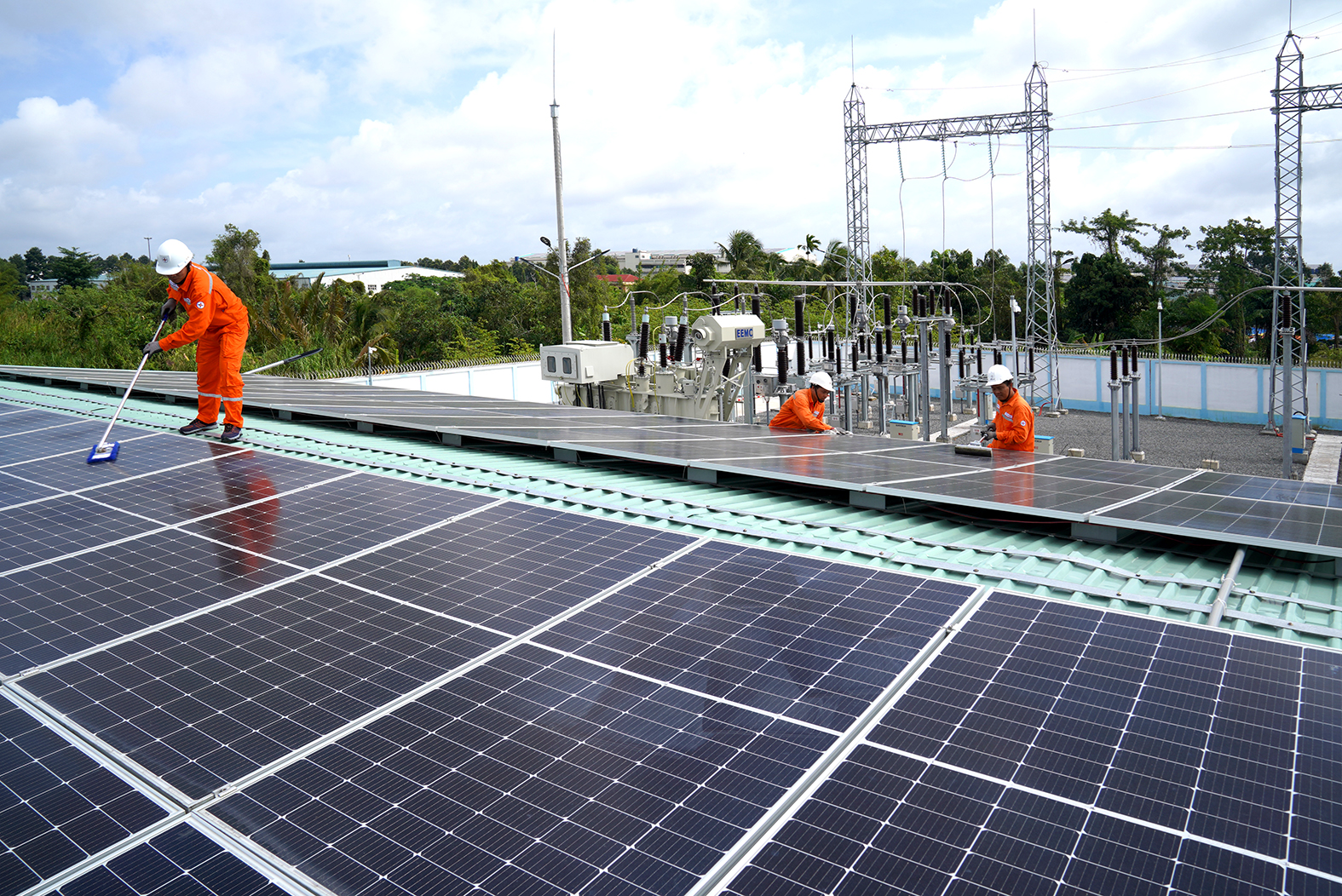 |
Power company employees clean rooftop solar panels. Photo: An Phuong. |
Power company employees clean rooftop solar panels. Photo: An Phuong.
Despite these challenges, Power Development Plan VIII sets an ambitious national goal: by 2030, approximately 50% of government office and household rooftops are targeted to have self-consumption rooftop solar, equivalent to a capacity of 26,000 MW.
For Ho Chi Minh City, where electricity demand for economic growth, digital economy, and artificial intelligence is projected to rise rapidly, leveraging millions of rooftops as "small power plants" is considered a vital solution to supplement local power sources.
Nguyen Thi Kim Ngoc, Deputy Director of the Ho Chi Minh City Department of Industry and Trade, reported that the city currently has 22,355 rooftop solar systems with a total capacity of approximately 1,832 MWp. However, significant potential remains for development in residential, commercial, and industrial areas.
Ngoc affirmed that Ho Chi Minh City is actively developing a specific resolution with special mechanisms and policies to support rooftop solar for households and businesses. Concurrently, the city is exploring additional solutions such as green credit, preferential loans, ESCO models, technical support, digitization of procedures, and tax incentives to reduce initial investment costs.
In 2026, the Ho Chi Minh City power sector aims to meet an electricity growth rate of about 5% compared to the previous year. Bui Trung Kien, Deputy General Director of EVNHCMC, stated that the Ho Chi Minh City power system has expanded significantly after integrating the former Binh Duong and Ba Ria - Vung Tau areas. The system's peak capacity in 2025 reached 8,936 MW; the installed capacity of 110kV transformers owned by the power sector is 13,363 MVA, corresponding to approximately 12,027 MW with a power factor of 0,90; and the grid reserve ratio is about 35%.
Kien noted that while Ho Chi Minh City's expanded power system maintains a relatively safe reserve level, the power sector believes that to meet high growth demand in the coming years, the city still needs to boost localized distributed power sources. EVNHCMC encourages households and businesses to develop rooftop solar combined with energy storage to reduce grid pressure during peak hours and optimize long-term electricity costs.
Le Tuyet


