During the annual general meeting this morning, leaders from each business segment of Masan Group (MSN) collectively took the stage to present their content. This approach differed significantly from previous years, where each leader spoke individually, underscoring the message that Masan's business segments will be more tightly connected, as Board of Directors Chairman Nguyen Dang Quang stated in his opening remarks.
In his presentation, CEO Danny Le asserted that MSN's stock price is undervalued by approximately 60% compared to its actual worth. According to Le, the reason is that the management "has not fully articulated the journey and strategy of serving consumers across the entire Masan ecosystem."
Masan Group currently comprises key business segments including consumer goods manufacturing (Masan Consumer - MCH), modern retail (WinCommerce - WCM), meat production (Masan Meatlife - MML), and mining (Masan High-Tech Materials - MSR). Additionally, the group owns the Phuc Long tea and coffee chain.
During the Q&A session, a shareholder inquired about the stagnant stock price. Danny Le explained that the market is currently valuing MSN primarily through MCH and MSR, failing to adequately reflect the potential of MML, WCM, and Phuc Long. Consequently, the group will focus on strengthening the interconnectedness of all its business segments, aiming to help the market understand and fully recognize the potential of the entire portfolio.
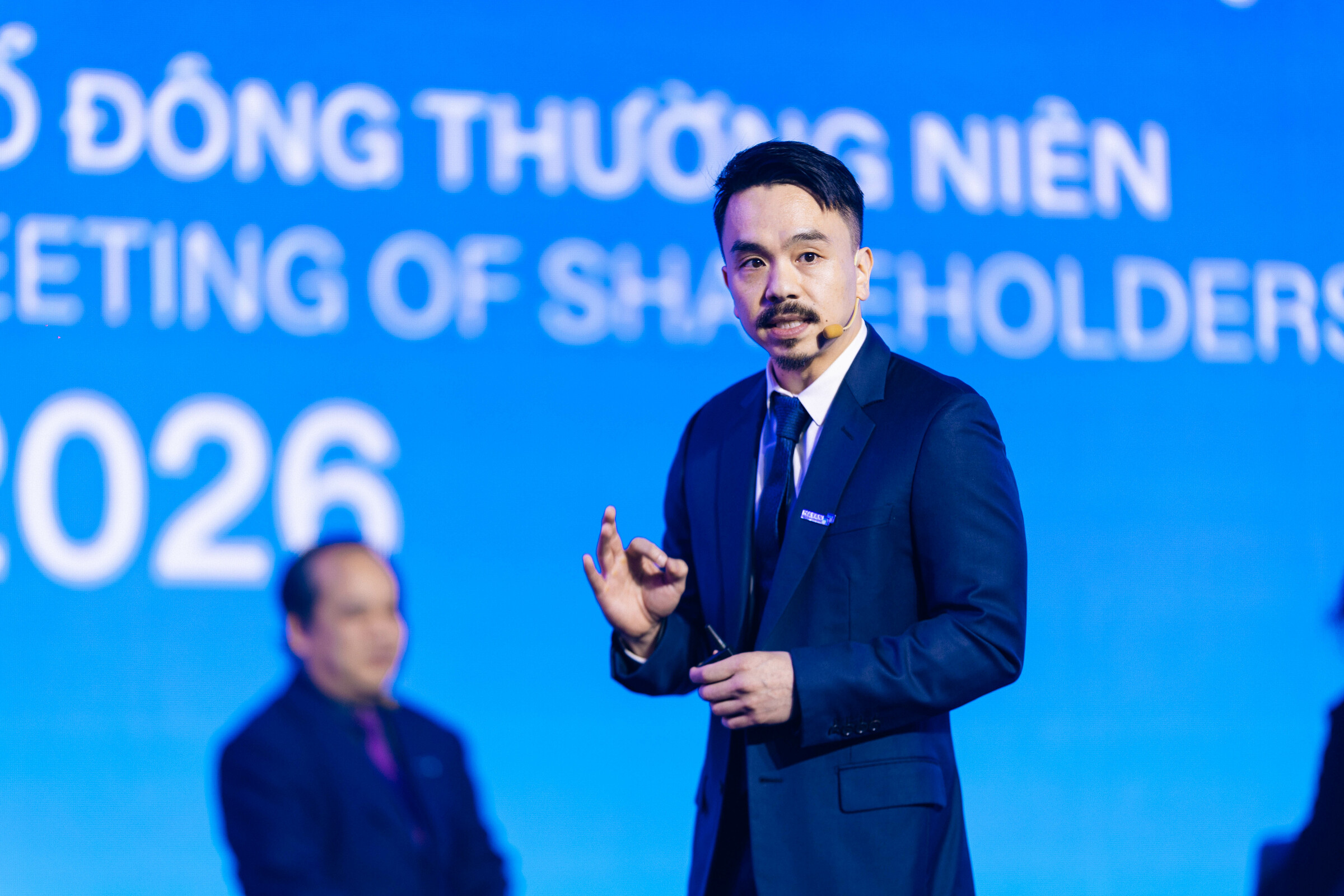 |
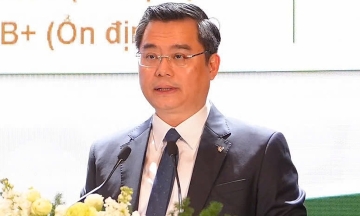
Danny Le, CEO of Masan Group, speaking at the annual general meeting on 24/4. Photo: MSN |
Speaking with VnExpress, Masan's CEO added that since acquiring WinCommerce, the group incurred a loss of approximately 150 million USD. The group's cash flow in 2020 was around 80 million USD. The market began to raise significant questions about Masan's ability to turn around the struggling retail system.
"This year, there is a high probability that we can increase our cash flow sevenfold, reaching over 500 million USD, which is the answer to that big question", he affirmed.
Furthermore, Danny Le noted that many people often perceive Masan as building separate businesses, viewing it as a complex business model. In reality, despite MSN having various business units, it operates with a unified strategy, maximizing synergy to own an end-to-end consumer retail value chain. He believes this year's business results will demonstrate Masan's value to shareholders, the market, media, and investors in Vietnam.
"What we are doing is no different from what Steve Jobs did when he launched the iPhone, integrating the phone, internet, and music into one solution. That is why we call this the consumer operating system", Danny Le compared.
He also cited concerns about Masan's cash flow generation as another reason for the undervaluation. Le stated that this situation has changed, as by the end of 2025, the group is generating 500 million USD in operating cash flow with minimal capital expenditure (CAPEX). This helps Masan reduce debt on its balance sheet. Concurrently, from a corporate finance perspective, the net debt to EBITDA (earnings before interest, taxes, depreciation, and amortization) ratio has decreased to 2,8 times, falling below the target of 3 times.
He addressed the concerns of some investors and the market regarding the approximately 400 million USD debt at Masan High-Tech Materials. However, with tungsten prices at 3,000 USD per MTU, even if prices were to halve in the next two years, the debt would still be cleared.
"We believe we can manage the balance sheet well and achieve the healthiest state in the past five years", he stated.
Closing yesterday's session, MSN shares dropped 1% to 78,200 VND per share. Year-to-date, the market price has only increased by 1,5%, but compared to late january, the stock has adjusted down by approximately 7%. The stock's valuation stands at about 28,7 times based on P/E and 2,7 times based on P/B. This valuation is comparable to the overall market average and relatively low compared to peer companies in the same sector.
In fact, reports over the past year consistently indicate that MSN represents one stock with four growth stories. The remaining concern among investors is debt management and financial health.
In its mid-april report, Rong Viet Securities (VDSC) likened the investment potential of MSN stock to the idiom "no xuoi duoi lot" (debt flowing smoothly). This metaphor implies that debt management relative to capital is paramount for a diversified group like Masan, while business performance and potential stock price have been significantly impacted by the increasing debt burden since 2020 due to numerous mergers and acquisitions involving new business models.
To date, VDSC observes positive shifts in Masan's debt management, with older business models stabilizing and newer models experiencing growth driven by the recovery of Masan Consumer and the expansion of store networks based on the profitable formula established since 2025 by WinCommerce and Phuc Long, thereby boosting the Masan Meatlife model. Most notably, this analysis group believes Masan is benefiting from "heaven's timing" (favorable conditions) due to the tungsten story.
In its march report, KB Vietnam Securities (KBSV) anticipated Masan Consumer's recovery as regulations for business households become more adapted. Simultaneously, the modern retail system continues to expand, capturing additional market share from traditional stores. Masan's mining segment is also projected to drive profit growth, benefiting from tungsten selling prices.
Tat Dat