Delegate Nguyen Ngoc Son, a full-time member of the National Assembly Committee on Science, Technology, and Environment, presented this information during a group discussion on the afternoon of April 9.
Son stated that to achieve double-digit growth, the government needs to address many issues, including ensuring energy supply. "Energy must always accompany the goal of double-digit growth. If we achieve double-digit growth but face localized electricity shortages, then growth targets for industry, services, logistics, data, artificial intelligence (AI), and other sectors will all be impacted domino-style," the delegate shared.
Therefore, he believes the government should consider ensuring electricity for production as the number one goal for managing growth. He also advocates shifting the mindset from the electricity sector self-balancing to energy security as an infrastructure for growth.
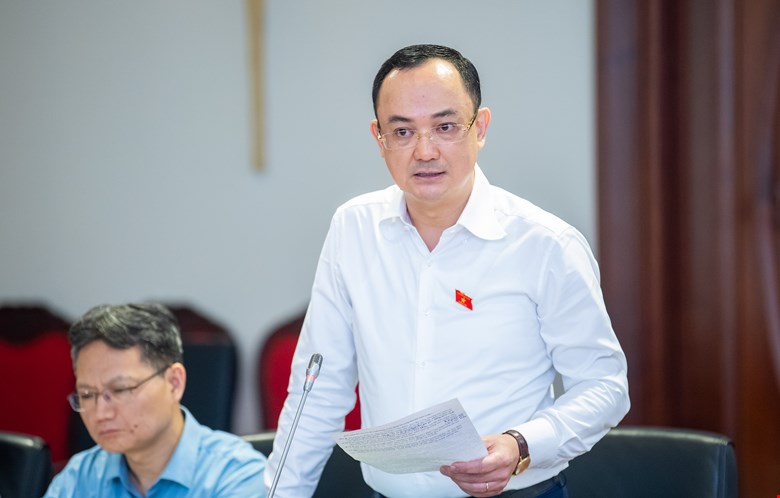 |
Delegate Nguyen Ngoc Son. Photo: National Assembly Media |
A delegate from Hai Phong City added that "electricity saving is the cheapest and fastest source of electricity." He suggested that the Ministry of Industry and Trade needs strong solutions to save at least 10% during peak hot months, considering this a direct solution to reduce pressure on investing in new power sources.
Furthermore, Son emphasized the need to adhere to Power Master Plan 8, develop large-scale battery storage systems (projected for 10,000-16,300 MW by 2030), and liquefied natural gas (LNG) power sources (22,524 MW) to support the base load. Solar power with self-generation and self-consumption mechanisms for households, offices, and industrial zones also needs to be promoted. Finally, this delegate recommended reducing over-reliance on imported fuels and building strategic reserves.
Pham Thi Thuy Chinh, Vice Chairwoman of the National Assembly's Economic and Financial Committee, urged the Prime Minister to continue focusing on national reserves. Regarding petroleum – a critical input fuel for many production and business sectors of the economy – she noted that there are currently no national reserve warehouses, with storage primarily relying on enterprise facilities. Businesses currently only store refined petroleum products, not crude oil.
Therefore, this delegate stated that investment spending for petroleum reserves needs to increase, as this sector currently accounts for only 21% of the total expenditure on reserves. Concurrently, she also proposed modernizing technology and storage systems for other sectors.
In a report submitted to the National Assembly, the government aims to establish a large-scale crude oil reserve system to diversify and maintain a stable supply for at least 90 days.
Currently, petroleum reserves are stored at the warehouses of major petroleum wholesalers through contracts, with fees paid according to established rates with the units. This reserve level only covers approximately 7-10 days of consumption.
Speaking at the assembly hall on the afternoon of April 9, Prime Minister Le Minh Hung affirmed that Vietnam will ensure national energy security both in the short and long term, especially the supply of crude oil and natural gas. He also called for increased energy saving, ensuring no electricity shortages under any circumstances, and improving the operational efficiency of the power system.
Anh Tu