On 12/4, Saudi Arabia's Ministry of Energy announced the full restoration of oil pumping capacity through the East-West pipeline. This crucial artery, now operating at 7 million barrels a day, serves as Saudi Arabia's sole crude oil export route given the Strait of Hormuz's closure for over a month.
The restoration follows an attack three days prior, which Reuters reported was carried out by Iran. The assault, occurring just hours after a ceasefire agreement, initially reduced the pipeline's oil transportation capacity by approximately 700,000 barrels a day.
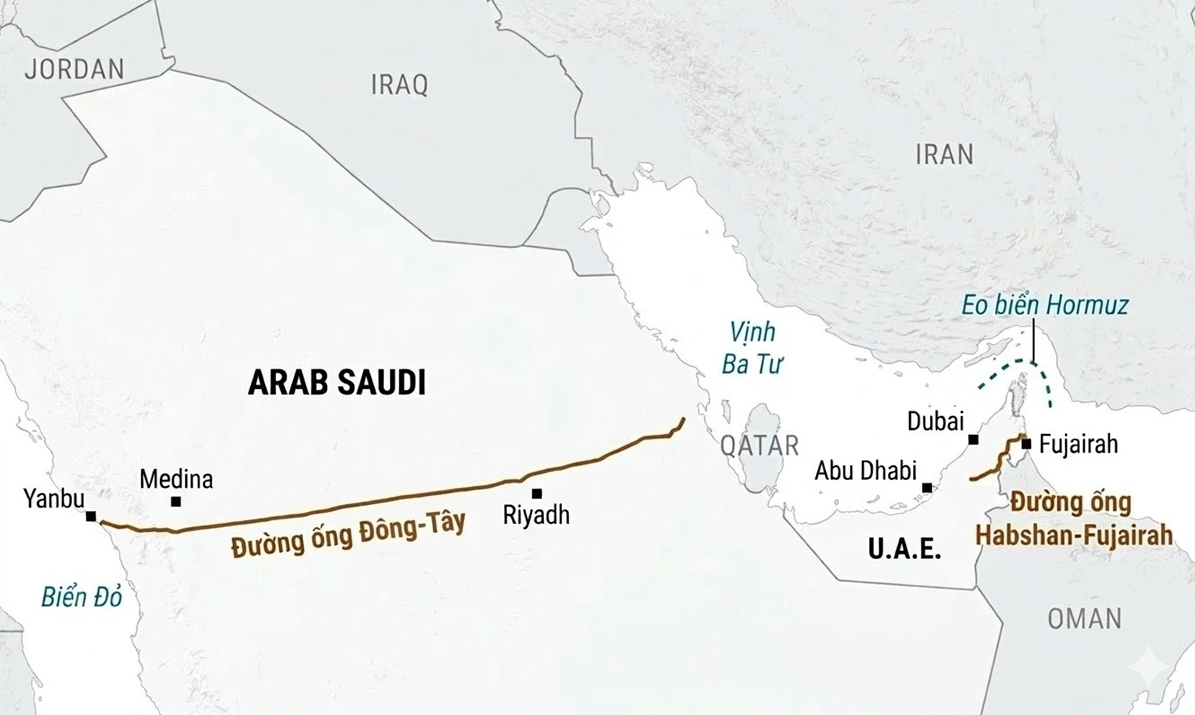 |
Location of the East-West pipeline and the Strait of Hormuz in the Middle East. *Graphic: WSJ*
The East-West pipeline, stretching approximately 1,200 km, is vital for transporting oil from Saudi Arabia's eastern fields to the Red Sea port of Yanbu. Constructed in the early 1980s when the Iran-Iraq war threatened Gulf shipping, this infrastructure bypasses the Strait of Hormuz, a strategic chokepoint.
The Ministry of Energy's announcement came days after it assessed damages from the wider Middle East conflict. Attacks had disrupted operations at key oil, gas, refining, and power generation facilities across Riyadh, Eastern Province, and the Yanbu industrial zone. Specifically, on 9/4, these strikes led to a national oil production capacity reduction of about 600,000 barrels a day.
Despite the disruptions, the Ministry confirmed that all affected energy facilities and pipelines have been repaired and are back in operation. While Saudi Arabia did not name the perpetrator of these attacks, it had previously reported intercepting numerous missiles and drones from Iran over recent weeks.
Officials also reported the restoration of production at the Manifa oil field, which had seen its capacity drop by approximately 300,000 barrels a day. Efforts are ongoing to repair damage at the Khurais production facility, where attacks also caused a 300,000 barrels a day reduction in output. The swift recovery, officials stated, will bolster the "reliability and continuity of supply for domestic and global markets".
Ha Thu (via Reuters)