In a dispatch issued on 31/3, Prime Minister Pham Minh Chinh stated that the transition to electric vehicles (EVs) is an inevitable trend. However, infrastructure for charging stations, parking spaces, and battery swap points in urban areas and apartment buildings remains insufficient and uncoordinated.
He emphasized the need to develop infrastructure for EV parking, charging stations, and battery swap points. Ministries and sectors must also promptly finalize standards, enhance safety management, and implement fire prevention measures for electric charging stations.
"There must be no loopholes that create opportunities for corruption, negativity, waste, or group interests. During implementation, agencies must increase supervision, inspection, and promptly address violations," the Prime Minister's dispatch stated.
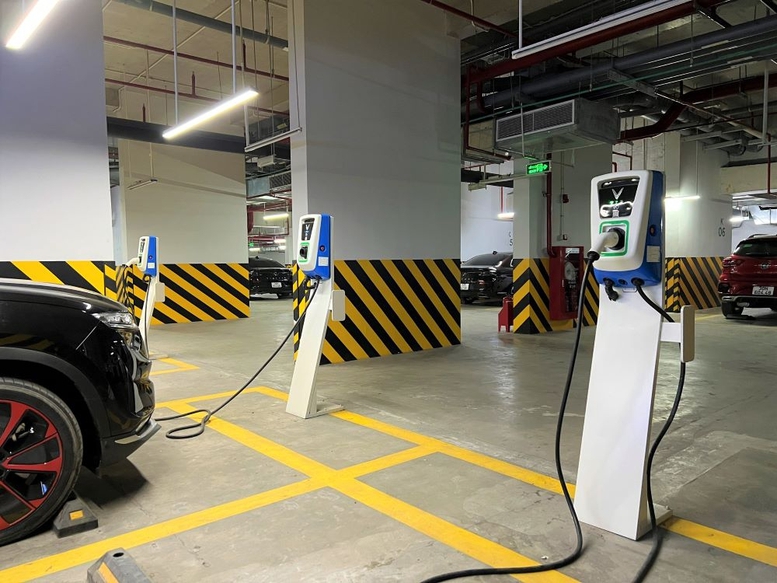 |
An electric vehicle charging station at an apartment complex. *Photo: VGP*
To develop the electric vehicle charging station system, Prime Minister Pham Minh Chinh assigned the Ministry of Construction to promptly complete regulations and standards for urban planning that integrate green transportation infrastructure (charging stations and battery swap infrastructure), to be finished by Q2. The Ministry must amend technical standards for apartment buildings to guide charging station design before 30/4, and remove obstacles in construction licensing and renovation of charging stations in existing buildings.
The Ministry of Industry and Trade is tasked with developing national technical standards for safety, energy efficiency, and power supply systems for charging stations, to be completed by Q3.
Vietnam Electricity (EVN) needs to accelerate its electricity demand management program, simplify connection procedures, and install separate meters for charging stations in apartment buildings to ensure transparent usage and electricity bill payment. People's Committees of provinces and cities are to review planning and arrange electric charging infrastructure in urban areas and construction projects.
Vietnam aims for 50% of urban vehicles and all buses and taxis to be electric by 2030. By 2050, all transport vehicles will transition to electric or green energy. To establish a charging station network for these vehicles, Vietnam will need to spend 2,2 billion USD by 2030, with this figure rising to nearly 14 billion USD by 2040 and 32,6 billion USD by 2050, according to World Bank estimates.
Currently, the country has approximately 6,7 million automobiles (about 3% are electric automobiles) and 70 million motorbikes (4,3% are electric motorbikes). Most electric vehicles are concentrated in major urban areas and are expected to increase rapidly, leading to an urgent demand for parking spaces and electric charging infrastructure.
Recently, due to a lack of specific standards and guidelines, many buildings have established their own regulations for electric vehicle parking and charging. In TP HCM, many apartment complexes have adopted different approaches: some prohibit electric vehicles in basements, some only allow electric motorbikes but not electric automobiles, and others arrange temporary parking on the ground floor instead of enclosed basements.
Phuong Dung