The Ministry of Higher Education, Science, Research and Innovation (MHESI) announced that Thailand is advancing the application of science and technology throughout its durian supply chain. This comprehensive approach covers sorting, quality inspection, processing, and export preservation.
This initiative comes as China, the world's largest durian consumer, implements stricter quality checks, chemical residue limits, and traceability requirements. Concurrently, regional competition is intensifying as Vietnam, Malaysia, the Philippines, and Cambodia expand their durian exports to this market.
Data from the Chinese Customs Administration reveals that in the 11 months of 2025, China imported 1.79 million tons of fresh durian, valued at 7.18 billion USD. Thailand remained the largest supplier, providing 903,610 tons and capturing 50.39% of the market share. However, this represents a decrease from 52.04% during the same period in 2024. In contrast, Vietnam's exports to China reached 884,590 tons, increasing its market share to 49.33%.
The rising competition in the Chinese market is prompting Thai exporters to intensify their use of technology to minimize defective products and secure market share.
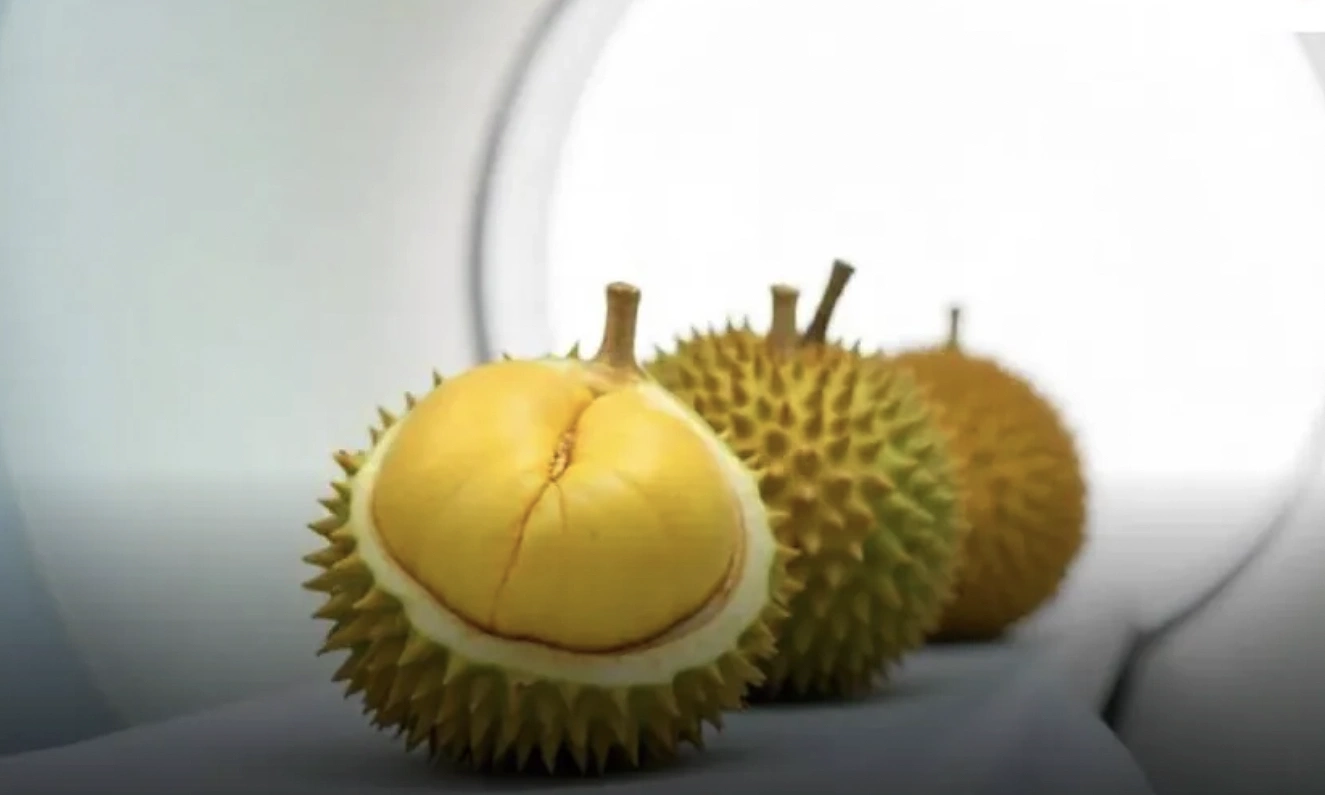 |
Advanced durian CT-scan machines accurately verify quality before export. Photo: Thai Government Public Relations Department |
For 2026, the Thai Ministry of Agriculture has set an export target of over 150 billion baht (4.2 billion USD) for durian. It is also implementing a "four no's" policy: no unripe fruit, no pests or diseases, no export rights violations, and no chemical residues.
Thai packaging businesses are now adopting AI and scanning systems to assess ripeness and identify unripe or internally flawed durians before export, moving away from manual sorting. MHESI indicates that this technology reduces reliance on manual methods, such as "tapping the fruit," for assessing durian quality. Instead, it employs quantitative standards for export.
Notably, the Agricultural Research Development Agency (ARDA), as reported by the Thai Government Public Relations Department, has developed an AI-integrated "Durian CT-scan" machine. This device can detect ripeness, unripe fruit, and seed borers in just 3 seconds per fruit, achieving approximately 95% accuracy. The system is capable of sorting up to 1,200 fruits per hour.
This technology was developed in collaboration with Suranaree University of Technology by repurposing decommissioned medical CT-scan machines. ARDA states that equipment costs have decreased from approximately 10 million baht to 2 million baht per machine. This reduction helps packaging facilities save labor and expedite the processing of export goods.
Concurrently, Thailand is increasing its use of nuclear technology for post-harvest preservation and treatment. Controlled X-ray doses extend shelf life, slow ripening, and treat quarantine pests, catering to demanding markets like the US and China. Beyond X-rays, MHESI noted that gamma irradiation technology for treating fruit flies has been piloted in Chanthaburi for over 20 years. This initiative aims to reduce chemical use and lower costs for farmers.
Previously, China had heightened inspections for Basic Yellow 2 in imported durian after detecting several shipments from Thailand contaminated with the dye. Thailand was compelled to destroy numerous returned consignments and reinforce its inspection procedures to uphold confidence in the world's largest import market.
*By Thi Ha (Source: The Nation Thailand, Thailand.go.th)*