On 25/5, the Government approved the program for supporting industry development for the 2026-2035 period. Supporting industries will serve as "fuel" for "Vietnam's industrial engine", contributing to increased domestic production capacity and reducing reliance on imported raw materials, components, spare parts, and input equipment.
The program's overall objective is for enterprises in the supporting industry sector to gradually master the technology for producing essential raw materials, components, spare parts, and input equipment. These materials, components, and equipment will serve key areas such as smart electronics, energy equipment, rail, automotive, mechanical engineering, automation, high-tech industry, textiles, and footwear, aligning with a green economy orientation.
By 2030, the goal is for several key industries to achieve localization rates of 40-45%, while elevating the industrial competitiveness index into the top three leading nations in ASEAN. Specifically, the localization rate for the electronics industry is targeted at approximately 25-30%; mechanical engineering 40%; the automotive industry 22-30%; textiles 60%; the footwear industry 60-65%; and the high-tech industry around 15%. These rates are expected to further increase by 5-10% by 2035.
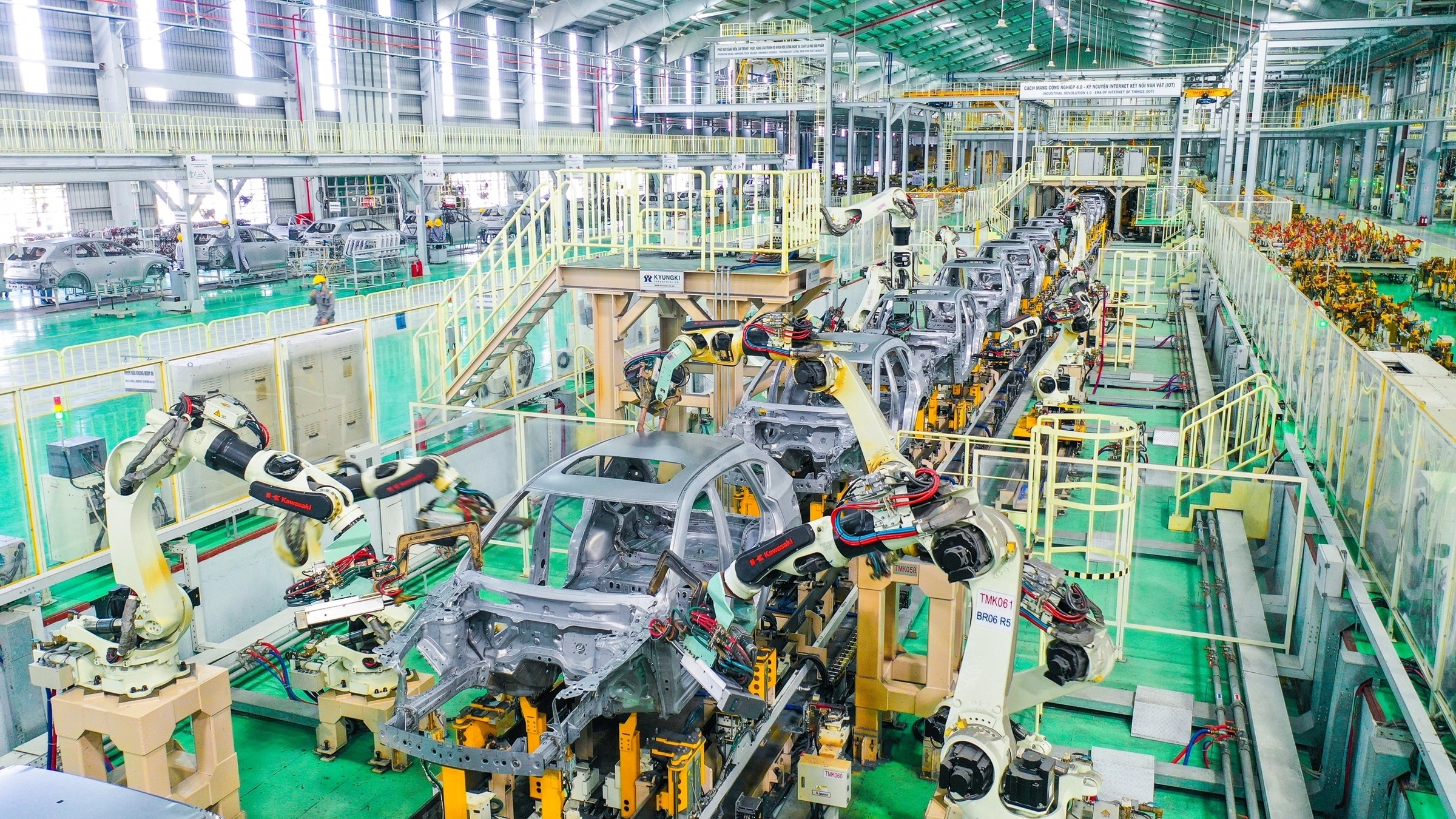 |
Inside an automotive assembly plant in Da Nang. Photo: Van Minh |
To achieve these localization rates, the program plans to provide training in enterprise management and production management systems, tailored to international requirements, for 600 supporting industry enterprises.
At least 80 enterprises will receive support for their product research and development capabilities, with a minimum of 40 enterprises successfully adopting technological innovations. Additionally, the program is expected to support 800 enterprises in training high-quality human resources through collaborations with higher education institutions and research institutes.
Going forward, mechanisms and policies to support enterprises in the sector will continue to be refined. This includes creating opportunities for access to new technology, digital transformation, green-smart operations, and linkages with domestic and international production chains.
According to data from the Ministry of Industry and Trade, Vietnam has approximately 6,100 supporting industry enterprises, offering over 5,500 types of products, primarily in the simple parts and components group. This program to promote the supporting industry, aimed at increasing localization rates, is seen as an opportunity for enterprises in the sector to participate more deeply in global value chains.
Previously, in 9/2025, Decree 205/2025/ND-CP also expanded preferential policies for supporting industries. Specifically, enterprises producing supporting industrial products can receive up to 70% of the costs for market development activities such as brand registration, exhibition participation, M&A consulting, and cooperation to become suppliers in industrial chains.
Support for technology transfer has also been expanded, with a maximum of 50% of machinery and equipment investment costs, and 70% of human resource training costs to enhance operational capacity. Enterprises are also facilitated in accessing capital from the National Technology Innovation Fund, the National Science and Technology Development Fund, and high-tech support programs.
Hoai Phuong