The Ministry of Finance, in its draft amendment to Decree 123 and Decree 70 on invoices and documents, proposes that several services be permitted to issue consolidated invoices at the end of the day or month. This would replace the current requirement of issuing an invoice for each transaction.
These services include: banking, securities, insurance, money transfers via e-wallets, power disconnection and reconnection, parking, cinemas, and e-commerce (encompassing postal and shipping activities for platforms). A key condition is that these service providers must possess software systems capable of detailed control and management for each transaction involving individual non-business buyers.
Public passenger transport services, specifically by bus and taxi, are also proposed to issue invoices at the end of the day. However, businesses offering these services must have software that accurately calculates fares for buyers, providing comprehensive trip information such as license plate, route, distance, and the total amount payable.
Service providers are responsible for the accuracy of these consolidated invoices and must furnish a detailed summary upon request from state agencies. Should a customer require an invoice for each individual transaction, the provider must accommodate that request.
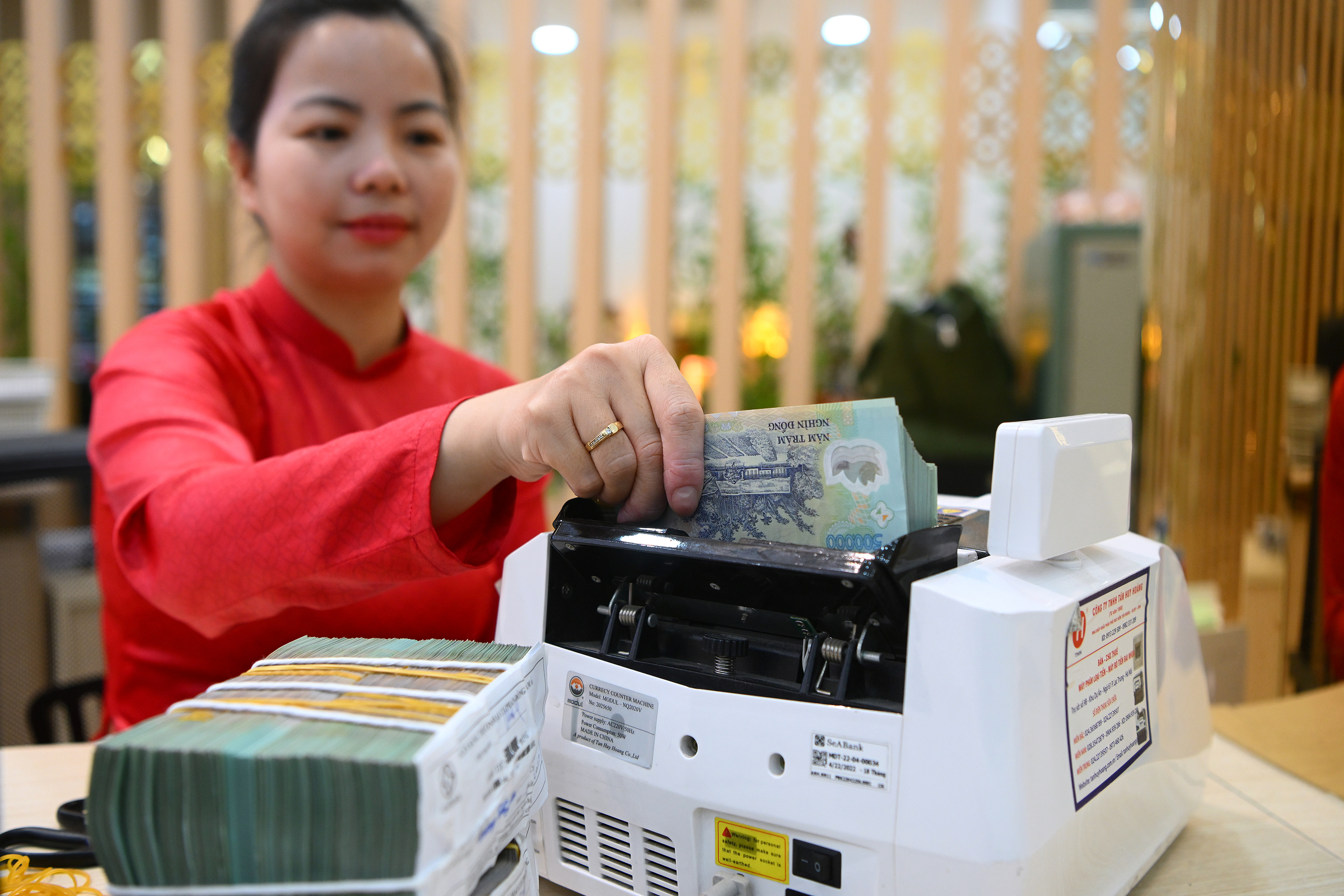 |
Seabank transaction office. Photo: *Giang Huy* |
Historically, Decree 123/2020 already allowed for consolidated invoicing for certain services, including securities, banking, insurance, e-wallet money transfers, and power disconnection and reconnection. However, Decree 70/2025 subsequently abolished this provision.
The current regulation's implementation has revealed several challenges. A significant issue is the sudden surge in electronic invoices, far exceeding the design capacity of the tax authority's system. This situation poses a risk of system overload, potentially disrupting business operations and the broader economy.
Actual data indicates the tax authority's electronic invoicing system, designed to handle approximately 6,4 billion invoices annually, currently receives up to 18 billion, three times its intended capacity. Furthermore, many banks and securities companies currently do not issue invoices for each transaction. The Ministry of Finance estimates that if all parties adhere to this regulation, the number could reach 60 billion invoices each year, a volume that would far exceed the designed capacity.
Another issue is that requiring individual invoices compels banks, securities firms, insurance companies, and power utilities to generate documents for millions of small transactions. This leads to increased costs, staffing needs, and data storage pressure, often unnecessarily when customers do not request an invoice.
The Ministry of Finance's proposal follows requests from corporations, businesses, and associations in the banking, insurance, and securities sectors to continue issuing consolidated invoices daily. This approach aims to reduce costs while maintaining complete and transparent data. Subsequently, similar recommendations were received from: transport companies (Vingroup), film companies (Phim Thien Ngan, BDH, Lotte Cinema), and e-commerce platforms (Grab, Shopee)...
According to the Ministry of Finance, the new regulation will not introduce additional administrative procedures and will simplify existing ones. Allowing consolidated invoicing at the end of the day for non-business buyers reduces the number of documents requiring creation. This, in turn, lessens the compliance burden for businesses, saving both time and costs.
Phuong Dung