In the draft decree guiding the amended personal income tax law, the Ministry of Finance outlines detailed regulations for calculating tax on various types of capital transfer and securities income.
The drafting agency suggests that shares of unlisted companies be subject to capital transfer tax, alongside existing capital contributions in businesses.
For these transactions, the tax is calculated at 20% of the taxable income, which is the sale price minus the purchase price and related costs, for each transaction.
If the purchase price and associated costs cannot be determined, a tax rate of 2% of the transfer price will apply. This calculation method applies uniformly to both resident and non-resident individuals in Vietnam.
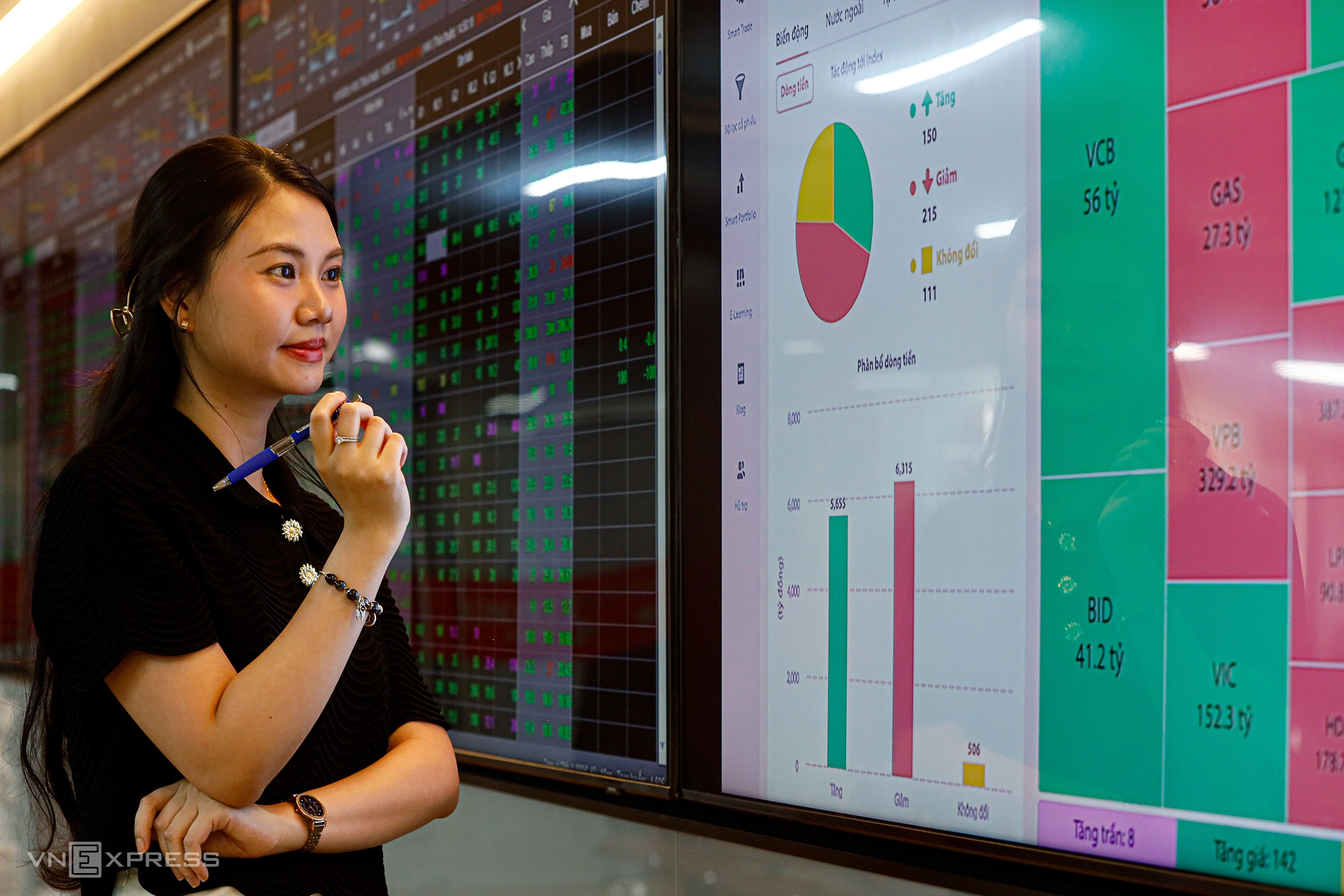 |
Securities transactions at Rong Viet Securities Company (TP HCM) in 10/2024. Photo: An Khuong. |
Securities transactions at Rong Viet Securities Company (TP HCM) in 10/2024. Photo: An Khuong.
The Ministry of Finance stated that unlisted shares exhibit transaction characteristics similar to capital transfers: they are not frequent and lack transparency. Therefore, they should be subject to tax.
Conversely, income from listed securities transfers, such as shares, bonds, and fund certificates, will continue to be taxed at 0.1% of the transfer price per transaction, as is currently practiced. The reason is that these transactions feature clear, transparent prices and occur frequently in the market. According to the drafting agency, maintaining a low tax rate for listed securities aims to encourage businesses to list on the stock exchange, enhance transparency, and protect investors.
Regarding tax declaration, individuals transferring capital will self-declare and pay the tax. For securities, income-paying organizations are responsible for withholding, declaring, and remitting the tax on behalf of individuals at a 0.1% rate.
Quynh Trang