During a state visit to Canada, General Secretary and President To Lam met with Ian L. Edwards, President and Chief Executive Officer of AtkinsRealis Group, on 25/9, according to TTXVN.
AtkinsRealis is a Canadian corporation specializing in engineering and project management. Edwards stated that the company’s development strategy focuses on sustainable infrastructure, clean energy, advanced nuclear technology, and digital technology.
Edwards expressed the group's interest in opportunities in Vietnam across infrastructure, energy, transportation, engineering services, and project management. The current primary focus of their proposal is cooperation in nuclear power.
During the meeting, General Secretary and President To Lam stated that Vietnam is seeking long-term partners for its entire nuclear power program. He emphasized that safety is the paramount principle and cannot be compromised.
Therefore, the selection of technology and partners will be carefully considered based on technology maturity, safety, economic efficiency, financial viability, progress, technology transfer, human resource development, and Vietnam's long-term benefits. Proposed technology must be practically deployable and accompanied by a feasible financial plan.
The General Secretary and President commended AtkinsRealis's proposal for technology transfer, localization, and human resource training. He requested the group clarify what capabilities it can transfer over the next 10-20 years, to what extent Vietnamese enterprises can participate, and which stages of the nuclear value chain they can gradually take on.
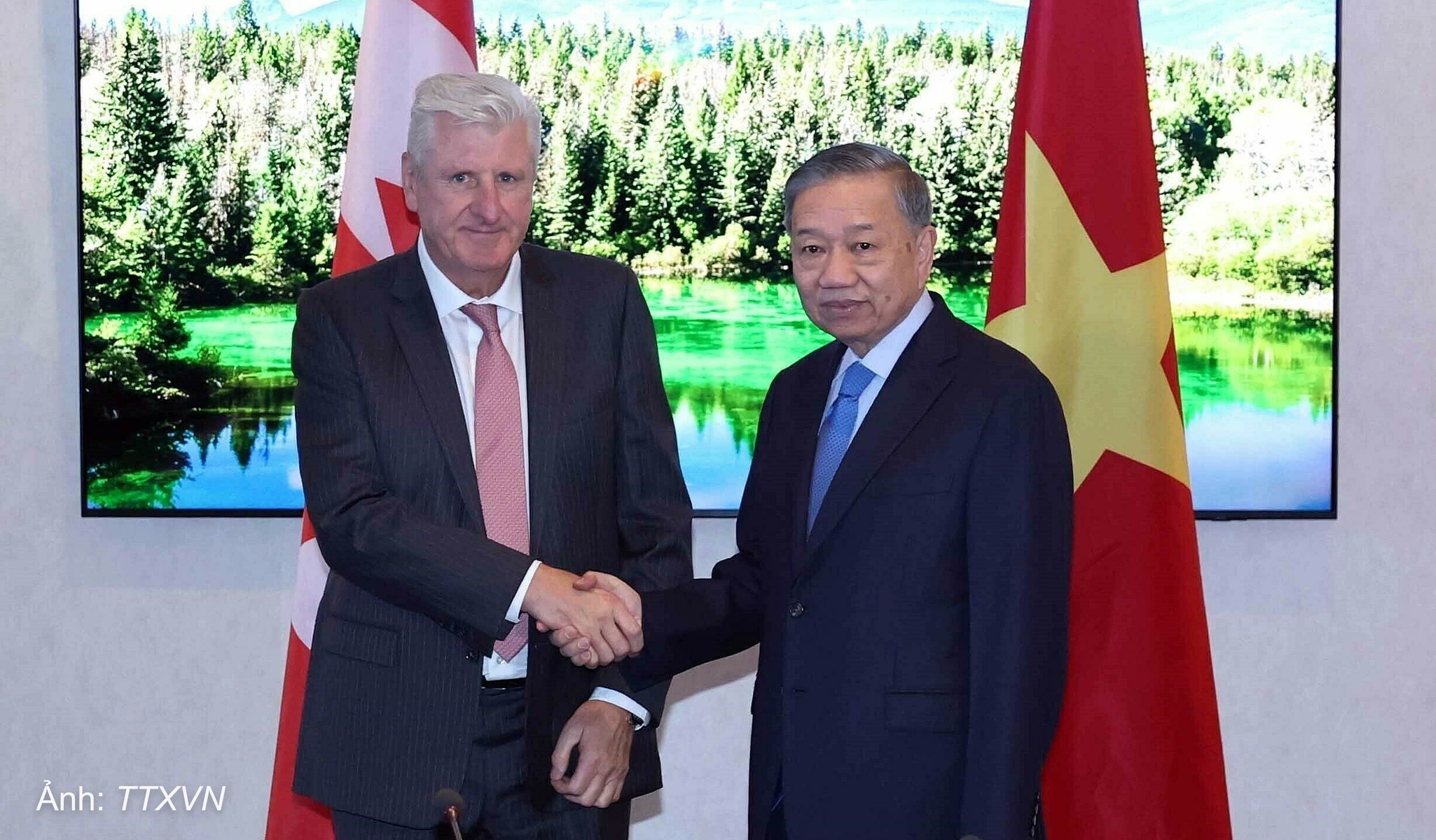 |
General Secretary and President To Lam meets Ian L. Edwards, President and CEO of AtkinsRealis Group. Photo: TTXVN
On the same day, General Secretary and President To Lam also met with leaders of CAE, a Canadian enterprise in aviation training and simulation. The General Secretary and President noted that Vietnam's aviation sector is growing in fleet size, airports, and service demand, necessitating advanced human resources, training capacity, and safety measures.
He urged CAE to explore developing Vietnam into a significant training and simulation hub in Southeast Asia, serving both domestic airlines and regional clients. Additionally, he expressed a desire for CAE, along with Vietnamese partners, to establish a roadmap to help Vietnam gradually master technology, share experience, and technology. The ultimate goal is to enhance the capacity of Vietnam's entire aviation system.
Alexandre Prevost, CAE’s President for Civil Aviation, expressed the company's desire to expand cooperation in Vietnam in pilot, flight attendant, maintenance technician, and air traffic controller training. The company also aims to collaborate on increasing simulation capabilities, digital learning, and aviation safety through phased partnership implementations in Vietnam.
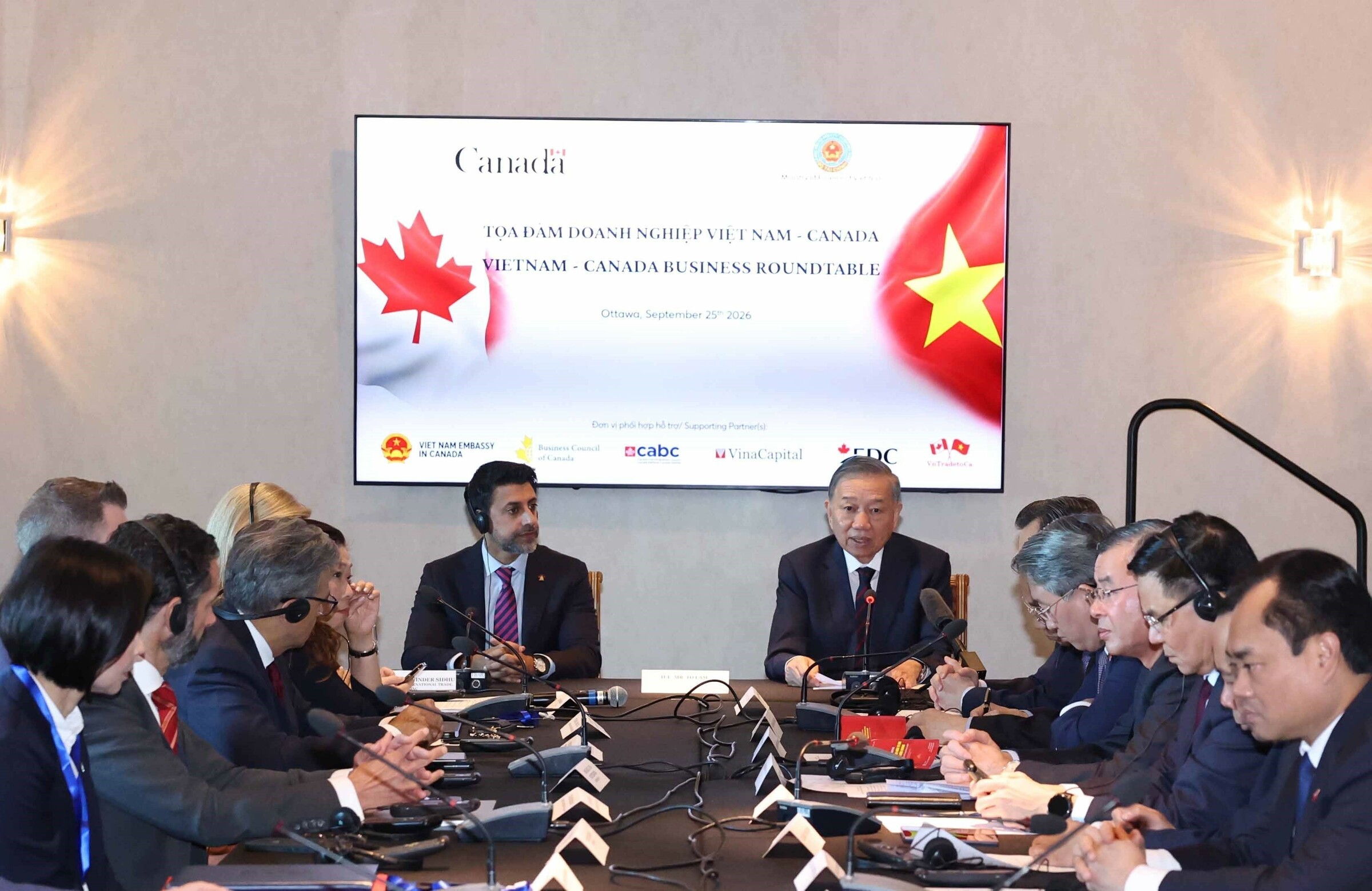 |
General Secretary and President To Lam attends and speaks at the Vietnam - Canada High-Level Business Forum. Photo: TTXVN
At the Vietnam - Canada business forum, Vietnam Airlines and Vietjet exchanged cooperation documents with CAE regarding aviation human resource training and simulation technology. Vietjet also exchanged a memorandum of understanding for cooperation with aviation technology company InteliSys.
Speaking at the forum, Canadian Minister of International Trade Maninder Sidhu stated that the two sides have a strong trade and investment relationship, which strengthens ties between Vietnam and Canada. According to him, Canada possesses significant potential in clean and renewable energy. Canadian companies have also established long-standing relationships with Vietnam and wish to connect Vietnam with international markets.
The Minister noted a growing number of Vietnamese businesses investing in Canada. He believes high technology will boost production efficiency and enhance cooperation between the two sides. He encouraged Vietnamese businesses to continue their presence in Canada, as there is still much room for development that benefits both countries.
The General Secretary and President observed that Vietnam - Canada trade is developing faster than investment. Canada currently has over 300 projects in Vietnam with a total registered capital of approximately 5 billion USD, but the scale of capital has not increased commensurately over many years.
In contrast, cooperation in processing and manufacturing, as well as the formation of joint production chains, remains limited. This gap represents the largest development potential that both sides need to focus on filling in the coming period.
He proposed that the two sides connect Canada's long-term capital with infrastructure, energy, logistics, and technology projects in Vietnam, while selecting feasible projects for the 2026-2028 action plan.
Vietnam and Canada can aim for bilateral trade turnover of 14-15 billion USD by 2030, according to the General Secretary and President. He suggested that cooperation results should be measured by implemented projects and disbursed capital, in addition to signed memoranda of understanding.
Phuong Dung