


Siemens Mobility is a manufacturer involved in the research and development of the InterCity Express (ICE) high-speed train series, a source of German pride. The company's history dates back to the 19th century when it built the first electric trains in Berlin. It currently employs approximately 43,400 people globally.
The Velaro Novo, Siemens Mobility's newest high-speed train series, was developed from the ICE 3. The Velaro's advanced technology has brought transformative changes to cities worldwide.
In Germany, the Velaro Novo underwent testing within Deutsche Bahn's ICE-S train, integrating hundreds of sensors to gather real-time data. This data forms the basis for optimizing operations and condition-based maintenance. The train achieves a maximum speed of over 350 km/h, enhancing connectivity between major urban centers.
In the United States, Siemens Mobility developed the American Pioneer 220 train series, the American version of the Velaro Novo. This advanced technology will be supplied to VinSpeed.
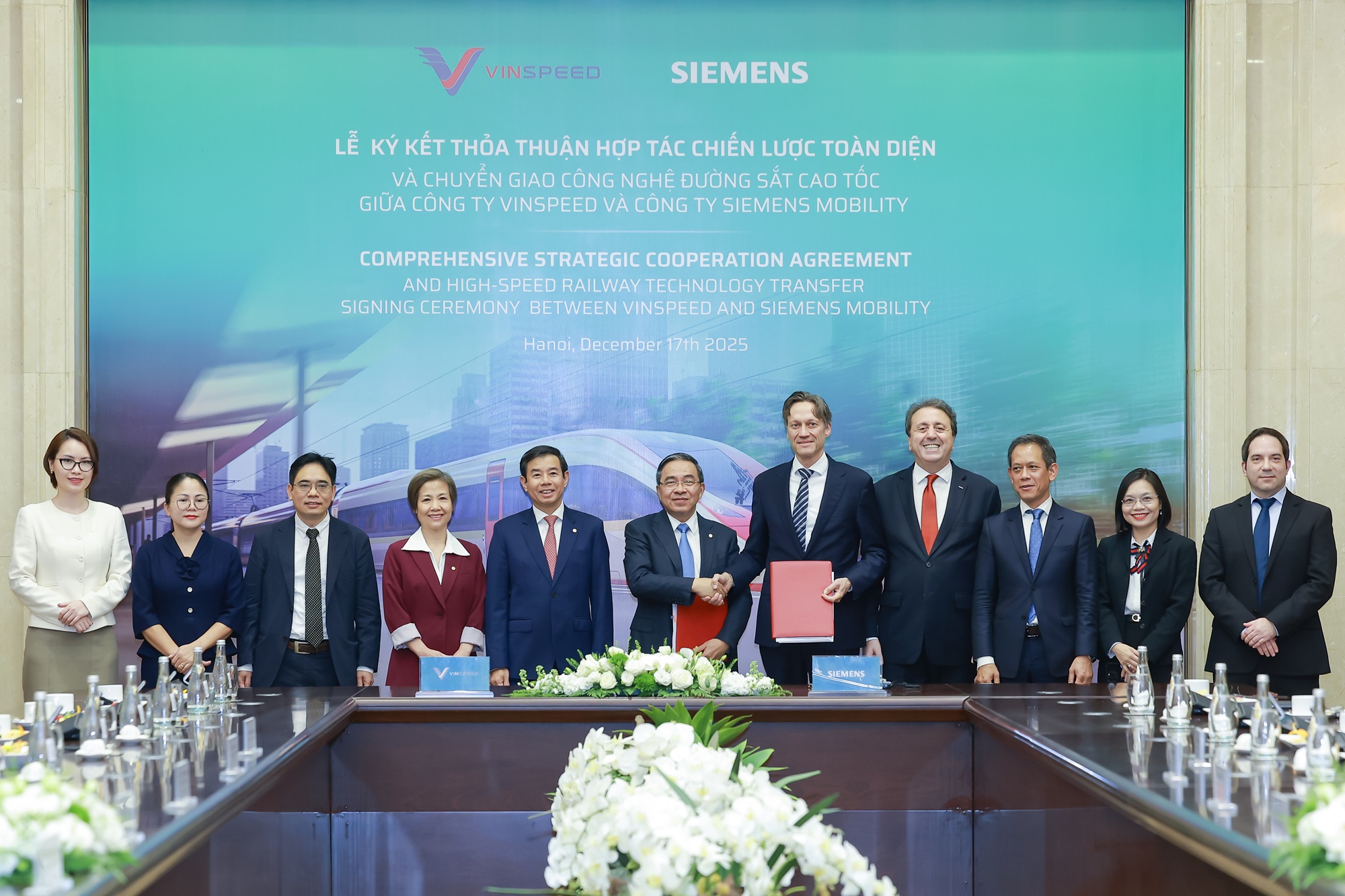 |
Nguyen Viet Quang, Vice Chairman and General Director of Vingroup (fifth from left), Pham Thieu Hoa, General Director of VinSpeed (sixth from left), and Michael Peter, General Director of Siemens Mobility (fifth from right), with representatives from both parties at the signing ceremony for a comprehensive strategic cooperation and high-speed rail technology transfer agreement. Photo: Vingroup |
Beyond its speed, the American Pioneer 220 is positioned as an economical and sustainable solution for US high-speed rail. Its design incorporates advanced manufacturing and car body welding technologies, reducing its weight by approximately 15% compared to previous generations, or over 70 tons. This results in about a 20% reduction in investment costs and up to a 30% reduction in maintenance expenses.
Siemens also supplied 16 Velaro RUS trains to Russian Railways (RZD) for the Moscow - St. Petersburg high-speed line. Since 2009, Siemens-developed high-speed trains have connected Moscow with Saint Petersburg and Nizhny Novgorod, operating effectively in extreme climates ranging from -40 to 40 degrees Celsius. This has shortened the Moscow - Saint Petersburg journey by about one hour compared to previous trains.
In Spain, during the 2001-2005 period, Renfe, the Spanish railway operator, ordered a total of 26 Velaro E trains from Siemens. This Velaro version was custom-designed for Spain, operating at 350 km/h. The new system reduced travel time on the 621 km Madrid - Barcelona high-speed line to under 2.5 hours. Furthermore, using Velaro E trains can reduce CO2 emissions by 88% compared to air travel, saving approximately 29,000 tons of CO2 annually.
On 17/12, Michael Peter, Global General Director of Siemens Mobility, visited Hanoi to sign a comprehensive strategic cooperation and technology transfer agreement with VinSpeed (Vingroup), witnessed by Helga Margarete Barth, Ambassador of the Federal Republic of Germany to Vietnam.
The signed agreement is a "turnkey" package, encompassing the provision of modern railway infrastructure technology and advanced trains. This aims to establish the highest standards for Vietnam's high-speed rail system.
Yen Chi


