In a newly released report, analysts at SSI Securities Corporation assessed that Vietnam is highly likely to be included in MSCI's watchlist during the june review period. The market has already fulfilled 10 out of 18 market accessibility criteria according to MSCI standards and is improving the remaining criteria.
According to SSI, notable advancements include the effective implementation of the non-prefunding mechanism, which allows foreign investors to purchase shares without requiring sufficient funds at the time of order placement. Furthermore, the roadmap for adopting a central counterparty (CCP) mechanism is on track, and the expansion of short-selling tools through VN30 index futures contracts is progressing. The actual foreign ownership ratio on the Ho Chi Minh City stock exchange increased from 41.4% to 46% in april, primarily due to newly listed large-cap enterprises with a 100% foreign ownership limit. The level of information disclosure in English, from both regulators and listed companies, has also significantly improved.
MSCI is one of three leading global index providers, alongside FTSE Russell and S&P Dow Jones Indices. Their index products are widely used by fund managers, financial institutions, banks, and investment organizations worldwide.
Currently, MSCI classifies Vietnam as a frontier market in Asia, alongside Bangladesh, Pakistan, and Sri Lanka. If upgraded to an emerging market, Vietnam would join the ranks of mainland China, India, Indonesia, South Korea, Thailand, and Taiwan.
MSCI ranks stock markets based on three main categories of criteria: economic development level, market accessibility, and market size and liquidity. Each category includes several specific quantitative criteria.
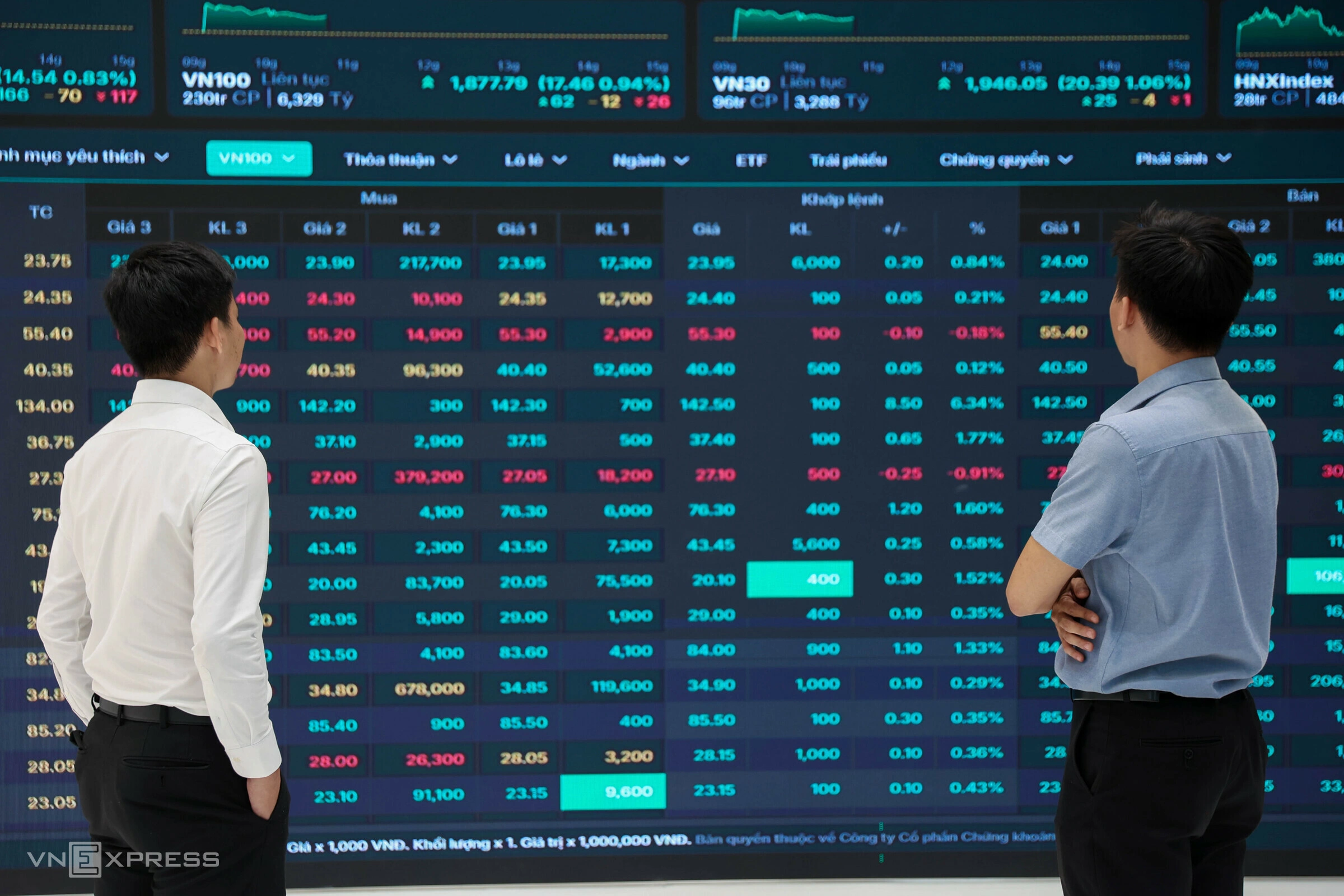 |
Investors monitor stock prices at Kafi securities company, 4/2026. Photo: Quynh Tran
SSI analysts believe that the remaining challenges for Vietnam's stock market primarily involve foreign exchange market liberalization. This is a complex criterion, but not an absolute barrier, as many existing MSCI emerging markets have not fully met it either.
"Recent discussions about allowing commercial banks to provide foreign exchange hedging (FX hedging) instruments are seen as a positive signal, further strengthening the prospect of inclusion in the upgrade watchlist", the analysis team stated.
Vietnam aims to upgrade its stock market from frontier to emerging status according to FTSE Russell standards by 2025 and MSCI standards by 2030. The first goal was achieved when FTSE Russell confirmed Vietnam's stock market was upgraded from a frontier market to a secondary emerging market on 21/9.
Nguyen Duy Hung, Chairman of the Board of Directors of SSI Securities Corporation, noted that MSCI's upgrade criteria are much more stringent. However, he believes that after the success with FTSE Russell, market regulators have gained experience in improving upgrade conditions, which could help achieve this goal sooner.
Last year, stock market capitalization reached nearly 10 trillion dong, accounting for almost 78% of GDP. The government aims to increase this capitalization to 120% of GDP by 2028, a level comparable to other countries in the region and globally.
In late april, Prime Minister Le Minh Hung directed the Ministry of Finance to implement strong enough solutions to ensure the stock market becomes a medium and long-term capital mobilization channel for the economy. He emphasized, "Discipline must be ensured so that the stock market operates transparently and fairly, increasing investor and public confidence."
Phuong Dong