Speaking on Fox Business on February 25, Jamieson Greer stated that the current tariff rate is 10%. "For some countries, this rate will increase to 15% and potentially higher," he said.
Greer did not name specific countries but affirmed there are no plans to increase tariffs on Chinese goods beyond current levels, especially as President Donald Trump is expected to visit China in a few weeks. "We truly intend to abide by the agreement reached with them," he stated.
Later, on Bloomberg TV, the US chief trade representative revealed that the White House is preparing a statement to raise temporary tariffs to 15% "where appropriate." Greer noted that this move considers countries with existing trade agreements, but he did not provide further details.
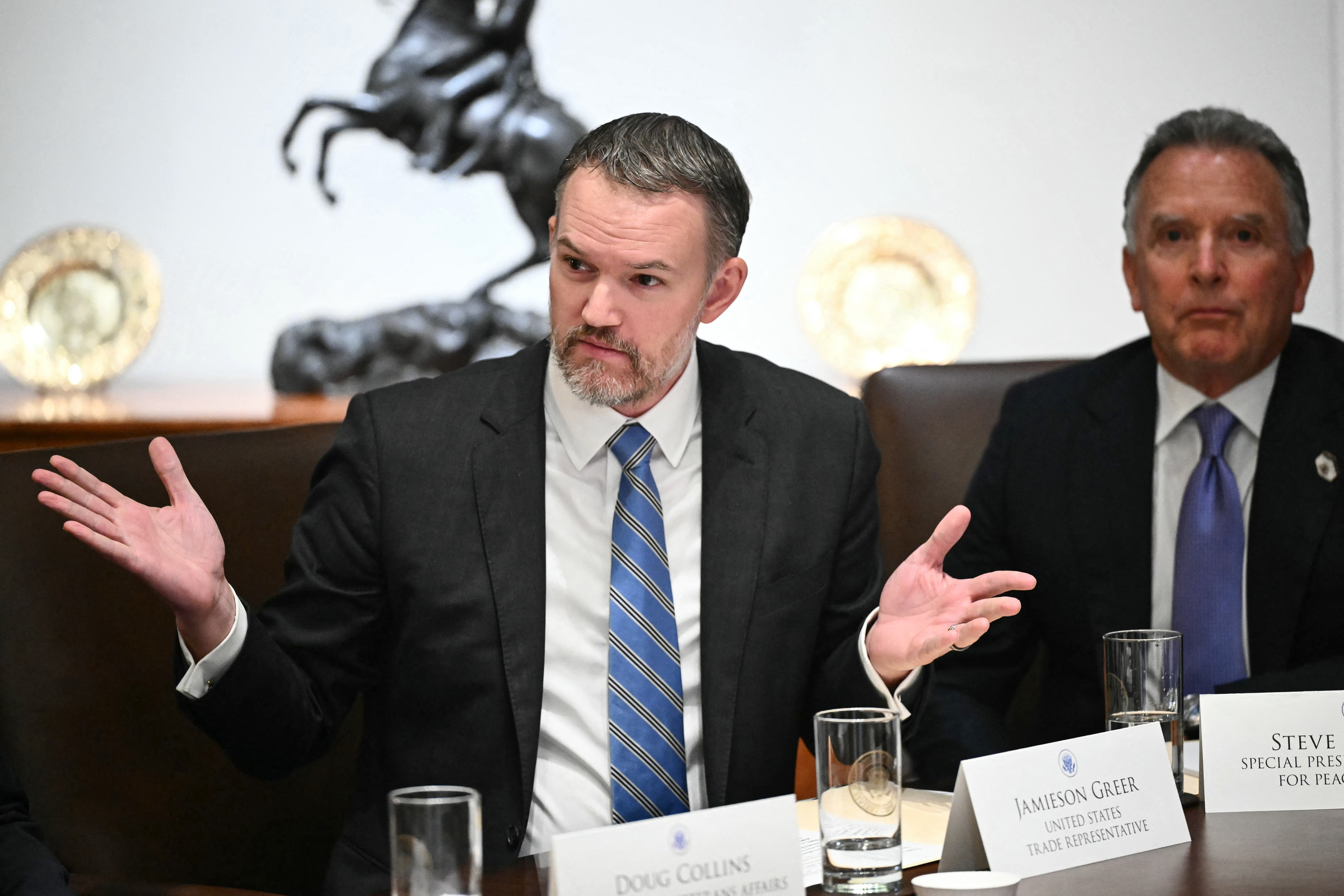 |
US Chief Trade Representative Jamieson Greer at the White House on 26/8/2025. *Photo: AFP* |
Goods from various countries imported into the US have been subject to a temporary 10% tariff since February 24, based on an executive order signed by President Trump on February 20. This action followed the Supreme Court's rejection of tariffs imposed under the International Emergency Economic Powers Act (IEEPA).
According to Jamieson Greer, the plan to use a different legal basis to replace the invalidated IEEPA tariffs is compatible with existing trade agreements. The focus of this effort is to expand investigations into unfair trade practices under Section 301, targeting issues such as: overcapacity, forced labor, and discrimination against American technology companies.
Greer said that Section 301 investigations could serve as an enforcement mechanism for trade agreements signed by the Trump administration in recent months. For example, the Office of the United States Trade Representative (USTR) opened an investigation into Indonesia to examine industrial capacity and fisheries subsidies.
The findings will be compared with steps taken by Indonesia to address US concerns, as well as commitments in the agreement between the two sides. "Then, we will make a decision on appropriate tariff levels, and expect to maintain consistency across agreements," Greer said.
The US administration will also open additional national security investigations under Section 232 for strategic industries, where tariffs have proven to have a strong legal basis. "They have withstood legal scrutiny in the past and continue to do so," he noted.
Additionally, he suggested Section 338 of the Tariff Act of 1930, which allows for tariffs up to 50% and remains in effect after nearly one century. It could be applied if a country discriminates against US trade compared to other partners.
Phien An (according to Reuters)