In the first two months of the year, wood and wood product exports reached 2.61 billion USD, a 5.8% increase compared to the same period in 2025, according to the Ministry of Agriculture and Environment.
The favorable situation was disrupted by the outbreak of the Middle East conflict. While Vietnam's wood furniture consumption in this region is not substantial, indirect impacts are unavoidable. Nguyen Chanh Phuong, Vice Chairman of the Handicraft and Wood Industry Association of Ho Chi Minh City (Hawa), stated that freight costs are likely to increase.
The impact was immediate at the Ho Chi Minh City Furniture & Home Accessories Fair (HawaExpo 2026), which recently took place. Some buyers and visitors from the Gulf region and Europe were unable to attend as planned due to flight disruptions.
"Geopolitical risks, including the Middle East conflict, exacerbate supply chain instability, production and logistics costs, and market sentiment", Vu Ba Phu, Director General of the Trade Promotion Agency (Ministry of Industry and Trade), commented at the event.
The unexpected conflict emerged as the wood furniture industry aims for 18.5 billion USD in exports this year, an increase of about 7% compared to 2025. Phung Quoc Man, Chairman of Hawa, noted this is "a challenging but entirely achievable figure."
According to experts, the industry still benefits from its leading capacity in Southeast Asia and the US postponement of tariffs on kitchen cabinets. Additionally, businesses are proactively adapting to instability by diversifying designs, customers, and sales channels to increase opportunities and mitigate risks.
Man highlighted a clear shift in business mindset within the industry, from traditional original equipment manufacturing (OEM) to original design manufacturing (ODM). For example, Forexco Quang Nam presented a lounge chair with intricate cross-weaving techniques at HawaExpo 2026, attracting attention from buyers in Europe, the US, and the UAE.
Similarly, Nghia Son Furniture's collection of high-end dining tables featuring wood-wrapping techniques also garnered significant interest. Despite a decrease in visitors due to flight disruptions from the Middle East, a company representative stated that business opportunities at the event still increased by about 25%, with many deals currently under negotiation.
SangJoon Byun, Editor-in-Chief of GAGU Guide furniture magazine (South Korea), noted that buyers appreciate the innovation efforts. "Many Vietnamese products now command higher prices due to superior design and quality compared to some other mass-production markets in Southeast Asia", he said.
Businesses are also actively seeking new markets, attracting new buyers from India, Europe, and the Middle East. At the exhibition, Wood Concept reported a significant increase in visitors from the US East Coast, Northern Europe, the Caribbean, and Bulgaria. USofa observed the presence of new clients from South Korea, Japan, and the UAE.
Some are also exploring online retail. Le Dai Thang, Director of Nghia Son Furniture, revealed a 217-fold growth on Amazon within 5 years. Last year, they sold 120,000 USD on a single Prime Day shopping festival on the platform.
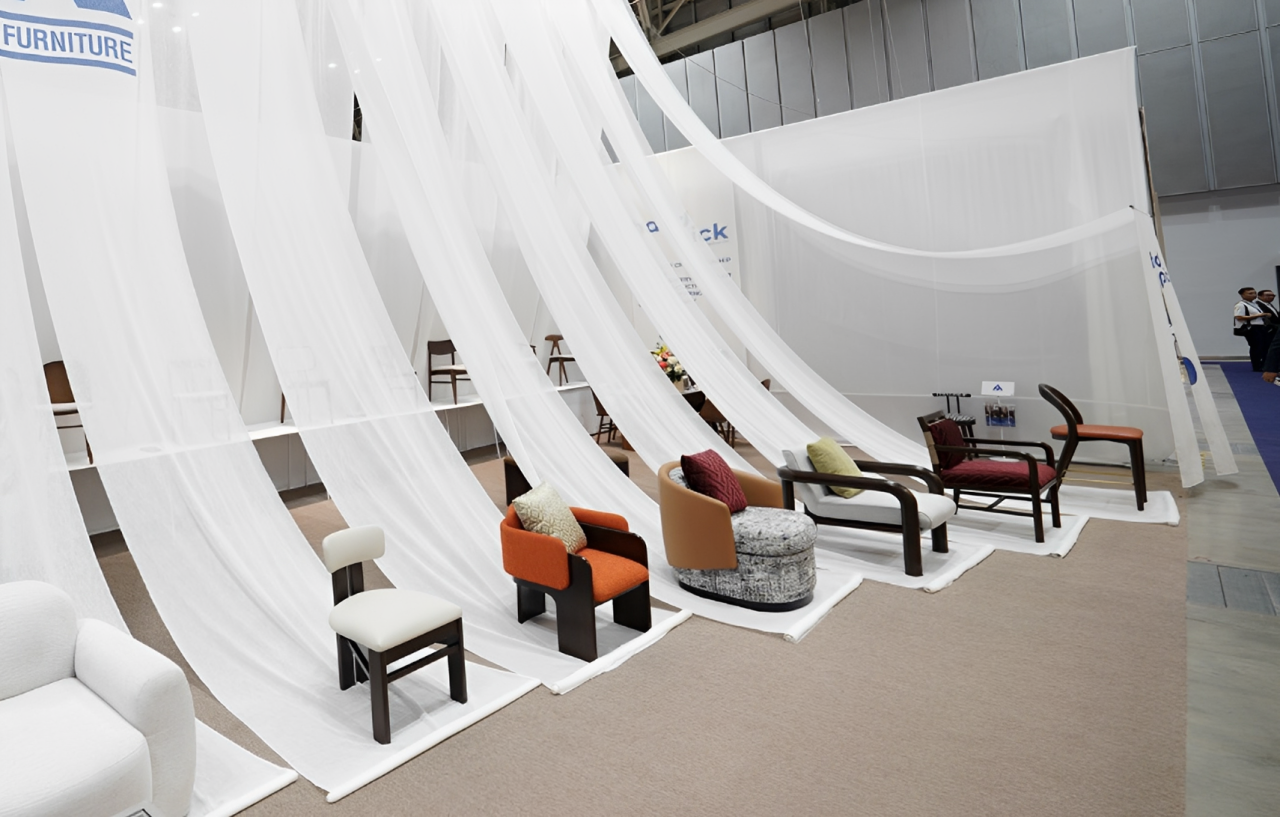 |
A display booth of a domestic wood furniture enterprise at HawaExpo 2026. *Photo: Hawa* |
The wood furniture industry still has many opportunities and adaptive strategies to implement, both to overcome immediate volatility and achieve sustainable development. Trang Dai, Senior Account Manager at Amazon Global Selling Vietnam, suggested a "value gap" that global customers are seeking.
This segment is termed "affordable luxury": high-quality, beautifully designed products at reasonable prices. Vietnamese businesses have an advantage in this area, thanks to domestic natural wood sources like acacia and rubberwood, enabling proactive production and cost control.
Concurrently, businesses need to transition to green practices to meet the "traceability" and "anti-deforestation" requirements of the EU and the US. This is also a task assigned to Hawa by Nguyen Van Duoc, Chairman of the Ho Chi Minh City People's Committee. "We must achieve the goal of 80% green products to transform challenges into competitive advantages", he stated.
Ho Chi Minh City currently accounts for half of the country's wood furniture exports. Duoc encouraged businesses to shift from pure processing to mastering design and technology, thereby increasing added value.
Furthermore, as global supply chains "tremble" due to conflicts, international linkages also need to be more effective. On 4/3, Hawa assumed the role of coordinating the ASEAN Furniture Industries Council (AFIC). Nguyen Quoc Khanh, the new AFIC Chairman, believes that global supply chains are undergoing restructuring.
According to him, it is necessary to increase intra-bloc connectivity and trade, making ASEAN a hub for the furniture supply chain. Initially, the Council proposed establishing the AFIC Green Initiative to promote regional cooperation on traceability, legal compliance, and supply chain transparency.
"When global buyers seek suppliers, ASEAN should not appear as individual markets. Instead, they need to see a complete ecosystem where countries complement rather than compete with each other", he said.
Vien Thong