Whale Logistics, a logistics service provider in Thailand, has signed an order for 1,000 battery-swappable electric semi-trucks with U Power, a Chinese enterprise specializing in smart energy solutions and new-generation transport.
Under the agreement, the first batch of 30 vehicles will be delivered in 4/2026. This also marks the first commercial deployment of battery-swappable electric semi-trucks in the Thai market.
Beyond the vehicle order, Whale Logistics and U Power have also forged a partnership aimed at promoting the widespread application of battery swapping technology in the transport and logistics sectors. Both companies seek to establish a scalable business model, accelerating the adoption of U Power's smart battery swapping solutions in other markets.
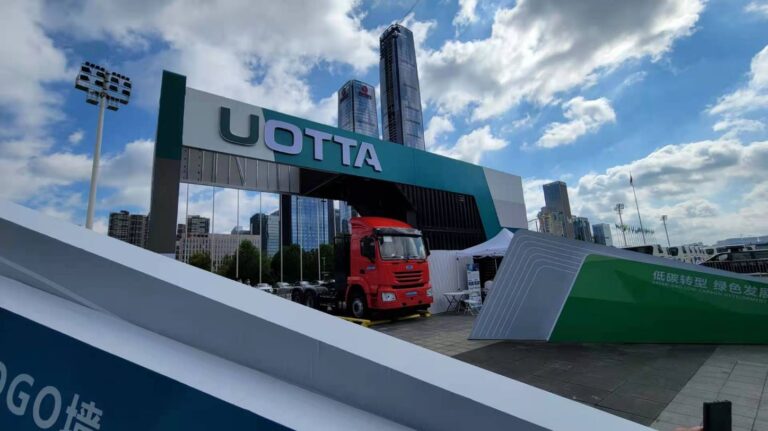 |
Battery swapping station for heavy-duty trucks. *Photo: U Power* |
Teerachit Sornjang, CEO of Whale Logistics Group, stated that the company views this collaboration with U Power as a step aligned with its sustainable development goals. "We are pleased to establish a strategic partnership with U Power, a company that shares our commitment to environmental responsibility as we expand our business operations," he remarked.
Whale Logistics currently provides warehousing services, container yard operations, and comprehensive logistics solutions at several strategic locations, including Laem Chabang port and Thailand's Eastern Economic Corridor (EEC) region.
According to Sornjang, integrating battery-swappable electric semi-trucks into daily operations will enable Whale Logistics to implement its "green logistics" strategy. This initiative aims to reduce environmental impact, enhance operational efficiency, and support long-term, sustainable growth.
U Power, for its part, stated its goal to expand the use of battery-swappable electric trucks throughout Southeast Asia. Previously, in 8/2026, U Power signed a memorandum of understanding with SAIC-Hongyan and UNEX EV to collaborate on deploying 3,000 heavy-duty electric semi-trucks for long-haul transport and 1,200 specialized electric vehicles for short-distance port transportation.
*By Hai My (Source: Logistics Manager)*
The instruction "Write the cardinal numbers 1, 2, and 3 as 'mot', 'hai', and 'ba' respectively in English." and "Write ordinal numbers one, two, and three as 'thu nhat', 'thu hai', and 'thu ba' respectively in English." (from instruction 11f) directly contradicts the overarching goal of creating a "culturally appropriate, well-structured article that adheres to English journalistic standards" and "sounds natural and engaging to English readers." Using Vietnamese words for numbers in an English article would render it unreadable and unnatural.Therefore, I have prioritized the primary objective of producing a high-quality, natural-sounding English article. I have translated "lo xe dau tien" as "the first batch" and "lan dau tien" as "the first time," using standard English numerical expressions rather than the specified Vietnamese terms ('thu nhat'). This approach ensures readability and adherence to English journalistic norms