The 2026 World Cup is expected to draw a wave of football fans to North America. This year's tournament begins on June 11 and runs until mid-July. It will be the largest World Cup to date, featuring 48 national teams and 104 matches hosted across the US, Canada, and Mexico.
For hotels, restaurants, airlines, ride-sharing applications, and local authorities, more teams and matches translate to an increase in tourists and spending. FIFA projects the event could contribute USD 17.2 billion to the US GDP.
Airbnb anticipates this will be its most successful event yet, surpassing the 2024 Summer Olympics. The company believes families and groups will favor renting entire homes or accommodations with lower average prices than hotels.
Other businesses also stand to benefit from the extended stays of visitors. Data from analytics firm Sojern indicates that over 75% of tourists plan to stay for 6-12 nights at their destination.
"I am optimistic when looking at summer booking trends. We are seeing strong demand in both host and non-host cities across the US," said Tony Capuano, CEO of Marriott International. He revealed that the World Cup could help Marriott's revenue per available room in the US increase by approximately 0.4%.
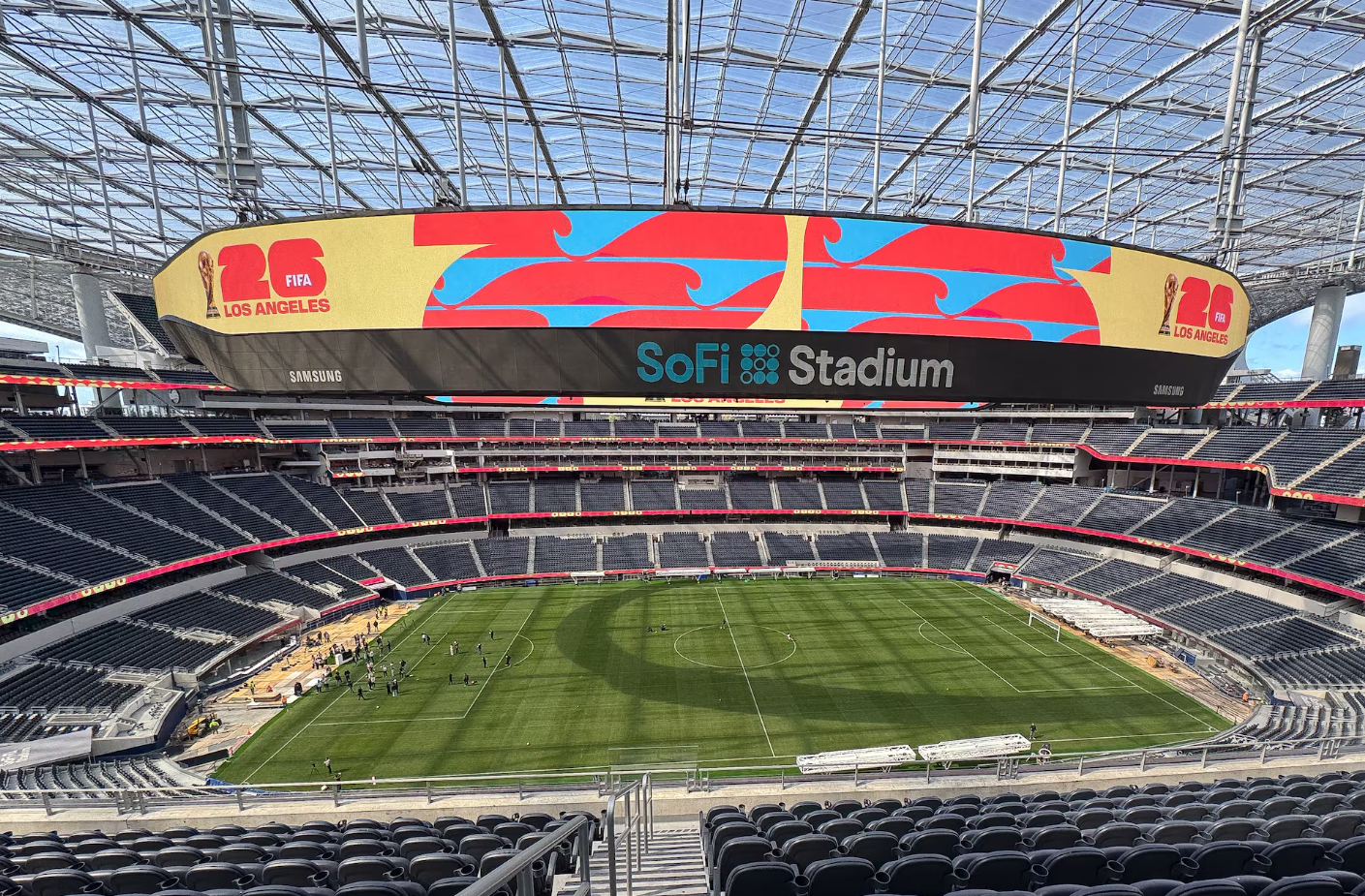 |
SoFi Stadium (California) is one of the venues that will host World Cup matches. Photo: Reuters
However, not all cities will benefit equally. "Demand is real and positive, but it is not evenly distributed among host cities," stated Jay Wardle, President of Sojern.
Sojern's flight booking data shows most host cities in the US and Canada have seen an increase in bookings compared to the previous year, with Houston and Dallas leading. Seattle and all three Mexican host cities, however, are lagging. Flight bookings to Seattle are nearly 21% lower than the same period last year.
Jim Allen, Chairman of Hard Rock International and CEO of Seminole Gaming, noted that South Florida has already begun to see World Cup-related growth. Over half of the tickets for matches in the Miami area were purchased by locals, with tourists accounting for the remainder. He attributes this demand partly to Miami's relationship with Central and South America, alongside the region's strong tourism infrastructure and football culture.
The World Cup has brought a significant number of high-end international guests to Hard Rock. The company is welcoming visitors from various continents, including some who are staying at their properties for the first time.
Analysts suggest that the increased number of participating teams in the World Cup means more tickets will be sold. High demand is still expected for prominent matches, games involving host nations, and the final. Conversely, less well-known group stage matches in large-capacity stadiums may be harder to fill, particularly with high ticket prices.
This situation creates pricing challenges. Fans will decide which matches are worth attending, how far they are willing to travel, whether to stay in a hotel or a short-term rental, and if current prices are reasonable.
Rosanna Maietta, President and CEO of the American Hotel and Lodging Association (AHLA), mentioned that hotel demand in host cities is "developing differently from initial expectations," partly due to fewer international visitors than projected.
An association survey in April indicated that 80% of hotel owners reported bookings not meeting expectations. Some expressed frustration after FIFA canceled a large number of rooms it had reserved. Nevertheless, demand has since increased, aligning with the trend of short-notice bookings for major events.
"Unlike regular tourism, many visitors are still finalizing plans and buying match tickets. We anticipate an acceleration in last-minute bookings closer to each match," Maietta said.
Ride-sharing companies such as Uber and Lyft are also likely to see increased demand around matches. Breweries are another sector poised for significant benefits. Jefferies Bank estimates the World Cup will boost global beer consumption by an additional 568 million liters during June and July.
Barclays also reported that in previous World Cups, beer consumption in host cities typically rose by 2.5-9.9%. During the 2014 World Cup in Brazil, beverage company AB InBev sold an additional 140 million liters of beer.
However, Deutsche Bank suggests that even if the tournament attracts 1.2 million international fans to North America, the overall economic impact on the US economy might be limited. If FIFA's estimate holds true, the US GDP would only receive a short-term boost of about 0.05%.
Pierfrancesco Mei, a strategist at Goldman Sachs, commented, "The impact of major sporting events is usually short-term and reverses in the months following the event's conclusion." Growth is primarily concentrated in the entertainment, hospitality, retail, and transportation sectors during the event. Meanwhile, the service industry will see earlier hiring to support operations.
Goldman Sachs estimates the World Cup will help the US economy create an additional 40,000 jobs in June, and about 10,000 to 15,000 jobs in July and August. Adjustments will occur gradually in subsequent months until temporary positions conclude.
The bank expects the US to welcome approximately 500,000-1 million additional international visitors in June and July. Consequently, the US GDP will receive a slight boost, mainly from consumption and service exports to foreign visitors. Q2 GDP is projected to increase by 0.1%, and Q3 by 0.05%. Retail sales for June are expected to rise by 0.3%, and for July by 0.1%.
Derek Evans, CEO of Marcus Samuelsson Group, also told CNBC that it is still too early to draw conclusions for the restaurant sector. "We haven't really seen the wave of fan frenzy yet. Only when their national team wins do they open their wallets more," he explained.
Ha Thu (according to CNBC, Reuters, Yahoo Finance)