In january, global gold prices set a record at 5,594 USD an ounce, then fluctuated, falling below 4,000 USD for the first time on 24/6. Overall, the precious metal lost over 20% in the first half of the year.
Last week, gold recorded its strongest price increase since the start of the year. Shares of companies trading this commodity also experienced their best five-session streak since 2008.
These sharp fluctuations mean the precious metal's profitability since the beginning of the year is almost zero. Despite ongoing risks, some investors are betting that the price chart will continue to rise. In fact, despite significant volatility this year, gold prices are still 1,000 USD higher than the same period last year.
Pippa Malmgren, a former member of the US National Economic Council, believes the factors attracting investors to gold remain unchanged. Many are concerned about uncontrolled US fiscal spending and weakening growth in other countries. "These developments mean inflation", Malmgren stated. She added that the US's pursuit of costly conflicts abroad and support for cryptocurrencies are unsettling many investors.
"They will turn to traditional stores of value, like gold", Malmgren said. Additionally, central banks globally are increasing their purchases of the precious metal. She suggests this further indicates declining confidence in fiat currency.
"Central banks have never stopped buying. The People's Bank of China (PBOC) added 19,9 tons in july—the highest since 10/2023 and its 21st consecutive month of purchases", said Patrick Kennedy, founder of AllSource Investment Management.
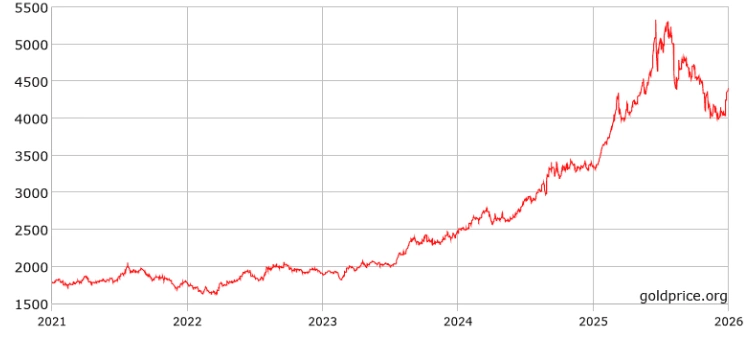 |
Global gold price movements over the past five years. Chart: Goldprice |
Investment billionaire John Paulson also expresses optimism. On CNBC, he stated that gold is only in the early stages of a long-term rally. This is due to declining confidence in paper money and uncontrolled public spending. Paulson has remained optimistic about precious metal prices since 2009.
While fear has always been a motive for buying gold, Joe Cavatoni, senior market strategist at the World Gold Council (WGC), suggests the recent recovery among US investors is more opportunistic. "The price recovery seems driven by changing expectations for interest rates and the economy, not just fear", Cavatoni explained.
Data indicates signs of weakness, especially in the labor market, prompting a quick reaction from investors. "When investors change interest rate expectations, gold reacts predictably as an asset particularly sensitive to macroeconomic factors", Cavatoni clarified.
After the US announced cooling july inflation on 12/8, expectations for a US Federal Reserve (Fed) interest rate hike declined. This increased gold's appeal, as the asset does not pay interest. The precious metal also benefits from a weakening USD.
"I believe we should not just view gold as a safe-haven asset. Many investors are seeing it as a wealth preservation and portfolio diversification tool amid continued growth and policy uncertainty", Cavatoni said.
Nick Cawley, an analyst at UK-based gold and silver company Solomon Global, noted that interest rate hike expectations had already fallen before the inflation report was released. "This suggests the market is more cautious about the US's ability to raise interest rates", Cawley observed.
Kennedy stated his firm believes the gold sell-off in the first half of the year was a buying opportunity, rather than a sign of prices peaking. "We bought and increased our holdings after prices hit a technical bottom last month", he said.
Technically, last week's price surpassing the 50-day moving average (MA) and breaking the sequence of lower highs supports the upward momentum. Cawley predicts short-term corrections will occur and present buying opportunities.
Cavatoni also forecasts significant gold price volatility in the near future. The upcoming Fed meeting and other macroeconomic policies will help determine if the current rally can be sustained.
New Fed Chairman Kevin Warsh is also a crucial factor. Warsh's "cautious and ambiguous" statements led to a sharp decline in stock markets, but gold began to rise.
When markets are uncertain about Fed policy, money shifts from stocks to safer assets like gold and other metals.
Kennedy agrees that Fed policy uncertainty could be positive for gold. "The Fed chairman is signaling maintaining high interest rates for longer, even as the labor market is weakening. Gold typically performs well when markets begin to doubt whether the Fed can achieve its dual mandate of inflation and employment", he commented.
Kennedy assesses that gold has more than doubled since late 2023, making a correction necessary. However, he believes the underlying drivers supporting prices remain in the long term. "Brent crude is near 90 USD a barrel, the Strait of Hormuz remains closed, and Iran continues to set conditions for its reopening. This situation means inflation risks persist, even with july's cooling data", he added.
Eugenia Mykuliak, founder and CEO of the B2Prime Group trading platform, also believes inflation will continue to be a major influencing factor. If the market still leans towards moderately rising prices, gold will still have room to rise. "Prices could even surpass the january peak", she added.
In the physical market, buying activity in China and India, the world's two centers for physical gold demand, will continue to support prices. Looking at this year's chart, "prices are relatively low and have potential for further increases", Mykuliak concluded.