Tran Van Minh, owner of a household appliance and electronics store in Ha Dong, Hanoi, reported that in 2025, his revenue reached approximately 6 billion dong, averaging over 500 million dong per month. His store employs 5 regular workers and operates under a lump-sum tax household business model.
With the lump-sum tax mechanism ending in 2026, Minh is considering converting his household business into an enterprise. He explained that increasing revenue, greater demand for invoices from partners, and online transactions primarily conducted via bank transfers have made managing accounting records increasingly complex.
Minh noted that if he continues as a declared household business, his establishment must still fulfill all tax obligations and meet strict documentation requirements. In contrast, converting to a micro-enterprise allows him to account for expenses, sign long-term contracts, access credit, and benefit from enterprise income tax exemptions in the initial years.
"My biggest concern is management capacity, accounting, and human resources. However, without this transformation, the store will struggle to expand and participate deeply in modern retail channels," he stated.
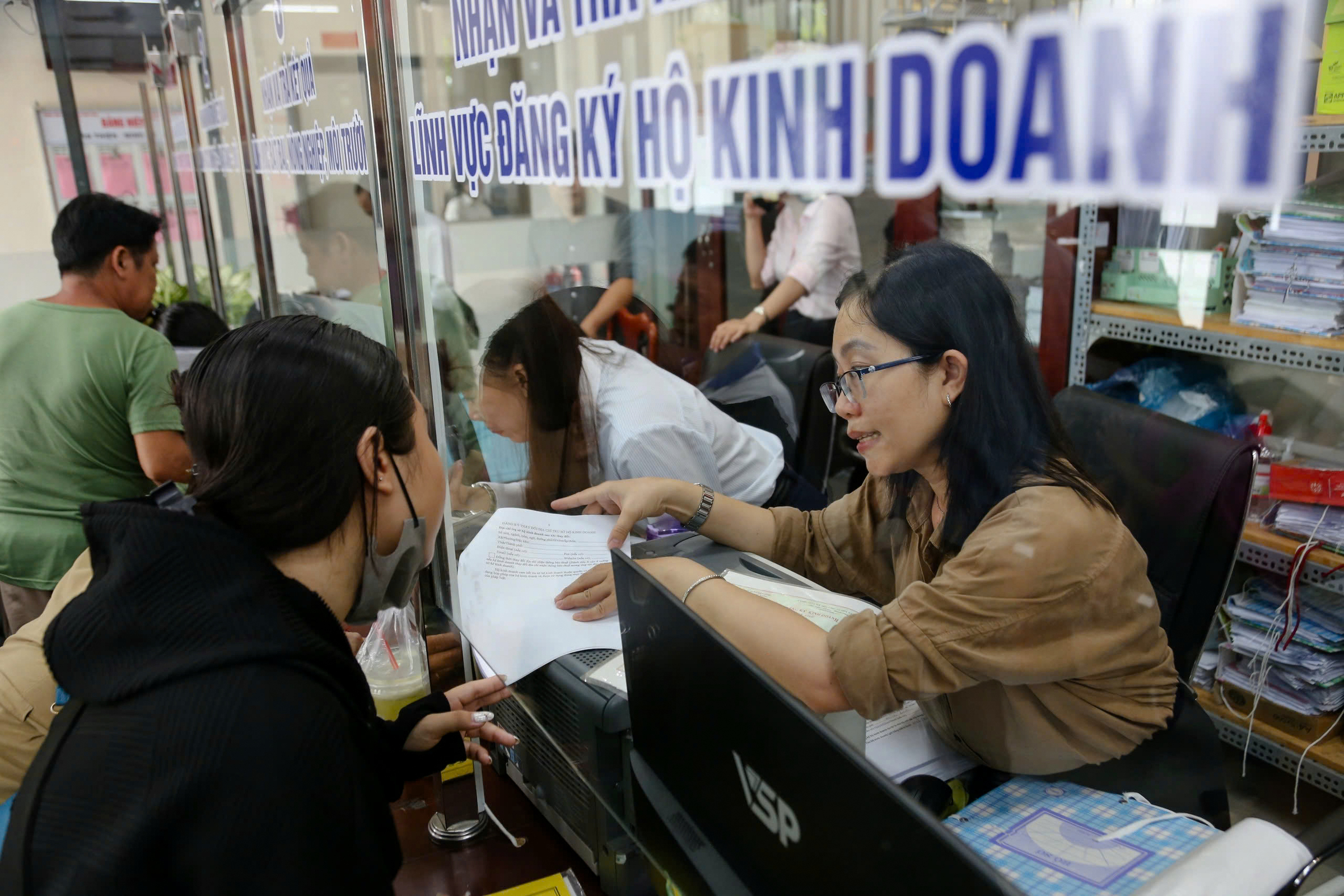 |
People register household businesses at a public administration center. Photo: Dinh Van |
Minh is not alone; many high-revenue business households face the dilemma: continue with the old model or "upgrade" to an enterprise.
According to Nguyen Quang Huy, CEO of the Faculty of Finance and Banking at Nguyen Trai University, with invoices and documents becoming standard from this year, the micro-enterprise or one-member limited liability company model offers distinct advantages.
"They will easily expand their scale, access capital, conveniently sign contracts, and participate more deeply in mainstream supply chains," Huy said, predicting a strong wave of conversions to enterprises, especially among household businesses with annual revenues exceeding 3 billion dong.
According to data from the Ministry of Finance, by the end of 2025, the country had 3 to 4 million business households, with over 2 million filing taxes consistently. However, revenue from this sector accounted for less than 2% of the total state budget. Their primary limitation is fragmented scale and a lack of standardized management and data.
Comparing the rights and tax obligations of enterprises and household businesses with annual revenues over 3 billion dong:
| Criteria | Enterprise | Business Household |
| Legal entity status | Yes | No |
| Accounting records | Yes | Yes |
| E-invoices | Mandatory | Mandatory |
| Tax declaration | Monthly/Quarterly | Monthly/Quarterly |
| VAT | Deductible or direct | Direct: Revenue × industry VAT rate |
| Personal income tax | 17% tax rate × profit | (Revenue - expenses) × 17% |
| Financial reports | Mandatory | No |
| Legal liability | Limited | Unlimited |
At a seminar in late 2025, Lawyer Truong Thanh Duc, Director of ANVI Law Company, described the conversion of business households to enterprises as a "wise calculation." He explained that the company model allows owners to bear limited liability. For instance, when an enterprise declares bankruptcy, debt liability ceases. Conversely, a household business owner bears unlimited liability, facing the risk of losing all assets and potentially carrying debt until "forgiven by creditors."
Additionally, Duc noted that under new regulations, large-scale business households must now maintain complex accounting records and tax declarations similar to enterprises. Therefore, conversion is necessary for transparency and risk reduction.
To support this group in "growing up," Nguyen Quang Huy suggested that management agencies should provide simple accounting and tax declaration software tools, and train them in cash flow management to reduce compliance burdens. The expert also emphasized that business households need digital skills training and assistance in utilizing e-commerce channels to expand their markets and increase competitiveness.
"When they adopt a modern entrepreneurial mindset, the transition from a household business to an enterprise is not an obstacle but an opportunity for expansion," he affirmed.
The CEO of the Faculty of Finance and Banking at Nguyen Trai University also believes that industry associations, localities, and large enterprises play a vital role in building an ecosystem to support the business household community. Access to standardized, well-priced goods with proper documentation enables them to operate more stably and sustainably.
From a management perspective, policymakers have implemented several solutions to encourage business households to "grow." Late last year, the amended Enterprise Income Tax Law, passed by the National Assembly in late 2025, grants a two-year tax exemption for new enterprises established from household or individual businesses. This policy helps business households alleviate financial pressure during the initial conversion phase, creating room for scaling up.
According to the Tax Department (Ministry of Finance), last year over 3,200 business households converted to the enterprise model. The agency affirmed that tax policies are designed to create a fair, transparent business environment, encouraging the individual economic sector to develop more professionally.
Phuong Dung