According to the Customs Department, Vietnam’s total macadamia export turnover in the first seven months reached nearly 34 million USD. Fresh macadamia nut exports amounted to nearly 18 million USD, a decrease of 11.2%, while processed macadamia products saw a significant increase of 346%, reaching nearly 16 million USD.
This shift in export structure, with fresh nuts declining and processed products surging, indicates an expansion in macadamia processing activities. This growth in processing creates a greater demand for a stable and consistent supply of raw materials.
A notable point is that Vietnam now boasts over 46,000 hectares of macadamia cultivation, a substantial area. However, the planted area does not immediately translate into a corresponding volume of nuts ready for market.
Macadamia is a perennial crop, meaning an increase in cultivation area does not result in an immediate rise in yield. The Vietnam Academy of Forest Sciences states that grafted macadamia trees can bear fruit from the third year, but require more time to reach high productivity and continue increasing yield in subsequent years.
The disparity between cultivation area and actual yield is evident. According to agricultural sector data, despite having over 46,000 hectares nationwide, the estimated fresh macadamia nut output for 2025 is only over 20,000 tons. In 2024, Vietnam still needs to import approximately 3,500-4,000 tons of raw macadamia nuts for domestic processing and consumption.
Lam Dong province provides a clear illustration of this gap. The provincial Department of Agriculture and Environment reports that Lam Dong has about 16,000 hectares of macadamia, but only approximately 6,600 hectares are currently in commercial production. The province’s output for 2025 is projected to reach about 13,700 tons, nearly 50% higher than the previous year.
Consequently, domestic supply depends not only on the total cultivation area but also on factors such as tree age, yield, nut quality, and the ability to aggregate raw materials. For processing factories, these elements are crucial in determining their purchasing capacity and maintaining a stable raw material supply.
Meanwhile, the demand for processed macadamia products is rapidly increasing. A nut processing enterprise in TP HCM noted that as processed macadamia products expand, the enterprise requires a more stable supply of raw materials in both quantity and quality. Domestic sources, however, cannot always meet these requirements. This gap explains why imports continue to rise despite the expanding domestic cultivation areas.
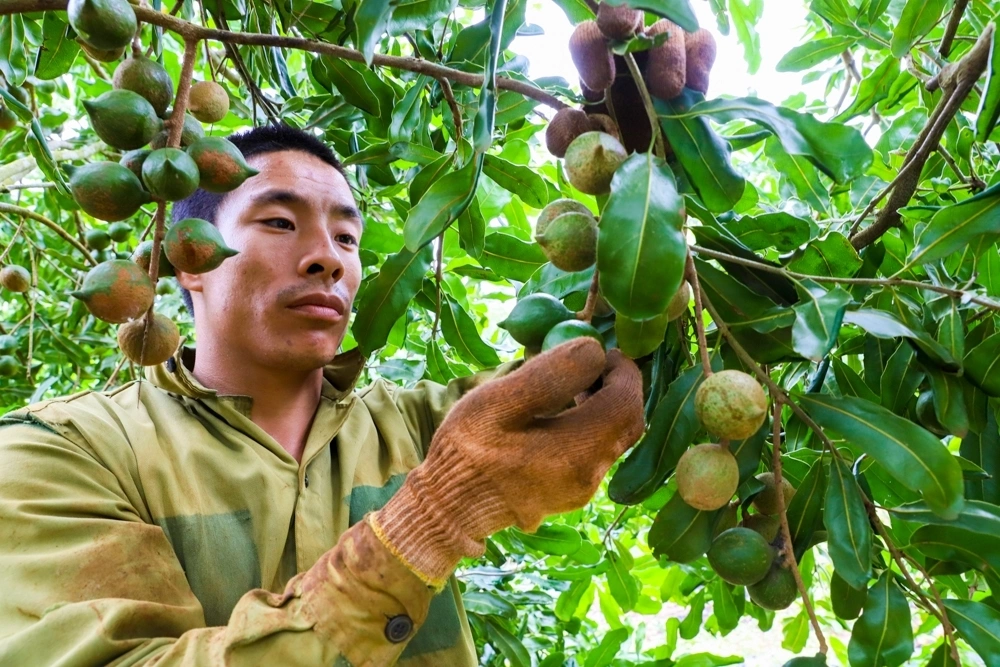 |
Harvesting macadamia nuts in Dak Lak. *Photo: Dak Lak Newspaper* |
Beyond the domestic market, global macadamia demand is also expanding, creating further potential for Vietnam’s processing industry. According to Dang Phuc Nguyen, General Secretary of the Vietnam Fruit and Vegetable Association, the global market is projected to need approximately 220,000 tons of macadamia kernels by 2030, equivalent to 850,000 tons of fresh nuts. Consumers are increasingly interested in nutrient-rich nuts, and macadamia can also be developed into various products such as dried kernels, milk, and oil.
Given this global potential, Nguyen believes Vietnam can participate more deeply in the macadamia value chain. This requires improving the quality of raw material areas, developing processed products, and meeting the standards of demanding markets like the US, Japan, South Korea, and the EU.
From an industry perspective, the Vietnam Macadamia Association aims to increase macadamia cultivation area to 130,000-150,000 hectares by 2030, and export over 100 million USD worth of macadamia products. The association also plans to enhance guidance for farmers in developing macadamia trees, particularly in highland, border, and sparsely populated regions, thereby contributing to creating livelihoods and reducing poverty.
Thi Ha