QS, a global higher education analyst, released its 2026 world university rankings on March 25, covering five broad subject areas, including overall and 55 specific disciplines.
Overall, Australian institutions secured nearly 930 positions across 37 subjects. Over 350 of these improved their standing from the previous year, positioning Australia as third globally for this indicator, trailing only the US and the UK.
When considering representation within the global top 100, Australian universities lead worldwide with 46%, surpassing the US (40%), the UK (42%), and Canada (34%), according to The Koala News.
Notably, there has been significant progress in science, technology, engineering, and mathematics (STEM). This year, 13 Australian universities are ranked among the world's top 100 for data science and artificial intelligence programs, nearly doubling last year's figure of 7. Additionally, four institutions placed in the top 10 of the overall engineering and technology subject rankings, as reported by The Sydney Morning Herald.
Doctor Kylie Walker, Chief Executive Officer of the Australian Academy of Technology and Engineering, stated that these results are a positive sign. However, she urged the government and businesses to increase investment in STEM to ensure a stable national economy and security in the future.
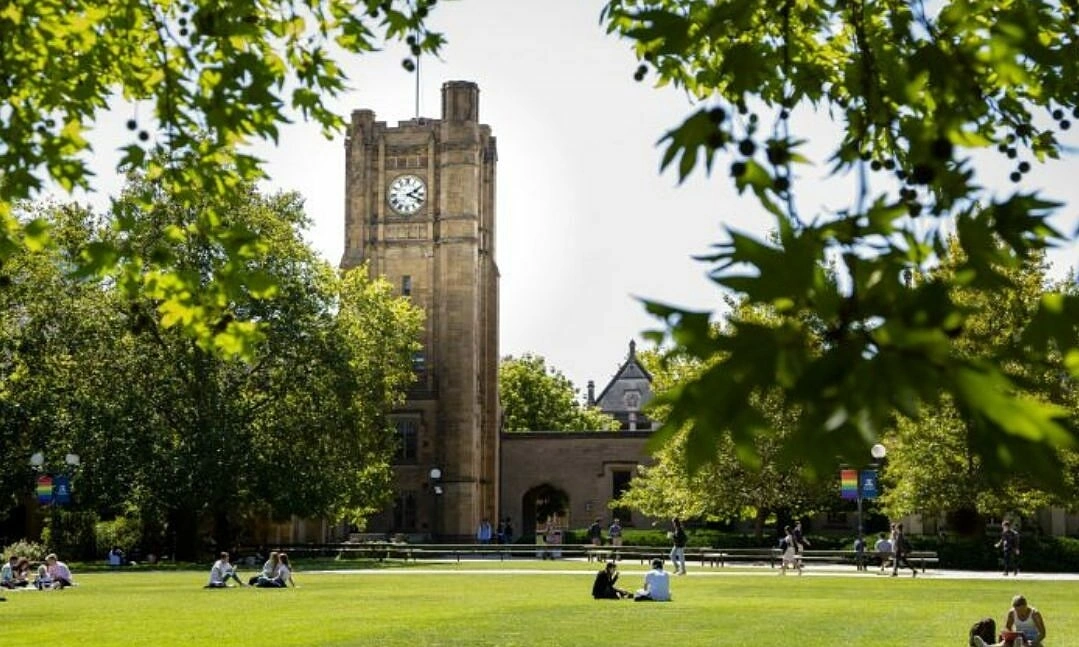 |
A corner of the University of Melbourne campus. Photo: The University of Melbourne Fanpage |
On an institutional level, the University of Melbourne — ranked first in Australia by both QS and THE — entered the world's top 20 in three broad subject rankings: life sciences and medicine (top 14), social sciences and management (top 19), and arts and humanities. The university also placed in the top 50 in the remaining two fields.
Meanwhile, the University of Sydney improved its standing across all five major fields, notably in engineering and technology (rising 14 places to 46th globally). Griffith University climbed 54 positions in social sciences and management to enter the top 200. Macquarie University appeared in the top 50 three times, an increase of two from last year.
Jessica Turner, Chief Executive Officer of QS, commented that the ranking results demonstrate Australian universities' academic strength and consistent global importance, even amidst significant policy changes within the country.
She recommended that Australia maintain clear and stable policies to safeguard its global standing and attractiveness, especially as international student trends shift and regional competitors develop rapidly.
Australia is a prominent global study abroad destination, alongside the US, the UK, and Canada. As of 12/2025, nearly 850,000 international students were enrolled in the country, including approximately 36,000 Vietnamese students, making them the 4th largest cohort, according to the Australian Department of Education website.
Over the past two years, Australia has consistently revised its visa regulations and policies for international students to manage immigration levels. Numerous measures have been implemented, such as reducing post-study work visa durations from 4-6 years to 2-3 years, increasing English language proficiency requirements, raising financial proof thresholds, and increasing study visa application fees. Consequently, the intake of new international students by late 2025 decreased by 15% compared to the same period the previous year.
Khanh Linh (Compiled)