Hong Wang, 35, is one of the most captivating names in mathematics ahead of this year's Fields Medal. She is an associate professor at the Courant Institute, New York University, US.
Wang's primary research focuses on harmonic analysis and geometric measure theory, fields known for their challenging and abstract problems.
Wang gained widespread recognition in 2025 when, with her collaborator Joshua Zahl, she solved the Kakeya conjecture in three dimensions—a problem that has challenged mathematicians for the past 100 years.
According to experts, Wang's achievement marks a significant milestone with far-reaching implications for mathematical research. Her work could impact applications in computer science and cryptography, including image generation, data processing, and wireless communication.
Born in Guangxi, Trung Quoc, Hong Wang was considered a prodigy, scoring 653 out of 750 points on her university entrance exam at just 16 years old. She was admitted to Peking University's Department of Earth Sciences before transferring to the Department of Mathematics.
Wang earned her master's degrees from Paris Sud University and Ecole Polytechnique (France), and her doctorate from the Massachusetts Institute of Technology (MIT), before joining the faculty at New York University. She currently serves as a professor at the Courant Institute and the French Institute of Advanced Scientific Studies (IHES).
Wang has received numerous major awards in mathematics, including the Breakthrough Prize, Clay Research Award, Maryam Mirzakhani New Frontiers Prize, Salem Prize, Ostrowski Prize, and the Gold Medal of the International Congress of Chinese Mathematicians.
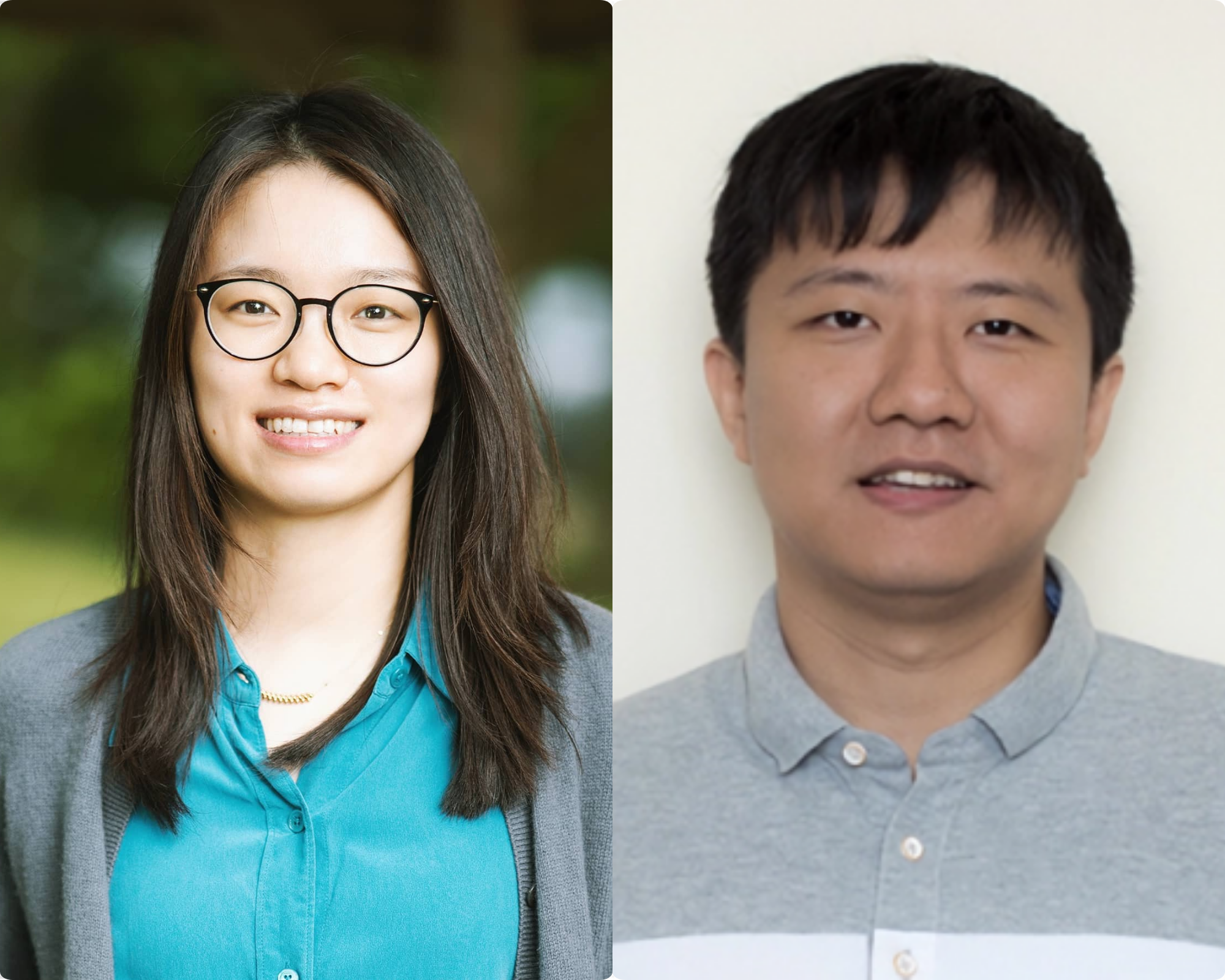 |
Hong Wang and Yu Deng. Photo: ICCM 2025, Baike
Yu Deng, a professor of mathematics at the University of Chicago (US), is also emerging as a strong candidate. His research areas include nonlinear wave and dispersion equations, fluid dynamics, harmonic analysis, probability theory for partial differential equations, and statistical physics.
In 2025, he and his collaborators published work that addresses a 125-year-long challenge concerning the mathematically precise formulation of fundamental laws of physics. This was the 6th of the 23 famous problems presented by David Hilbert at the International Congress of Mathematicians in 1900.
Experts say that Deng's work with his collaborators not only overcame a 50-year barrier in mathematics and created a complete bridge for theoretical physics, but also pioneered an entirely new methodology: molecular decomposition.
Yu Deng grew up in Shenzhen, Trung Quoc. From a young age, he excelled in national mathematics competitions. In 2006, Deng won a gold medal at the International Mathematical Olympiad, ranking 6th among nearly 500 candidates, which earned him direct admission to Peking University's Department of Mathematics. He spent two years there before transferring to the Massachusetts Institute of Technology (MIT) in 2009.
He received his doctorate from Princeton University, beginning his teaching career at the University of Southern California before moving to Chicago.
Deng jointly received the Clay Research Award with Hong Wang this April. Previously, Yu Deng was honored with prestigious awards such as the Oberwolfach Prize, the MCA Prize of the American Mathematical Society, and the Gold Medal of the International Congress of Chinese Mathematicians.
The Fields Medal, often called the "Mathematics' Nobel", is awarded every four years to a maximum of four mathematicians under 40 years old. The selection committee is appointed by the Executive Committee of the International Mathematical Union (IMU). Recipients receive a 14-carat gold medal engraved with Archimedes' image and a prize of CAD 15,000 (approximately VND 270 million).
This year's awards ceremony will take place during the opening session of the International Congress of Mathematicians (ICM) on 23/7 in Philadelphia, US.
If awarded, they would follow in the footsteps of Shing Tung Yau and Terence Tao, two Chinese-origin mathematicians who have previously received the Fields Medal. A notable distinction is that Wang studied and graduated from a university in mainland China.
Khanh Linh (compiled)