The product introduces a new approach to research activities, integrating artificial intelligence (AI). AgenTex v1.0 operates on a multi-agent AI architecture, aiming to build a comprehensive research assistant platform that helps scientists improve the quality of international publications and fosters innovation in academia.
A survey of research and training institutions in Central Vietnam identified five common bottlenecks hindering scientific research and publication: non-compliance with IMRaD academic standards, lack of pre-submission peer review, difficulties with LaTeX formatting, literature review times ranging from two to five days, and fragmented research tools. According to 2023 Overleaf data, 67% of researchers spend over 20% of their time on formatting tasks.
Addressing these issues, Duy Tan University developed AgenTex as a technical solution, positioning the system as a virtual research assistant to help scientists optimize the technical stages of the research process.
AgenTex v1.0 is built on a multi-agent AI architecture comprising five system layers and nine specialized AI agents, operating on a unified web interface. The system uses React for the interface layer, allowing users to monitor research progress in real-time. The service layer integrates FastAPI, Redis, and Celery to coordinate tasks such as document search, draft creation, peer review, and LaTeX compilation. According to the development team, this design maintains interface responsiveness while efficiently handling complex backend research processes.
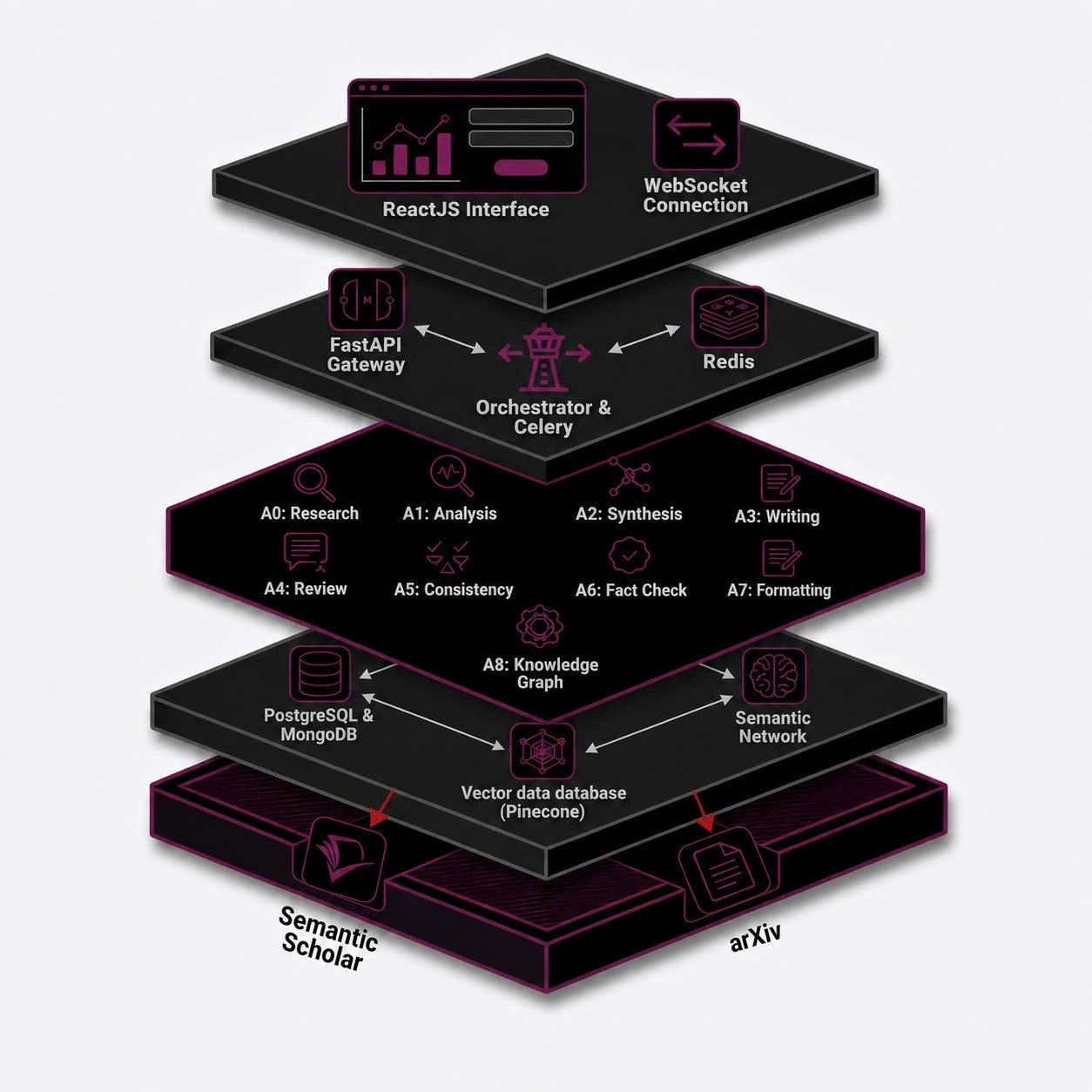 |
The five system layers and ecosystem of nine specialized AI agents in AgenTex v1.0. *Photo: Duy Tan University* |
The core of AgenTex lies in its ecosystem of nine AI agents coordinated by a "state machine" model. Instead of relying on a single language model, the system divides the research process into specialized roles: idea generation, document search and evaluation, manuscript drafting, academic peer review, and LaTeX-standard publishing.
"Through a transparent and precise process, the system helps faculty and students transform ideas into high-quality research works," stated Phan Vu Minh Tue, AgenTex project author.
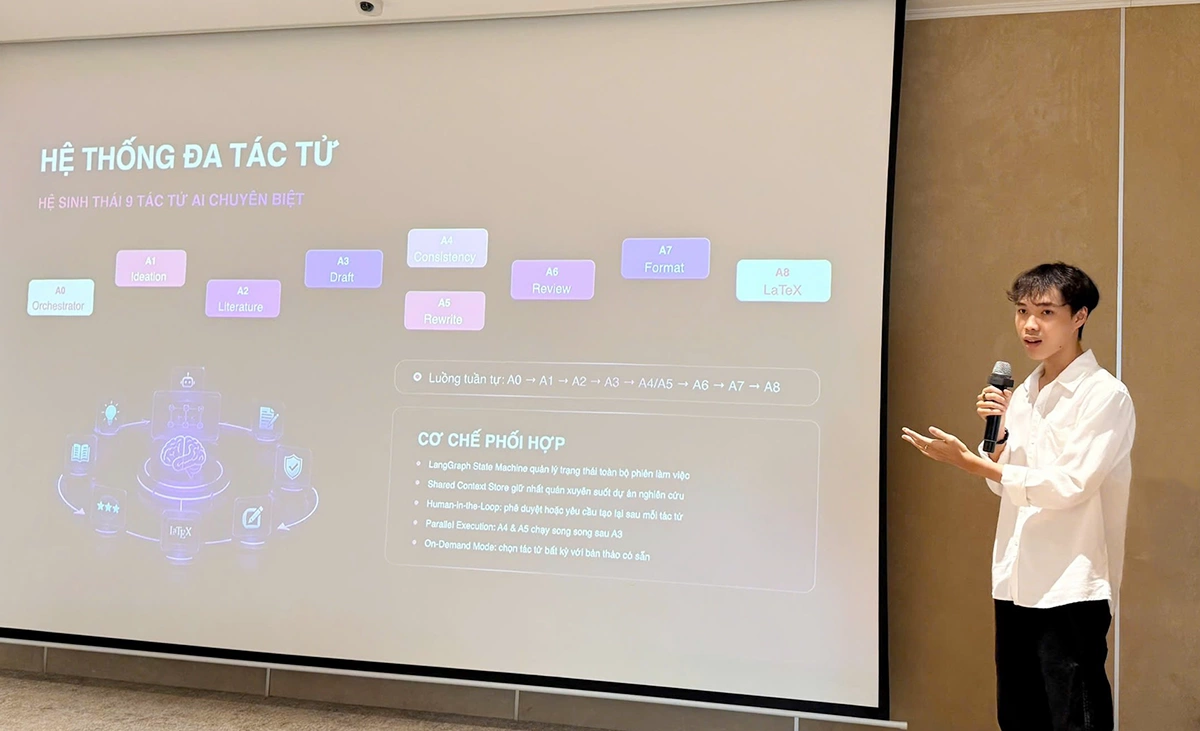 |
Phan Vu Minh Tue, AgenTex author from Duy Tan University, introduces the multi-agent AI application. *Photo: Duy Tan University* |
AgenTex v1.0 features three core groups of functionalities: drafting, reviewing, and formatting. The drafting feature allows simultaneous searching of ArXiv, Semantic Scholar, OpenAlex, and Tavily to build IMRaD outlines, generate cited abstract drafts, and export LaTeX code. The system estimates it needs about 10-15 minutes to process 15 to 20 reference documents.
The reviewing feature simulates the peer review process, checking arguments, data, suitability for specific journal requirements, and research ethics standards. Meanwhile, the formatting feature supports direct LaTeX compilation in the browser, compatible with templates from IEEE, Elsevier, Springer, and ACM. It also allows data export in PDF, TEX, or ZIP formats.
The system can simultaneously search data from ArXiv, Semantic Scholar, OpenAlex, and Tavily. It supports building research outlines following the IMRaD structure, performs academic peer review simulating the peer review process, and standardizes papers according to IEEE, Elsevier, Springer, or ACM standards. According to the research team, standardizing papers according to journal requirements ensures academic rigor and manuscript professionalism from the initial stages. This reduces technical revision time, minimizes formal errors, and improves adherence to international publication standards.
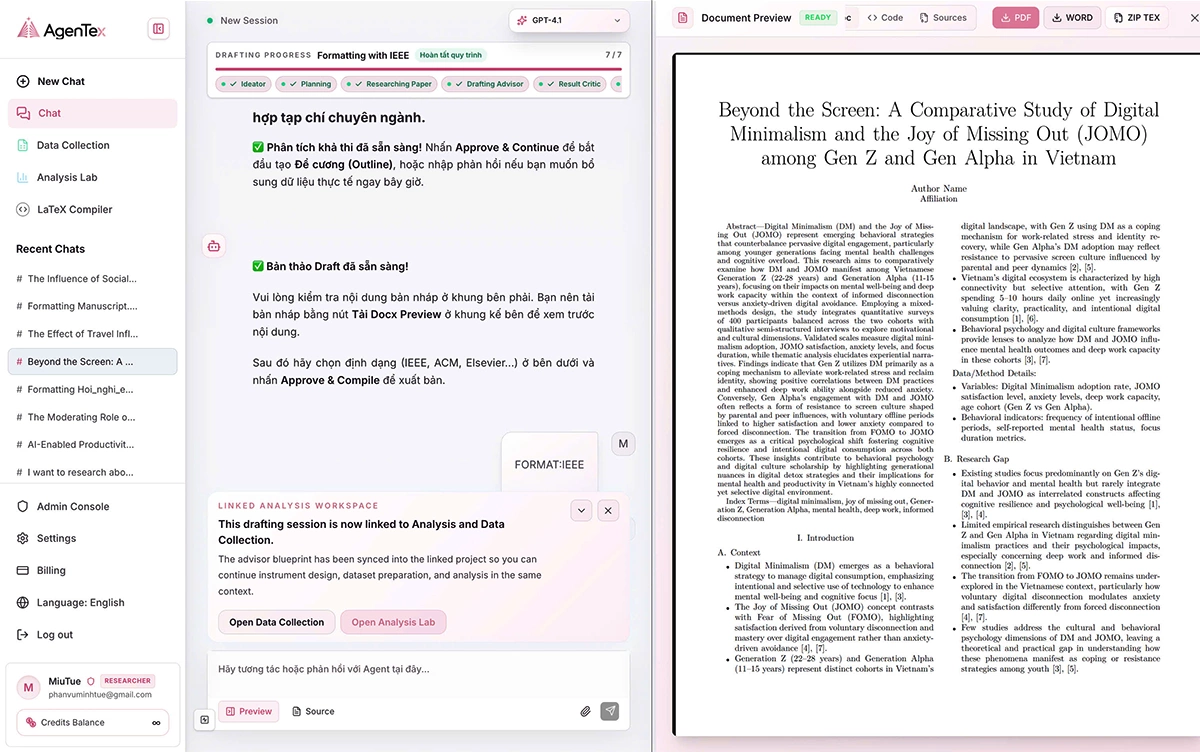 |
The AgenTex v1.0 interface from Duy Tan University. *Photo: Screenshot* |
Dr. Truong Tien Vu, Head of the Science and Technology Department at Duy Tan University, noted that AgenTex embodies many core principles of "The AI Scientist" model proposed in Nature magazine in March. The system is designed with an end-to-end approach, optimizing the research process from idea generation, literature search and synthesis, experimental design, and data analysis to manuscript compilation according to international LaTeX standards.
He highlighted AgenTex's "human-in-the-loop" mechanism as a key feature, allowing scientists to directly coordinate and validate results at each stage to control and mitigate risks from "AI hallucination."
Dr. Truong Tien Vu observed that combining multi-agent AI automation with human control enhances research efficiency while ensuring academic ethical principles. The current AgenTex v1.0 version is suitable for exploratory research. In the future, the system will be upgraded to meet more complex requirements in research and development (R&D) activities and specialized fields.
Following the AgenTex v1.0 pilot launch, the research team plans to expand the system in giai doan 2026-2027 by integrating multimodal AI, developing multi-author collaboration spaces, and building a cloud service model for scientific research for various universities. With its vision of becoming an "AI University" in the near future, Duy Tan University is gradually developing a technology ecosystem that integrates AI into all activities: administration, training, learning, research, and entrepreneurship.
Attending the launch event, Tran Nam Tu, Deputy Director of the Department of Science, Technology, and Information, Ministry of Education and Training, emphasized the importance of developing AI products in education, especially in the context of building a smart education platform with controlled AI applications. He noted that the AI products implemented by Duy Tan University contribute to forming a shared platform, serving application needs in training, research, and administration.
"Duy Tan University needs to further develop and elevate AgenTex to increase the software's value when it is widely applied in society," he added.
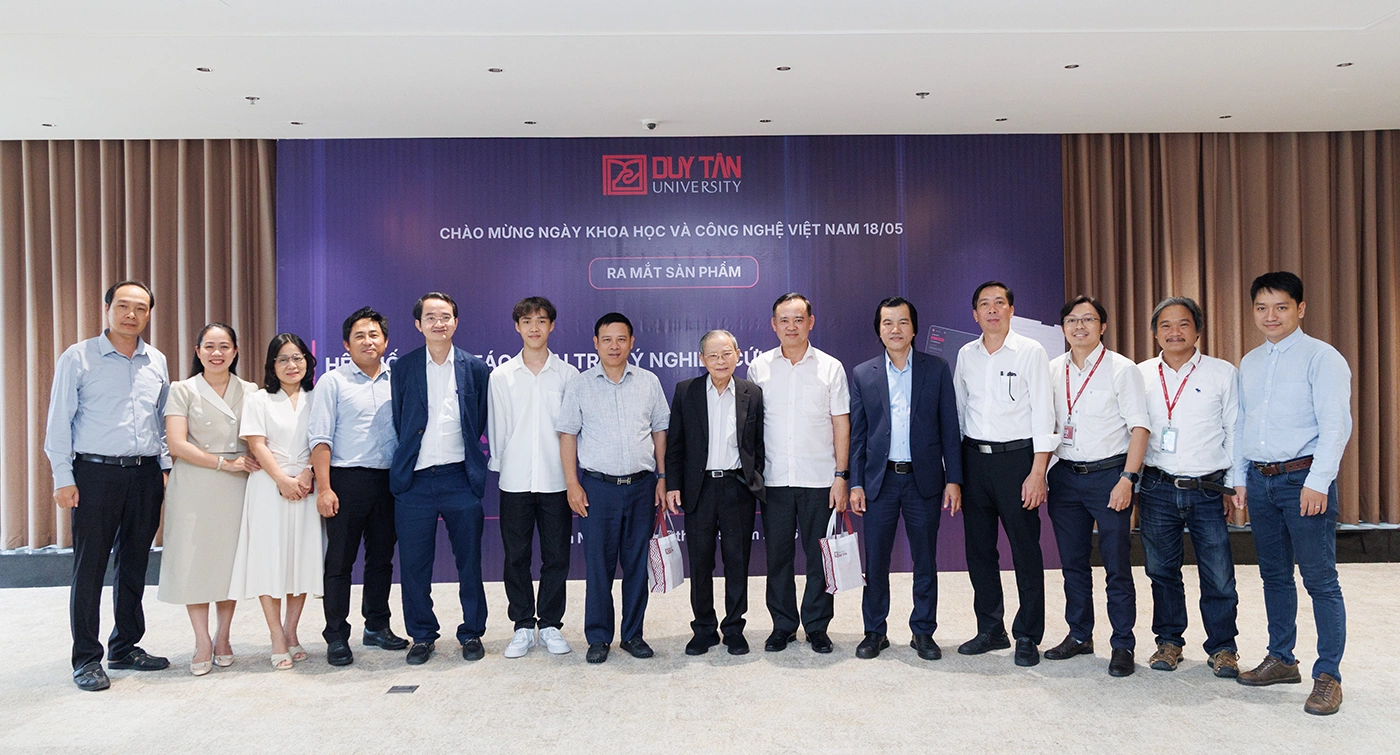 |
Leaders from the Ministry of Education and Training, Duy Tan University, and the AgenTex research team at the launch event. *Photo: Duy Tan University* |
The university currently leverages an academic data system of approximately 700 TB, encompassing about 350 million scientific articles and works worldwide, and actively deploys open-source AI models on its AI server system. According to the university, this is a crucial foundation for developing AI capabilities in searching, retrieving, classifying, drafting, and supporting research based on big data.
Dr. Le Nguyen Bao, Director of Duy Tan University, shared that in the coming period, the university aims to add data on Vietnamese scientific topics, theses, patents, and official journalism to AgenTex. This will allow the system to not only access international knowledge but also gain a deeper understanding of domestic research and development activities.
"If all conditions regarding data copyright, information security, infrastructure, and operating mechanisms are met, the system could be widely shared, providing free support to the domestic research community," he affirmed.
In addition to AgenTex, Duy Tan University's research groups and service units plan to launch 10 to 15 more AI products within the next one to two years, aiming to complete the AI ecosystem supporting the "AI University" model.
"Our vision is to build a complete AI ecosystem for a true AI University model," said Dr. Le Nguyen Bao.
Nhat Le
DTU Artificial Intelligence, Duy Tan University Da Nang,