Professor Vu Ha Van of the University of Hong Kong, also the director of the VinIF Innovation Foundation, shared insights on teaching and learning mathematics in the technology era at a conference organized by Vietnam National University, TP HCM on 13/4. His remarks highlighted a critical issue in global math education: students often prioritize passing exams over understanding practical applications.
He began by recounting a dental visit in the US. Upon learning he was a mathematics professor, the dentist questioned, "What's the point of studying mathematics? It has sine and cosine, but I've never encountered them in my work", he said. Similarly, Professor Van has heard many complaints about studying integrals and derivatives without seeing their application in daily life, reflecting a common disconnect between academic learning and real-world utility.
However, few ask what specific content is necessary to learn in this subject. Professor Van views this as a shortcoming because mathematics is a broad field with many smaller specializations, similar to sports. Everyone knows playing sports benefits health, boosts morale, and increases longevity, but it is important to choose the most suitable and beneficial sport. "If you live in a fishing village, it is clear you should learn to swim to serve your work and life", he illustrated.
According to Professor Van, the importance of mathematics has been affirmed in the global development of science and technology. It is a foundational subject for many natural sciences, technology, and engineering fields. Mathematics also forms the basis for developing high-quality human resources – a key factor for Vietnam to keep pace with global technological trends.
Prominent tech leaders echo this sentiment. He cited figures such as Elon Musk (CEO of Tesla), Jensen Huang (CEO of NVIDIA), and Pavel Durov (CEO of Telegram), all of whom advise students to prioritize mathematics. Jensen Huang once stated that in the AI era, students should focus more on mathematics and physics rather than programming. This is because AI will eventually program well, and humans must understand science.
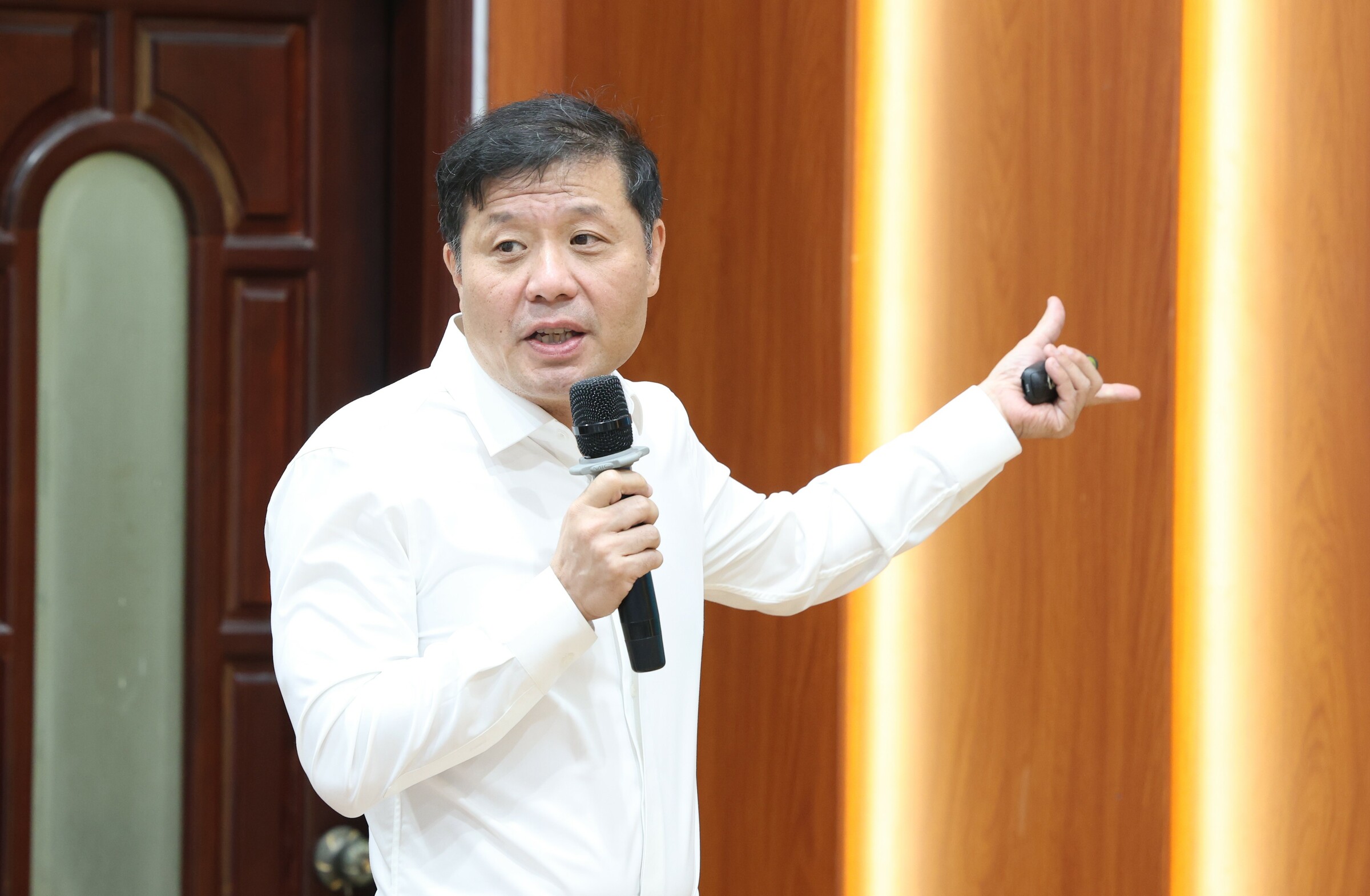 |
Professor Vu Ha Van shares insights on teaching and learning mathematics at the conference on 13/4. Photo: Khac Hieu |
Professor Van believes that mathematics is not just a collection of theories and formulas, but, more importantly, it teaches learners how to think and understand how the world operates. Drawing on nearly 30 years of experience working and collaborating at leading institutions like Princeton University, the University of California, Rutgers University, and Yale University, he contends that this represents a weakness in the teaching and learning of mathematics globally, not just in Vietnam. "Most students still learn mathematics to pass exams, to get by. Even in US universities, the majority of students approach mathematics with this mindset", he stated.
This inadequacy stems from fragmented curricula, outdated textbooks, and teaching methods that heavily emphasize theoretical transmission. Current mathematics programs in high schools and universities often include unnecessary content that does not align with the practical demands of technology and industry. "There are some theories that take students several months to understand and master. But frankly, if you are not working for NASA, we will probably never use them", he said. "Conversely, in daily life, there are needs related to basic mathematics, such as financial investment, where understanding variance theory is crucial, yet most people are vague about it."
This paradox also appears in professions requiring advanced mathematics. He recounted the selection process for VinIF's AI engineer program. Most students specializing in mathematics-related fields, graduating from prestigious universities like Bach Khoa University or the University of Natural Sciences, had very high mathematics GPAs but still needed about 4 months of initial training to relearn some foundational subjects.
Highlighting that human resources in mathematics will be a cornerstone for the nation to achieve its development goals in the new era, Professor Van stressed the urgent need for curriculum and teaching method reform. "Not only Vietnam, but many countries worldwide are also racing to innovate their mathematics programs", he noted.
Le Nguyen