At Ha Huy Giap Primary School in An Phu Dong ward, Principal Nguyen Hoang Yen stated that the semi-boarding program has been overwhelmed for many years. Last school year, the remaining two semi-boarding classes for fifth-grade students had to be discontinued to make room for new students. The school now provides only one session of instruction daily, despite the Ministry of Education and Training's curriculum stipulating two sessions for this level.
An Phu Primary School, which achieved national standard level one in 2012 with 33 classes (35 students per class), has seen both its class size standards and semi-boarding capacity breached. The number of classes has ballooned to 74, with class sizes reaching 50 students. According to Principal Ho Tan Tai, the school had twelve fifth-grade classes graduate but welcomed 15 first-grade classes. Students now attend classes in morning and afternoon shifts, including on saturday.
Pressure has reached its peak at Nguyen Van Troi Secondary School in An Phu ward, with 114 classes (including 33 sixth-grade classes), making it the largest in the country. This significantly exceeds the Ministry of Education and Training's regulation, which caps secondary school size at 45 classes.
Principal Nguyen Trung Toan explained that the number of classes has continuously increased while classroom space remains limited. Consequently, the school had to stop offering two sessions per day, divide long classrooms, and repurpose the library and meeting rooms. With nearly 5,200 students and 152 staff, the school faces a shortage of 50 classroom teachers.
This year, the number of students entering first and sixth grades is approximately 197,600 and 185,730 respectively. While a decrease from last year, these figures are still 11,900 to 15,000 higher than the number of students who just graduated from fifth and ninth grades. This indicates that many schools must accommodate more students than their current capacity allows.
The two-session daily learning model and semi-boarding programs are consequently disrupted in many areas, especially in hotspots of in-migration such as Thoi An, Tan Thoi Hiep, Dong Hung Thuan, An Lac, and Binh Tri Dong wards.
Pham Nguyen Truong Loc, Deputy Head of the Culture - Society Department of An Phu ward, attributed the primary cause to the large influx of temporary residents, including workers and freelancers. Despite having 5 primary schools, the ward has only one secondary school.
The neighboring Thuan Giao ward has helped bear the burden for nearly 1,000 students, largely ensuring sufficient learning spaces. Nevertheless, An Phu ward has not yet met the city's target of 300 classrooms per 10,000 residents and continues to face challenges with teacher recruitment and infrastructure.
According to educators, the reduction of semi-boarding and the shift to one daily session affect the quality of education and family life.
Teacher Ho Tan Tai reported that due to not attending two sessions, approximately 40 first-grade students were retained last school year, despite two assessments. He explained that students attending only one session finish by 10:40 h, making pickups and drop-offs difficult for parents. Families with financial means can provide additional learning support in the afternoon. However, for most parents who are workers, their children are left to fend for themselves. Many send their children to unregulated childcare facilities, which primarily provide supervision rather than academic support.
Large class sizes and increased workloads make it difficult for teachers to monitor each student closely. Currently, the school must assign subject teachers to additional classes, and homeroom teachers must also teach art, music, and physical education due to insufficient staff.
Mr. Loc stated that recruitment drives typically occur in september and october, meaning successful candidates can only start work in the second semester. As a result, schools must hire contract teachers, impacting operational budgets.
In the immediate future, An Phu ward will add approximately 40 new classrooms, 350 sets of desks and chairs, and repair several essential facilities. Additionally, the ward plans to construct one new secondary school and one primary school during the 2028-2030 period.
According to the Department of Education and Training, in densely populated areas, schools will prioritize organizing two sessions daily for initial-level classes and increase the number and size of classes to meet student demand.
Ho Chi Minh City is currently engaged in a 100-day intensive emulation campaign to complete 1,000 new classrooms. As part of this, the city has directed efforts to resolve bottlenecks in investment procedures, site clearance, licensing, material supply, and disbursement; to prevent delays due to subjective factors.
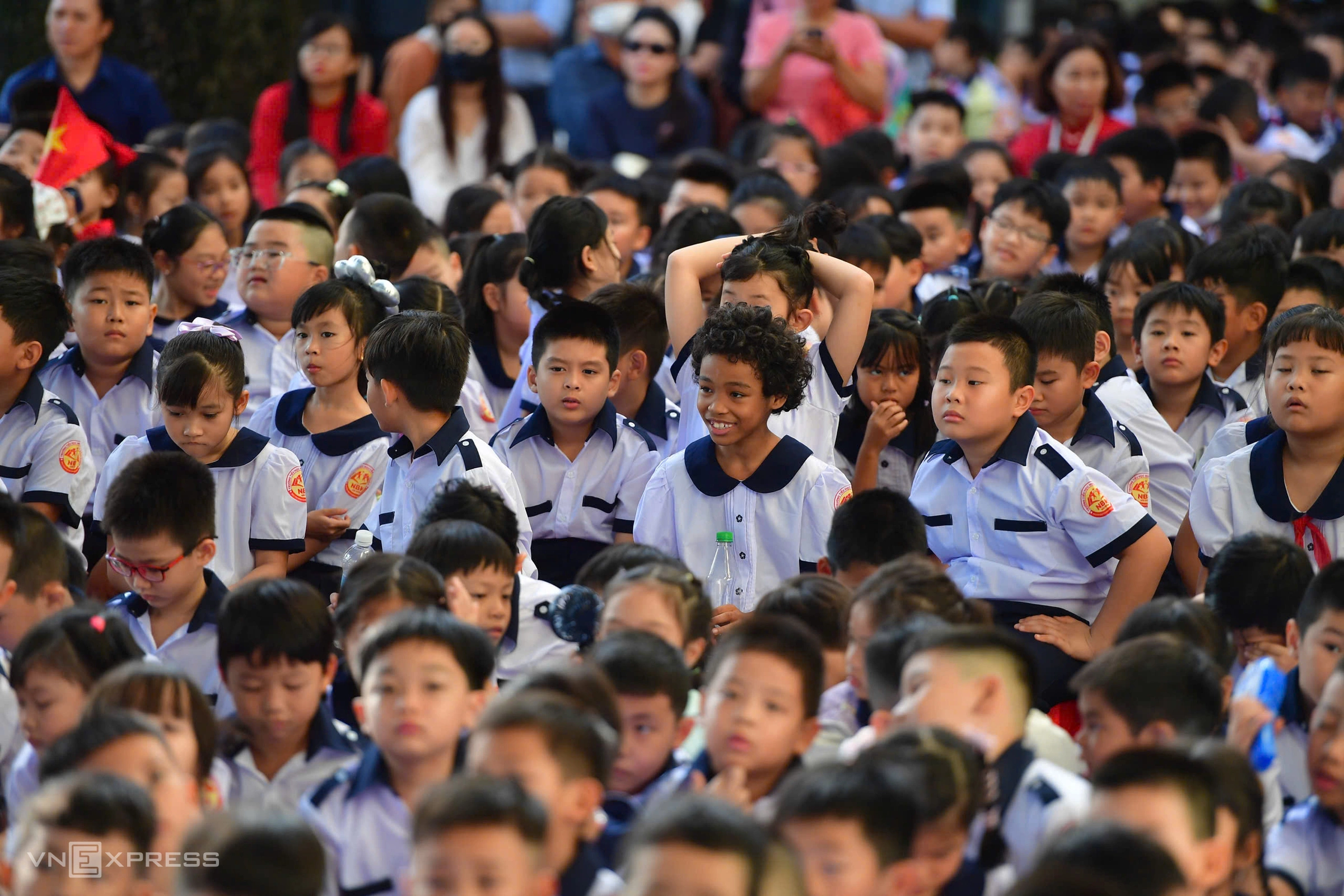 |
Opening ceremony at Nguyen Binh Khiem Primary School, Sai Gon ward, Ho Chi Minh City, 9/2025. Photo: Thanh Tung |
Quyen Nguyen