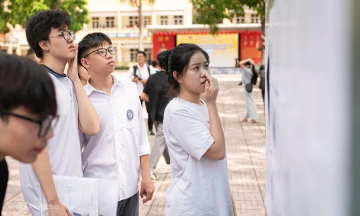
On the morning of 11/6, over 1,2 million candidates completed the literature exam for the 2026 high school graduation. This marks the second exam under the 2018 general education program, where the literature exam no longer uses content directly from textbooks.
The reading comprehension section (4 points) featured content from the work "Code and Sand – How technology powers changed the world", asking students about the relationship between theses and arguments, and how to use artificial intelligence (AI) to create intellectual synergy.
Moving to the writing section (6 points), the social commentary prompt stated that the United States has figures like Steve Jobs, Mark Zuckerberg, and Elon Musk, whose technological inventions have contributed to changing the world. Candidates were asked to write an essay answering the question: "How can we foster Vietnamese Steve Jobs?"
The literary commentary prompt used the poem "Nhung chiec la" (The Leaves) by Nguyen Dinh Thi, requiring students to analyze it in approximately 600 words.
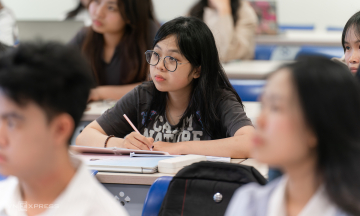
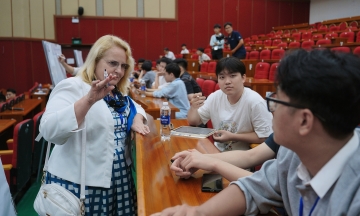
Many candidates in Hanoi, Ho Chi Minh City, and Da Nang left the examination centers feeling relaxed. Most considered the exam to be of appropriate difficulty, as technology-related topics had been frequently emphasized and reviewed by teachers. Some encountered minor difficulties due to limited vocabulary and experience.
Literature exam - suggested answers for the high school graduation literature exam
Ms. Duong Thi Thanh Thuy, head of the literature department at M.V. Lomonosov Middle and High School in Hanoi, highly praised the literature exam. She noted it clearly conveyed the perspective that studying literature is no longer about rote memorization, but about learning how to read, think, and present one's own views.
While the structure remained consistent with the previous year, a notable feature of this year's exam was its increased relevance to current affairs, connecting with science, technology, innovation, and the responsibility of young people in the digital age.
"If the 2025 exam focused on humanistic values, personal experiences, and familiar social issues, this year's exam expanded its scope to assess civic thinking skills regarding national and global development issues", Ms. Thuy stated. "Students needed critical thinking and the ability to link theory to practice to perform well."
Regarding the reading comprehension section, Mr. Nguyen Trong Truong, head of the literature professional group at Phenikaa High School in Hanoi, commented that the source material was appropriate. Students could grasp the basic information while also having content to ponder more deeply on integrating technological inventions into daily life. The five questions in this section were arranged by cognitive level, from recognition and comprehension to application.
A commendable aspect was question 5 (how to use AI to create intellectual synergy...), which was open-ended, allowing students to present personal opinions and relate them to the current context.
However, according to Mr. Vo Minh Nghia, a teacher at Nguyen Du High School in Ho Chi Minh City, questions 3-5 of the reading comprehension section ranged from difficult to very difficult. He also observed that students might struggle with the timely nature of the source material, which was not easy to quickly comprehend.
For the writing section, Ms. Thanh Thuy assessed it as having a strong differentiating quality. For instance, with question one, students needed a clear understanding of "Vietnamese Steve Jobs" to propose effective solutions. This question also demanded strong essay writing skills, logical and persuasive argumentation, and practical knowledge from the students.
"This was the best part of the exam because it provided an opportunity for students to demonstrate independent thinking and genuine language proficiency", Ms. Thuy said.
Mr. Minh Nghia believed that for this question, many students would likely resort to slogans and personal experiences. This is because, under time pressure and exam room stress, they would find it difficult to offer practical, effective solutions.
Regarding question two, Mr. Nghia considered the poem "Nhung chiec la" to be a challenging piece of literature.
"This poem is classified as symbolic poetry, rich in contemplation and life philosophy conveyed through the image of the leaf", he explained.
According to Ms. Thanh Thuy, to excel in this question, students needed strong literary appreciation skills, a deep understanding of the 'leaf' imagery, knowledge of literary theory, and the ability to use language precisely and flexibly.
Based on the exam structure and difficulty, Ms. Thuy predicted that the common score range for the 2026 high school graduation literature exam would primarily be from 6,5 to 7,75 points. Scores of 9 and above might still appear but would be reserved for essays demonstrating exceptional depth of thought, argumentative skill, and language proficiency.
Mr. Trong Truong suggested that the most common score achieved by candidates would be 6,5-7. Similarly, Mr. Nguyen Dinh Hoa, head of the literature department at Tran Phu High School in Da Nang, predicted that the average score could be around 7.
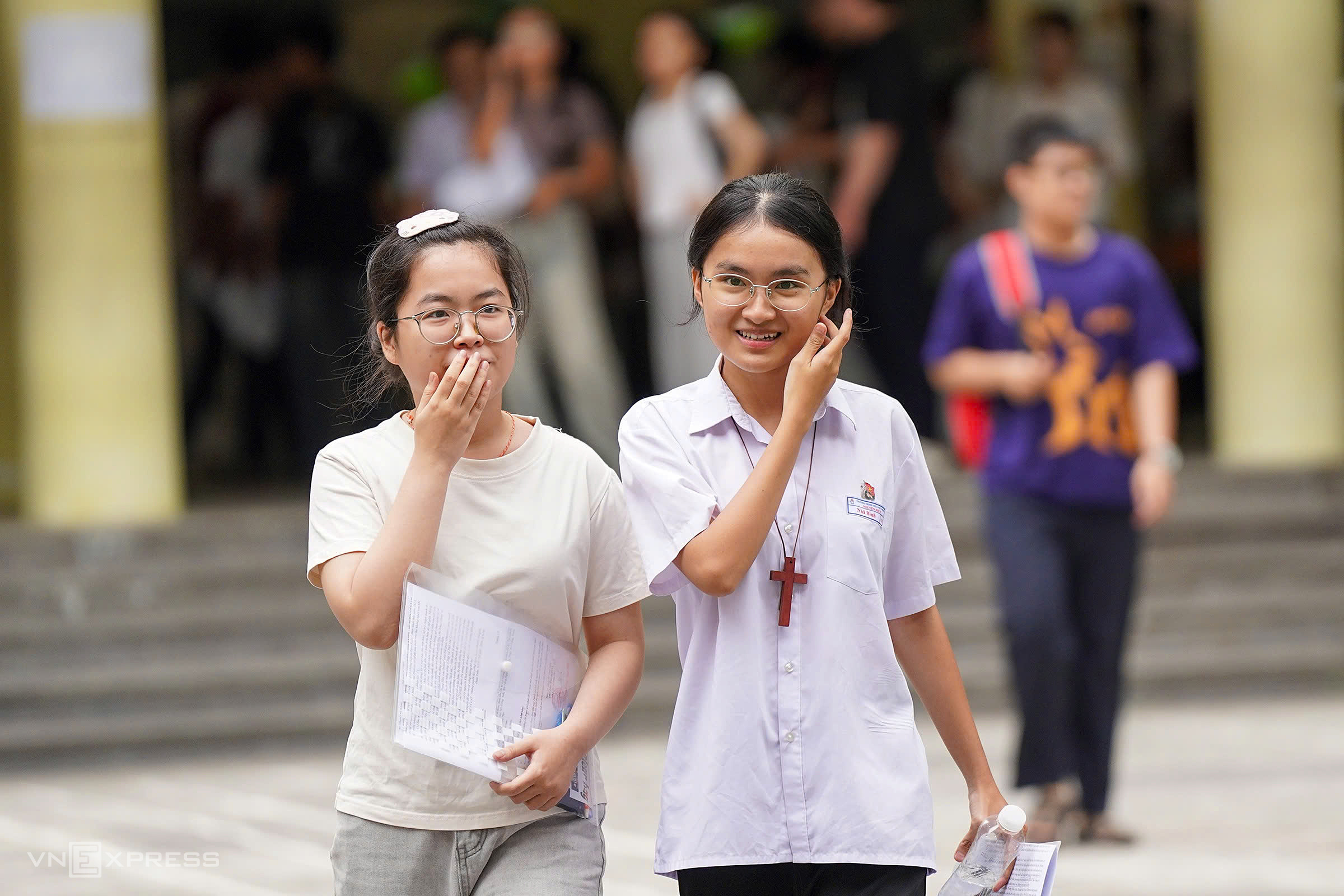 |
Candidates in Da Nang leave the high school graduation literature exam feeling relaxed. Photo: Nguyen Dong |
After the literature exam on the morning of 11/6, candidates will take the mathematics exam this afternoon, a 90-minute multiple-choice test. On the morning of 12/6, they will sit for two elective subjects. The results for the 2026 high school graduation exam will be announced on 1/7.
Reporters' team