Recently, suspicions of AI use by several authors have sent shockwaves through the international literary community. In March, publisher Hachette canceled the release of Mia Ballard's horror novel "Shy Girl" after some readers commented that the book heavily relied on AI. In May, entrepreneur Steven Rosenbaum admitted to "using ChatGPT, Claude in the research, writing, and editing process" for his book "The Future of Truth" when it was found to contain many fabricated quotes. Also in May, "The Serpent in the Grove" by Indian-born writer Jamir Nazir, which won the Commonwealth Short Story Prize, was accused of using AI, although organizers defended the work's authenticity.
As AI-generated content becomes more prevalent, writer David Shariatmadari published an article on Guardian on 4/7, distinguishing between human and machine-written text based on academic research and writers' perspectives. According to Shariatmadari, readers are currently circulating by word of mouth certain signs to identify AI text, such as content with many hyphens and cliches. However, these are also characteristic traits of human writing, which AI learns after processing training data.
"The problem is not only that AI is trained on human-written text, but humans are also influenced by AI's style. This reciprocal interaction creates a kind of 'linguistic mirror room'. If authors do not admit it, it is very difficult to say for sure whether a specific text was generated by AI," the article states.
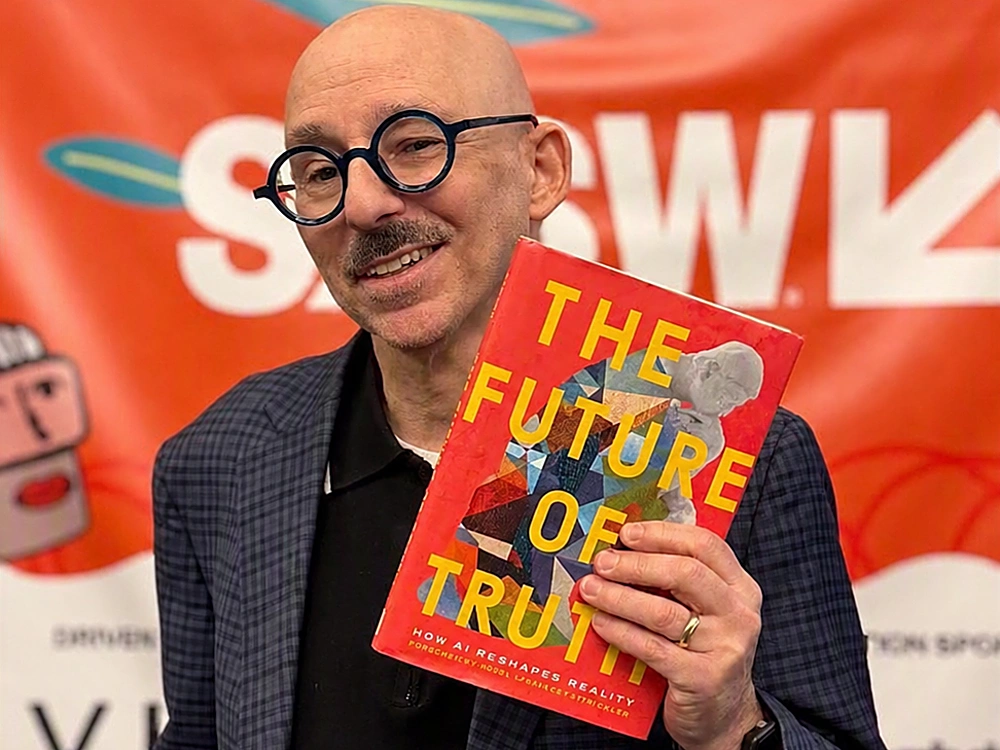 |
Author, entrepreneur Steven Rosenbaum and his book "The Future of Truth" at the "South by Southwest" event on 18/3. Photo: Facebook Steven Rosenbaum |
According to the author, artificial intelligence currently generates a large volume of text daily, from advertisements to academic summaries. It also appears in "AI-generated overviews" when searching for keywords on Google or as suggested email replies. In 2025, a team of linguists at the University of Pavia, Italy, compared human and machine-written texts to identify distinguishing characteristics.
The results showed that in English, AI content often contains more nouns and fewer pronouns and predicate adjectives. Machine writing tends to be concise; for example, AI would write "the uncomfortable chair" rather than "the chair was uncomfortable."
Not only appearing in AI's responses, large language models (LLMs) are changing how humans use language in the real world. David Shariatmadari referenced a 2024 study by Hiromu Yakura, a doctor in computer science at Germany's Center for Human and Machine. In this study, Yakura and his colleagues investigated the influence of LLMs on human verbal communication by analyzing over 700,000 hours of discourse across many fields through hundreds of thousands of English YouTube speeches and podcasts.
The results indicated that some words commonly used by LLMs, such as "delve" and "boast", have appeared more frequently in human speech since ChatGPT's launch. Speaking to Scientific American in 2025, co-author Levin Brinkmann observed: "The words stored in AI data seem to be transferring into human minds."
 |
Logos of AI applications ChatGPT and Claude – applications commonly used to generate text – on a phone. Photo: Luu Quy |
Also in his Guardian analysis, David Shariatmadari questioned the future of literature as AI develops: Could a machine-written novel ever rank among the top 100 greatest works? According to Peter Stockwell, a professor of linguistics at the University of Nottingham, UK, AI can perform basic tasks like learning human grammar and narrative styles. However, it cannot reach creative peaks because it fails to meet higher-level requirements, such as crafting convincing plots.
"If you ask AI to write a story, it does a decent job of creating a sequence of events and an ending. But it's not an easy story to tell. Nothing surprising or interesting happens. If something is surprising, it often feels more like a flaw than an excellent twist," Stockwell told Shariatmadari.
The professor also suggested that storytelling might be the ultimate way to detect chatbot writing. He explained that the main purpose of LLMs is to train machines on existing languages, making artificial intelligence's prose style nostalgic. "I can ask AI to 'write me a short story in the style of Virginia Woolf'. It will do quite well. But you cannot ask it to 'write me a story in the unique style of the next great, talented writer'. It cannot do that," Peter Stockwell stated.
Additionally, he explained that machines lack creativity due to the absence of a social environment and a living body to perceive the world – elements that drive human creation. British writer Jeanette Winterson holds a similar view, stating that AI's linguistic capacity cannot match humans. According to her, machines lack a limbic system, preventing them from accessing the full depth of human expression.
Given the reality that readers might confuse human and AI-generated text, David Shariatmadari noted that some authors are consciously limiting writing habits easily attributed to AI. Jennifer Egan, a 2011 Pulitzer Prize winner, said she recognizes some signs of AI in literature, though she had favored those writing styles previously. "For example, I like long hyphens, but now I find myself having to check them more carefully. I also realize I like to use three-word phrases, and now I have to reconsider those too. Actually, I don't mind, because the purpose of all that is not to write what others can imitate," she said.
Novelist Egan also offered advice for the younger generation of writers: Stay away from AI. She believes people can use technology for writing emails or finding research ideas, but they need to learn to write to become writers. In contrast, Jeannette Winterson holds a more open view, stating that each individual has the right to decide.
"Humans are tool-users. That is the story of our success. Currently, all AI, including generative AI, are tools. So should I collaborate with an LLM? Of course, why not?" she commented.
Thao Uyen (according to Guardian, Scientific American)