The Prime Minister recognized a collection of 18 rock carvings (ma nhai) in Lien Hoa Cave, Phong Phu Pagoda, Ninh Binh as a national treasure in early February. These carvings, depicting 18 arhats, are considered the earliest of their kind in Vietnam. The unique collection is divided into two blocks across two rock faces, with nine carvings on each, showcasing symmetry and harmony. They are situated within Lien Hoa Cave, alongside the Buddha hall, a statue of Tran Vu Thien Ton, and nine Ksitigarbha statues, creating a sacred and mystical atmosphere.
The individual carvings vary in size, with the tallest measuring 93 cm and the shortest 67 cm. Each carving portrays an arhat with distinct appearances, postures, facial expressions, and varied spatial settings. Some arhats are depicted sitting in full lotus position on a rock slab, while others hold staffs, raise prayer beads, or form mudras.
Each carving originally featured a line of Chinese characters identifying the arhat or their abode. Over centuries, natural elements and human activity have caused erosion, scratches, and fading on the surface of some carvings. The Chinese characters in many pieces are now faint or lost, making their specific content difficult or impossible to read. Currently, three carvings, located in the sixth, seventh, and eighth positions on the right wall of the Buddha hall, remain relatively clear, allowing for the restoration and reading of their faded or lost characters.
Based on their artistic style, decorative details, patterns, and comparisons with existing historical records, researchers have dated these carvings to the early Tran dynasty. This collection was created during a period when the Ninh Binh region was a center of religious activity under the Tran dynasty, a time of prosperity for Dai Viet Buddhism. Historical records from the 7th year of Kien Trung (1231) state that Emperor Emeritus Tran Thai Tong decreed that all communal houses and stations throughout the country should erect Buddha statues for worship, aiming to revitalize and expand the influence of Buddhism.
The Department of Cultural Heritage affirms that this collection is unique, possesses a distinct form, and holds significant historical and cultural value. Except for carving number nine on the right side of the Buddha hall, which has a straight rectangular frame, the other 17 carvings feature arched upper frames. The lower edges of these 17 carvings are shaped like lotus pedestals with many petals fanning out from the center, with a base beneath. The frames of all 18 carvings are adorned with scrolling vine patterns.
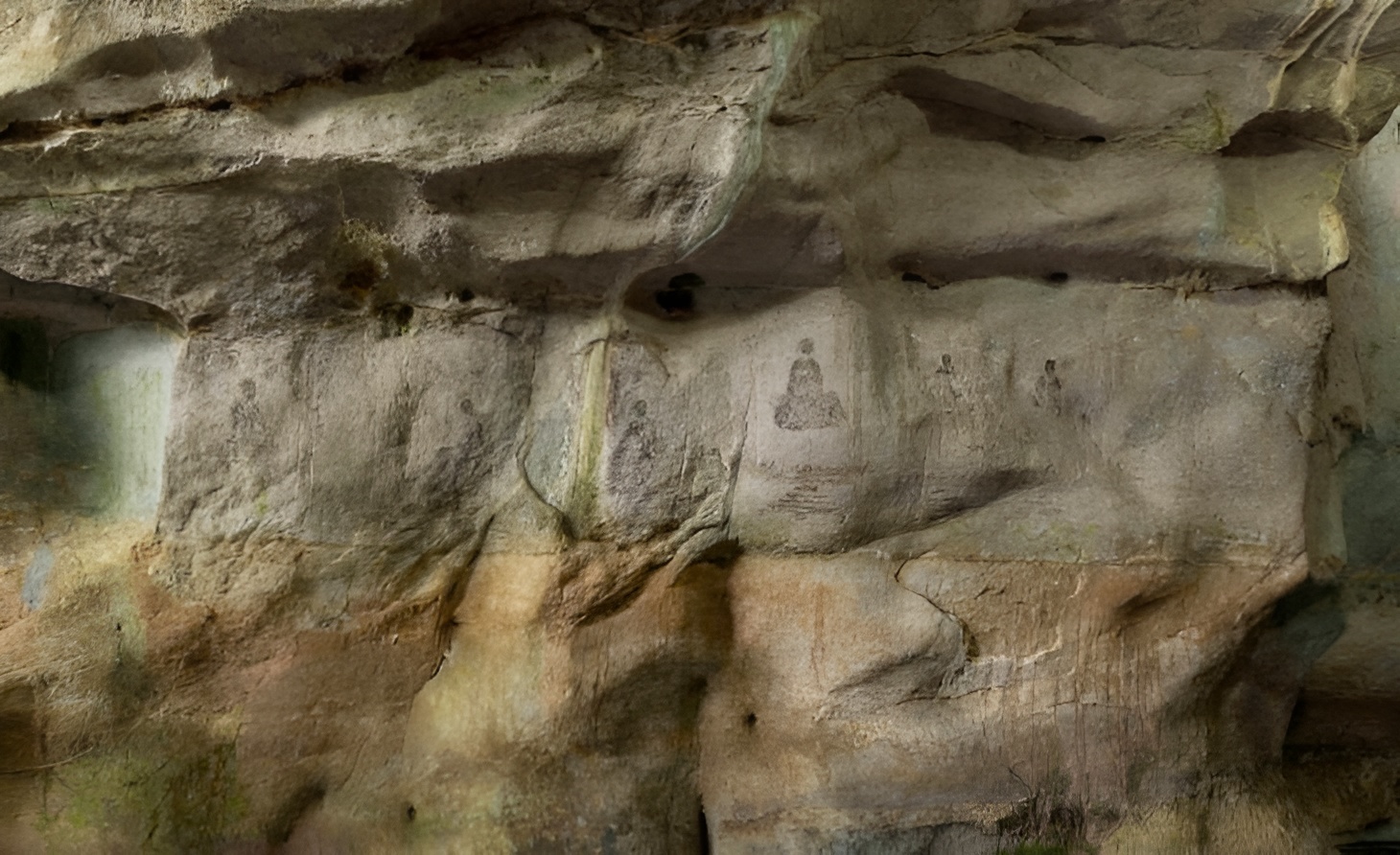 |
Some arhat rock carvings. Photo: *Department of Cultural Heritage*
According to documents from the Department of Cultural Heritage, this national treasure is the earliest evidence of arhat worship being adopted and influencing Vietnamese Buddhism. In China, the first images of 16 arhats were drawn by Zen master Guan Xiu in his "Sixteen Arhats" in 891. This series depicted arhats with features such as thick eyebrows, large eyes, prominent cheeks, and high noses, set against backgrounds of pine trees and rocks, reflecting the ancient Chinese art style. Guan Xiu's arhat figures became a model for subsequent painters and artisans, though each period introduced slight variations.
However, a detailed study of the carvings in Lien Hoa Cave, from facial features and postures to the spatial context depicted in each of the 18 arhats, reveals notable differences in the contemporary Buddhist thought and aesthetic concepts.
Furthermore, the Chinese characters identifying the arhats in the Lien Hoa Cave rock carvings differ from those found in China. For instance, while the inscription for the 14th arhat at Shengren Temple in Hangzhou, Zhejiang Province, China, reads: "Di Shisi Fa Na Ba Sī Zūnzhě" (the 14th Arhat Vanavasi), carving number seven on the right side of the Buddha hall at Lien Hoa Cave, Phong Phu Pagoda, Ninh Binh, is inscribed: "Ke Zhu Shan Zhong Fa Na Ba Sī". This inscription notably mentions the arhat's abode before their name.
The Department of Cultural Heritage regards the 18 Arhats rock carvings at Lien Hoa Cave as a rare and valuable document for studying Tran dynasty Buddhist art, and Vietnamese Buddhist art and history in general.
Phuong Linh