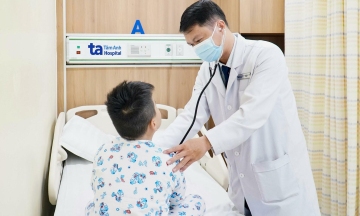
Master of Science, Doctor Le Dang Khoa, from the Fertility Support Center at Tam Anh General Hospital Ho Chi Minh City (IVF Tam Anh Ho Chi Minh City), reported that Minh had dual abnormalities in both reproductive organs, resulting in no sperm in his semen. His left testis had suffered inflammation, causing reduced sperm production, yet its vas deferens was intact. In contrast, his right testis produced sperm, but a congenitally short and incomplete vas deferens prevented sperm transport.
According to Doctor Khoa, congenital vas deferens agenesis typically affects both sides, making Minh's case of unilateral agenesis rare. Each of the patient's testes measured approximately 15 ml, yet normal reproductive hormone levels indicated preserved sperm production. Chromosome analysis revealed no genetic abnormalities.
 |
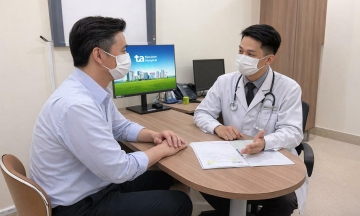
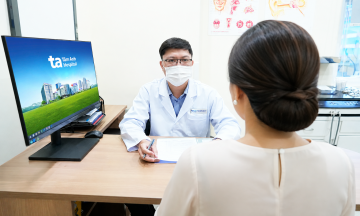
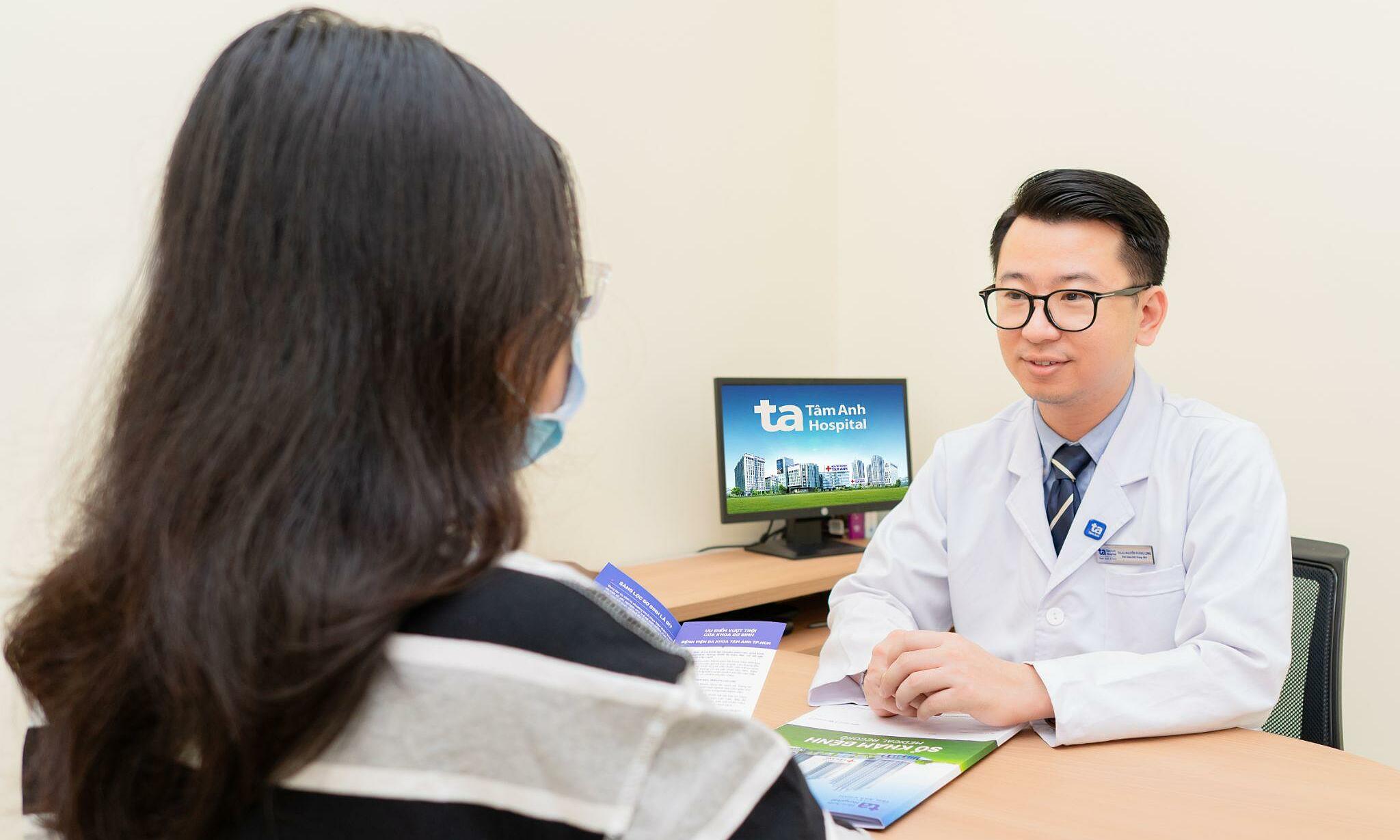
Master of Science, Doctor Le Dang Khoa advises Minh on vas deferens reconstruction. Photo: IVF Tam Anh |
Master of Science, Doctor Le Dang Khoa advises Minh on vas deferens reconstruction. Photo: IVF Tam Anh
Doctor Khoa devised a "2-in-1" treatment plan for Minh, which involved both sperm retrieval for in vitro fertilization (IVF) and the surgical rejoining of the vas deferens ends to re-establish natural sperm flow.
After opening the vas deferens at the anticipated connection point, doctors collected a fluid sample for lab examination, but found only immobile sperm. The team then proceeded with testicular sperm extraction (TESE) microsurgery, obtaining a sufficient quantity of high-quality, highly motile sperm for the IVF cycle and cryopreservation.
The team proceeded with the vas deferens crossover microsurgery. Under the magnified view of the microscope, Doctor Khoa adjusted the length and direction, crossing the vas deferens through the scrotal septum and using specialized sutures to rejoin it, restoring flow.
The technique was performed with high precision, ensuring the connection was not strained or kinked, and preserving the blood supply. Micro-sutures closed the incision, promoting rapid healing and leaving a scar barely visible. The surgery was completed in 90 minutes.
Concurrently, Thuy underwent egg retrieval, yielding 9 mature oocytes for in vitro fertilization with her husband's sperm. The culture resulted in 6 good-quality day-5 embryos. Thuy conceived on the second embryo transfer, and her pregnancy is now 9 weeks along and developing healthily.
Three months after surgery, Minh's semen analysis for the first time showed a motile sperm count exceeding 10 million/ml, with 90% motility, comparable to a normal individual. Doctor Khoa stated that if the wife's reproductive health is normal, Minh and his wife have a full opportunity to conceive naturally in the future.
 |
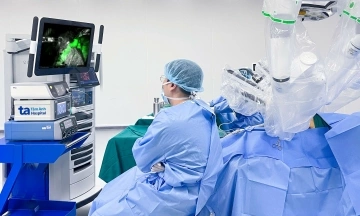
Master of Science, Doctor Le Dang Khoa (center) and the surgical team performing sperm retrieval and vas deferens crossover for Minh. Photo: IVF Tam Anh |
Master of Science, Doctor Le Dang Khoa (center) and the surgical team performing sperm retrieval and vas deferens crossover for Minh. Photo: IVF Tam Anh
According to Doctor Khoa, azoospermia can result from either ductal obstruction or impaired sperm production. Vas deferens obstruction may be linked to infection, injury, prior surgery, or congenital defects. Patients often maintain normal libido and sexual function, making the condition difficult to detect without fertility testing. Doctors select appropriate treatment methods based on the underlying cause. For complex obstructions, doctors consider microsurgery to re-establish flow, combined with sperm retrieval for cryopreservation to support various assisted reproductive options.
Doctors recommend that men with a history of testicular inflammation, genital surgery, or reproductive organ abnormalities seek early examination to prevent fertility issues and ensure optimal treatment for early conception.
Nguyet Nhi
| Readers can submit questions about infertility here for doctors to answer. |