Nearsightedness occurs when light rays entering the eye converge in front of the retina instead of directly on it, a result of an elongated eyeball. Many nearsighted individuals, especially those with severe myopia, report that their eyes seem to shrink over time when wearing framed glasses. However, Dr. Duong Minh Phuc, from the High-Tech Eye Center at Tam Anh General Hospital TP HCM, explains that eyes do not actually shrink; this perception is an optical illusion created by the lenses.
Nearsighted glasses typically use divergent lenses, which are thinner at the center and gradually thicken towards the edges. These lenses help redirect light rays so that images focus correctly on the retina. This optical property causes the eyes behind the lenses to appear smaller than their actual size. The higher the prescription, the thicker the lenses, and the more noticeable this shrinking effect becomes. To address this, Dr. Phuc offers advice on selecting appropriate lenses and frames for nearsighted individuals.
 |
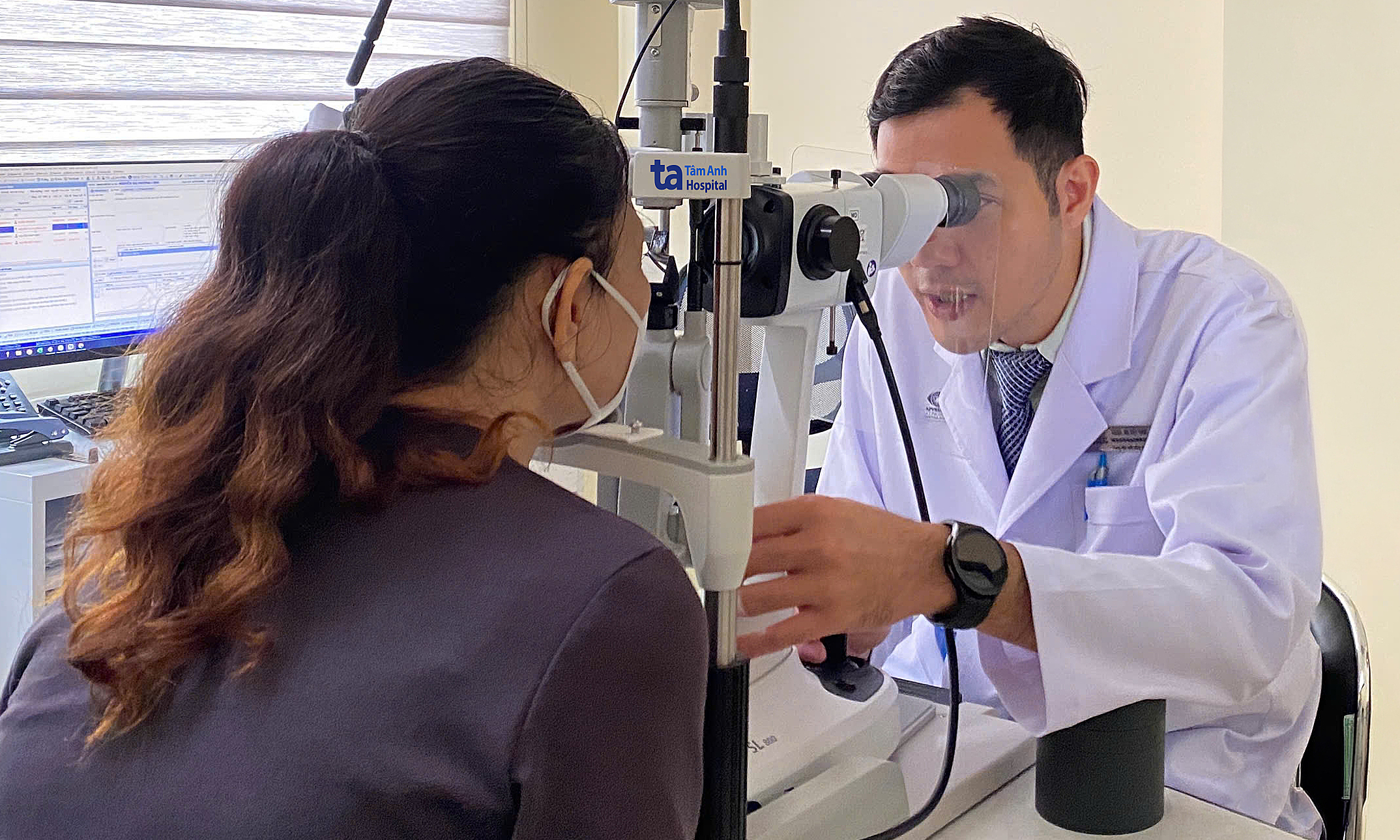
Dr. Phuc examines a man's eyes. Illustration: Tam Anh General Hospital
High refractive index lenses
The refractive index of a lens indicates how effectively the lens material bends light. High refractive index lenses are made from materials that bend light more efficiently. This allows lenses with the same prescription to be designed thinner and lighter, which is particularly beneficial for those with high prescriptions. Thinner lenses minimize the shrinking effect, making the eyes appear closer to their natural size.
Frames that suit facial proportions
It is important to choose frames that fit the face well, without putting pressure on the ears or nose bridge, ensuring the glasses remain stable. For individuals with high prescriptions, overly large frames can make the lens edges appear thicker, while frames that are too small may cause discomfort when looking.
Dr. Phuc emphasizes the need to check the position of the pupil and the optical center when fitting glasses. Off-center lenses can reduce image quality, leading to discomfort, eye strain, or headaches.
Replacing framed glasses with contact lenses or vision correction surgery
When divergent lenses are no longer in front of the eyes, the shrinking effect they create also disappears. Therefore, nearsighted individuals can replace framed glasses with soft contact lenses or Ortho-K night contact lenses.
Soft contact lenses are thin, flexible lenses placed directly on the cornea to correct nearsightedness. Ortho-K is a method that uses specialized rigid contact lenses worn overnight during sleep to temporarily reshape the cornea, allowing nearsighted individuals to see clearly during the day without needing framed glasses.
Individuals aged 18 and older, who have stable prescriptions and meet specific corneal conditions, can consider vision correction surgery such as Lasik, Smile Pro, or Phakic ICL, to eliminate their dependence on framed glasses.
Dr. Phuc advises nearsighted individuals to rest their eyes using the 20-20-20 rule: look away or close their eyes to relax and reduce eye strain, limiting feelings of sluggishness or dullness. Regular eye exams ensure the correct prescription is worn. If blurry vision, eye strain, headaches, or frequent squinting occur, nearsighted individuals should visit an ophthalmology department for an examination. Wearing an incorrect prescription can cause the eyes to over-accommodate, leading to discomfort.
Ngoc Kim Tham
| Readers can submit questions about ophthalmological conditions here for a doctor's response. |