Chen, a 56-year-old man from Zhanjiang city, Guangdong province, had always been in good health. However, three years ago, he began experiencing symptoms of frequent and painful urination. Believing it to be a common prostate issue and not wanting to disrupt his busy farm work, Chen decided to self-medicate, hoping the symptoms would subside.
Recently, his condition severely worsened, preventing him from traveling far during the day and causing frequent sleepless nights as he woke up three to four times to urinate. After repeated persuasion and accompaniment from his family, Chen finally agreed to visit the Urology Department at Ciwen Hospital, an affiliate of Guangdong Medical University Hospital, for an examination.
During the examination, results revealed a giant stone occupying almost the entire bladder. Dr. Lam Vien, Deputy Head of the Urology Department, stated that the stone measured 10 cm in width, 13 cm in length, and weighed 1.3 kg, comparable to the size of two adult fists. This is recorded as the largest bladder stone ever found in the western Guangdong province. The stone was also responsible for bilateral hydronephrosis, a condition where both kidneys swell due to urine accumulation, leading to severe urinary tract infections.
Doctors warned that prolonged compression of the bladder wall by such a large stone could severely damage kidney function, potentially leading to uremia (end-stage renal failure) and posing a life-threatening risk to the patient if not addressed promptly.
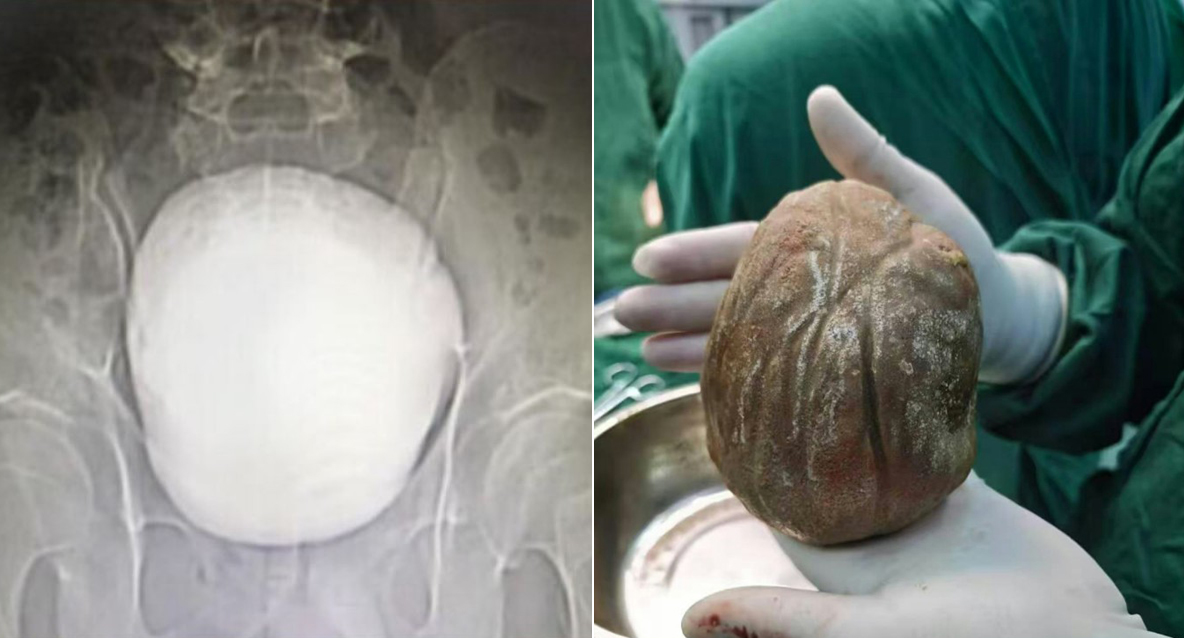 |
The giant stone inside the patient's bladder (left) and after removal. *Photo: Zhanjiang Evening News* |
Given the rarity of this giant bladder stone case, the hospital convened a multidisciplinary consultation, developed a personalized surgical plan, and established an emergency response strategy for the patient. The surgical team meticulously detached the stone from the bladder wall, taking care to avoid damaging surrounding blood vessels and nerves. The surgery was ultimately successful, completely removing the foreign object from the patient's body.
According to Dr. Lam Vien, bladder stone formation is closely linked to unhealthy lifestyle habits, as well as urinary tract obstruction or infection. If symptoms such as frequent urination, urinary urgency, increased nighttime urination, difficulty urinating, a weak urine stream, or a sudden interruption in the urine flow (which may resume after changing position), blood in the urine, bloating, lower abdominal pain, or recurrent urinary tract infections appear, patients must not self-medicate or delay treatment. Instead, they should seek a timely examination at a reputable hospital's urology department.
To effectively prevent bladder stones, individuals should drink plenty of water and urinate frequently, maintaining a daily fluid intake of at least 2,000 ml. It is crucial not to hold urine to reduce its concentration. Additionally, maintaining a balanced diet plays a vital role: limit excessive consumption of foods rich in oxalic acid, purines, and calcium, while increasing intake of vegetables, fruits, and fiber. Finally, thoroughly treating underlying conditions such as benign prostatic hyperplasia and urinary tract infections from their onset will help minimize the risk of stone formation at its root.
Binh Minh (According to SCMP, ST Headline, HK01)