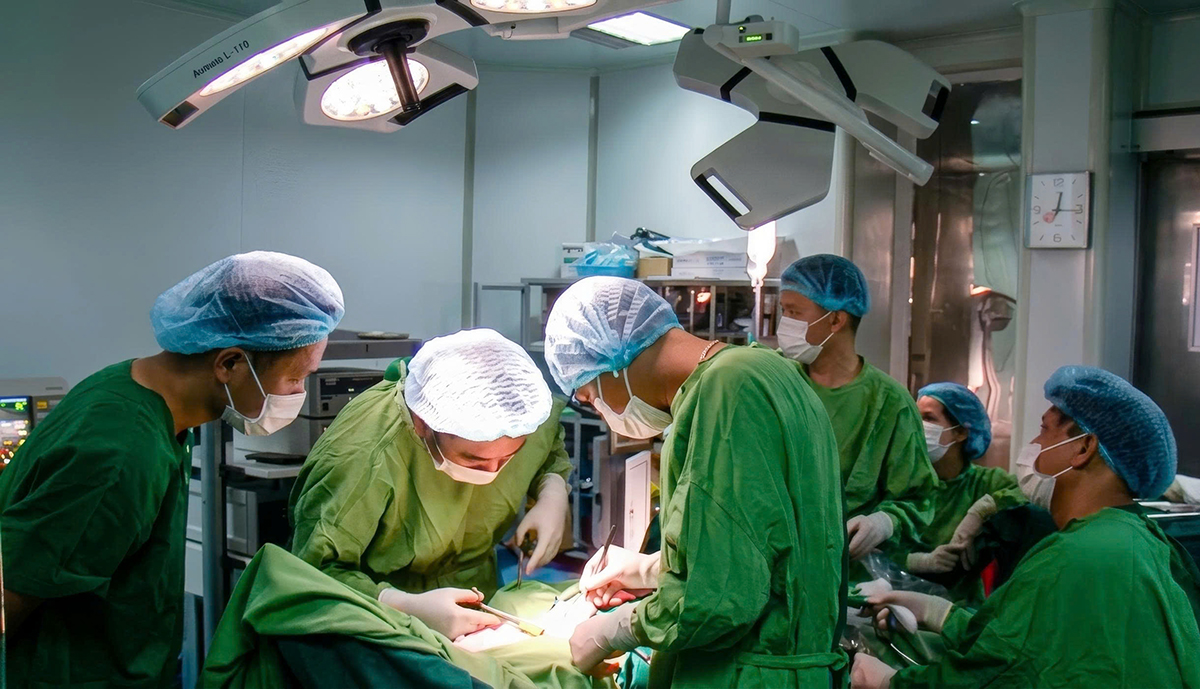
Mrs. Phuong’s swift recovery highlights the efficacy of advanced robotic technology in joint replacement. She was able to walk less than 3 hours after her left knee replacement, experiencing significantly less blood loss and pain compared to her previous traditional surgery one year ago. Her movement was natural and flexible, leading to her discharge just one day later. The procedure was performed with the assistance of the Cuvis-Joint robot at Tam Anh General Hospital Ho Chi Minh City.
The 65-year-old patient presented with end-stage degeneration of her left knee, characterized by severe deformation, complete cartilage loss, numerous bone spurs, and a curved leg axis. These conditions caused direct friction between bone ends during movement, resulting in considerable pain, bruising, and soft tissue swelling. This marked her second knee replacement, having undergone a traditional procedure for her right knee one year prior.
 |
Dr. Khoa performing knee replacement for Mrs. Phuong with Cuvis-Joint robot. Photo: Tam Anh General Hospital.
According to Dr. Le Dinh Khoa, Head of the Joint Reconstruction Department at Tam Anh General Hospital, the Cuvis-Joint robot, the first of its kind in Vietnam, offers enhanced precision for knee replacement surgery. Before the operation, the integrated J-Planner software uses 3D CT scans of the patient's knee to analyze bone morphology and anatomical parameters. This provides doctors with a comprehensive view of the joint, including deep and hard-to-see areas, enabling precise planning of incisions, joint placement, and bone cuts.
During the surgery, the robot's 6-axis arm employs a thin grinding blade to execute bone cuts with high accuracy according to the pre-determined plan. The resulting clean bone surface minimizes bacterial invasion and the risk of infection. The robot's real-time optical navigation system ensures safety by halting the saw immediately if it deviates from the bone boundary or if any collision or vibration occurs, thereby protecting surrounding blood vessels, nerves, and soft tissues. This precision ensures the artificial joint fits almost 100% to the patient's body, significantly reducing the risk of complications such as persistent post-operative pain, which is a common issue with knee replacements.
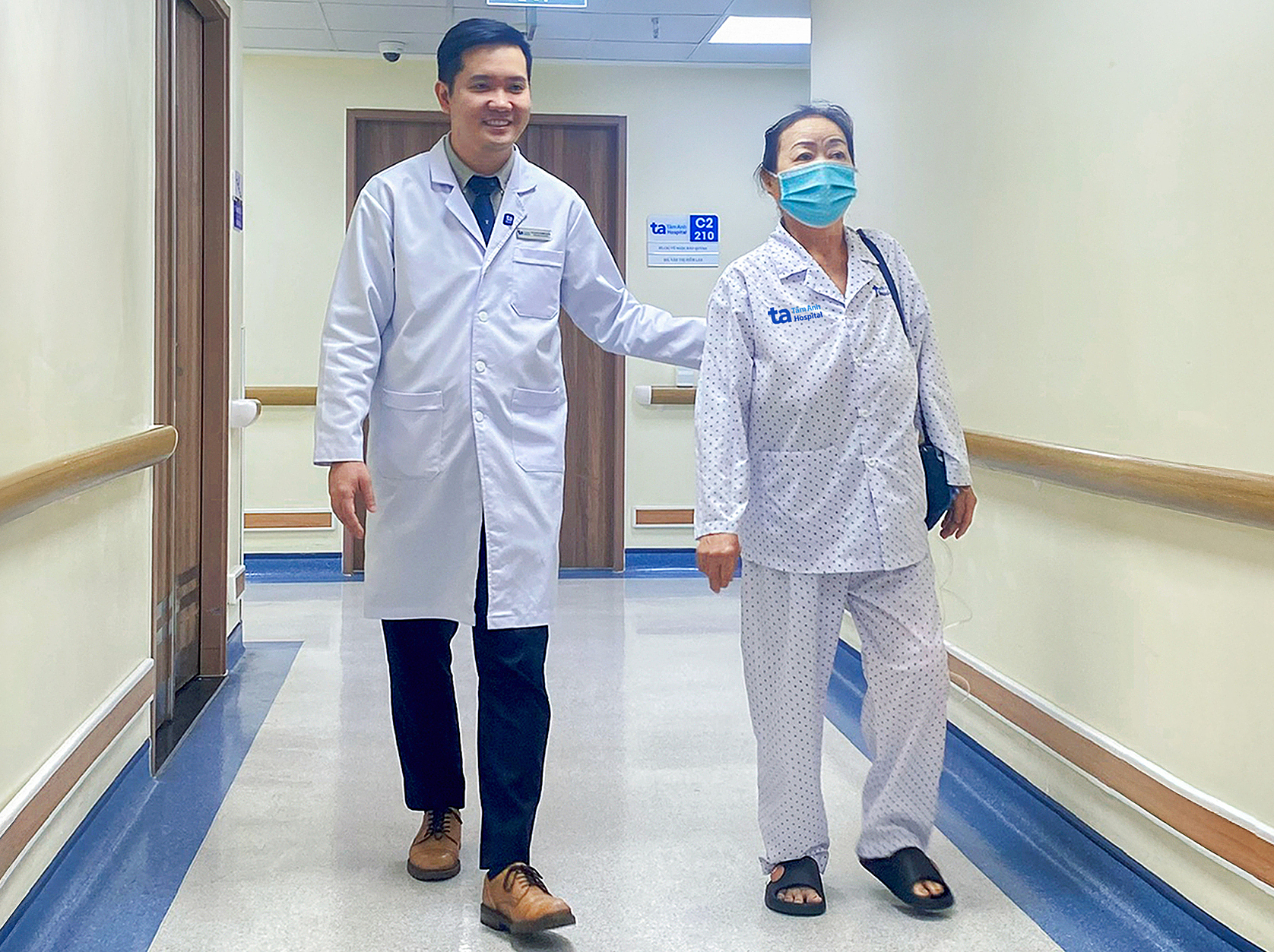 |
Dr. Khoa guiding the patient to walk on the first day after surgery. Photo: Tam Anh General Hospital.
Dr. Khoa emphasizes that knee replacement is a major surgical procedure with potential complications, including infection, post-operative bleeding, or limb misalignment. He advises patients to seek treatment at specialized orthopedic facilities to ensure effective outcomes. The advanced robotic assistance at Tam Anh General Hospital is particularly beneficial for complex cases involving severe joint deformation, obesity, or difficult surgical fields.
Phi Hong
| The consultation program "First New Generation AI Robot Joint Replacement in Vietnam: Correct Indication, Safe Surgery, Superior Efficacy" is currently running on the Tam Anh General Hospital website. Readers can submit questions here for answers. |