When an unusual lump is discovered on the body, most people immediately worry and think of cancer. Doctor Hieu advises patients to first remain calm and choose a reasonable approach to prevent unfortunate consequences from rushed treatment.
People should absolutely not adopt a "wait and see" attitude, expecting the lesion to disappear on its own, except for inflammatory lymph nodes caused by tooth decay or boils in the jaw, armpit, or groin areas. Early detection and accurate cellular diagnosis play a decisive role in treatment effectiveness.
In reality, benign tumors such as cysts, lipomas, hemangiomas, or fibroids account for 80% to 90% of all cases, especially in the thyroid gland. Many lung masses are also benign or result from medical staff misinterpreting imaging results. Therefore, people need to understand that a "tumor" is entirely different from "cancer."
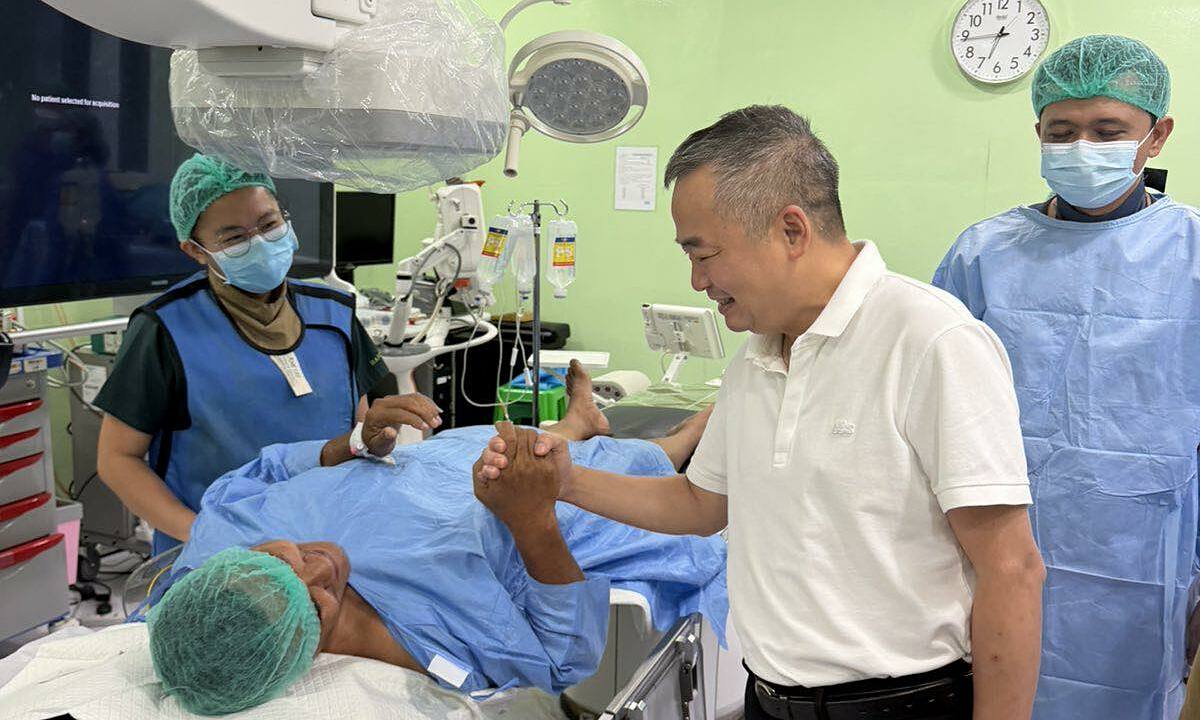 |
Doctor Nguyen Lan Hieu encourages a patient before surgery. *Photo: Doctor provided* |
For an accurate diagnosis, patients should seek the correct specialty related to the lesion's location rather than focusing solely on imaging centers. Doctor Hieu provides examples: individuals with thyroid nodules should see an endocrinologist, those with breast or uterine masses should see an obstetrician/gynecologist, and those with subcutaneous lumps should consult a dermatologist or musculoskeletal specialist. Choosing a local hospital where doctors provide thorough consultations without alarming patients can save time and money. He advises people to avoid clinics advertising modern equipment, which can lead to the risk of "losing money and worsening the condition," citing a case where thyroid nodule ablation was performed incorrectly, causing secondary bleeding and nearly fatal airway compression.
Once the right medical professional is chosen, patients must patiently adhere to the treatment protocol and await pathology results instead of demanding immediate "blanket" treatment. The medical field prescribes surgery, chemotherapy, or radiation therapy based on international scientific evidence, not a "better safe than sorry" approach. Doctors will continue to monitor benign tumors and only intervene with excision or ablation if the lesion grows or compresses surrounding organs. For cancer, specialists design individualized treatment plans, requiring patients to place full trust in medical experts to achieve the best possible outcomes.
In Vietnam, there are over 182,000 new cancer cases and more than 122,000 cancer deaths annually. Over 350,000 patients are living with the disease. On average, for every 100,000 Vietnamese people, 159 cases are newly diagnosed with cancer, and 106 cases result in death. Vietnam's new incidence rate ranks 91st, and its mortality rate ranks 50th out of 185 countries, showing a rapid increase in global rankings.
Experts attribute Vietnam's high cancer mortality rate to late-stage detection, which limits treatment effectiveness. Additionally, the most common cancers among Vietnamese people, such as liver and lung cancer, often have a poor prognosis. Increased life expectancy, an aging population, environmental pollution, unhealthy lifestyle habits like alcohol consumption, e-cigarettes, and an unbalanced diet also contribute to the rising risk of cancer.
Thuy An