Dr. Nguyen Phuong Thao, from the Fetal Medicine Unit at Tam Anh District 7 Polyclinic, explains that mitochondria are organelles within cells. They possess their own genome, called mitochondrial DNA (mtDNA), and are responsible for producing energy for the body. Mitochondrial disease results from genetic mutations that impair this process, causing cells to lack energy. Unmetabolized oxygen and fuel accumulate, damaging cells. The disease primarily affects organs with high energy demands, such as the brain, muscles, heart, liver, kidneys, eyes, and ears.
The 7-month-old boy frequently cried, could not roll over or grasp objects, had a weak neck, "trigger thumb," and muscle rigidity. Tests and an MRI scan of the brain at Tam Anh District 7 Polyclinic revealed lactate levels three times higher than normal. They also showed bilateral basal ganglia lesions, which are neural cell structures deep within the brain's hemispheres that control movement, muscle tone, and coordination.
Dr. Thao assessed these symptoms as potentially related to mitochondrial disease. Genetic testing identified a MT-ND3 gene mutation on the mitochondrial DNA, showing 100% abnormality. This gene alteration causes severe energy deficiency in nerve and muscle cells. It is the reason the boy developed Leigh syndrome, a form of mitochondrial disease, leading to severe psychomotor developmental delay.
According to Dr. Thao, mitochondrial disease, caused by mutations in mtDNA, is mostly maternally inherited. During fertilization, the egg cell eliminates all mitochondria from the sperm, meaning the embryo receives mtDNA exclusively from the mother. In some cases, mutations can arise de novo (newly) in the early embryonic stage.
Test results showed the mother carries the MT-ND3 variant with a 17% abnormality level; 83% of her mitochondria remain normal, so she does not exhibit obvious symptoms of the disease. The doctor explained this as mitochondrial heteroplasmy, where normal and mutated mitochondrial DNA coexist within one body at different ratios. When the proportion of variant-carrying mitochondria is low, normal mitochondria can still meet cellular energy demands. However, this ratio can increase or vary across tissues, organs, and between mother and child. With each subsequent pregnancy, her children face a risk of being affected, as the mutation transmission rate to offspring is random.
For future natural pregnancies, the couple needs to be prepared for the risk of their child developing mitochondrial disease; amniocentesis can assess this risk. To reduce the chance of transmitting the mitochondrial gene variant from the mother, pronuclear transfer technology can be performed. Doctors create an embryo from the mother's egg and father's sperm, and simultaneously create an embryo from a donor egg that does not carry the mitochondrial gene variant. The nucleus from the parents' embryo is then transferred into the enucleated donor embryo, retaining healthy mitochondria, and subsequently implanted into the mother's uterus.
 |
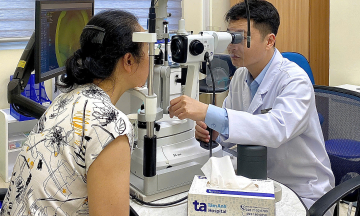
The boy's mother undergoes genetic blood testing. *Photo: Tam Anh District 7 Polyclinic* |
Currently, no specific treatment exists for mitochondrial disorders. Most interventions focus on symptom management, physical therapy, or special diets. Dr. Thao noted that the 100% abnormal mitochondrial gene level in this patient indicates a high risk of severe neurological developmental impairment and early mortality. The boy requires comprehensive, specialized support to mitigate complications.
Leigh syndrome, caused by mitochondrial gene mutations, is observed in approximately 1 in 40,000 live births and can be associated with variants in over 110 different genes. Disease manifestations are diverse, often affecting high-energy organs such as the brain, muscles, and heart. Children may experience psychomotor developmental delay, seizures, hypotonia (muscle weakness), vision impairment, and other lesions. Disease severity can also vary among individuals carrying the same mitochondrial DNA variant.
Children who are slow to reach developmental milestones, exhibit weak or abnormal muscle tone, seizures, movement disorders, or other unusual neurological signs should consult specialists, such as those in Genetics and Fetal Medicine. Based on the child's symptoms and family history, doctors can recommend appropriate ultrasound, MRI scans, or gene testing.
By Ngoc Chau