Dr. Duong Quang Huy, Head of the Andrology Unit at the Center for Reproductive Support, Tam Anh General Hospital - District 8, stated that gynecomastia is a condition where male breast tissue grows larger than normal. This can occur on one or both sides, sometimes asymmetrically. Typically, this condition begins during puberty and resolves on its own after one to two years. If the breast tissue does not shrink after this period, it will progress to a fibrotic stage, where medication or gym exercises will not be effective, and surgical intervention will be necessary.
In the past two months, the hospital has received many men seeking consultation and breast reduction surgery. Dr. Huy explained, "Many choose to undergo surgery at the year-end, finding it convenient for recovery time and to improve their appearance for the new year."
For instance, Tim, 41, a Vietnamese expatriate living in Germany, had bilateral breast enlargement since puberty. Despite 8 years of dieting and bodybuilding that toned his body, his breast size remained unchanged. An ultrasound at Tam Anh General Hospital - District 8 revealed his right breast tissue measured 10x6x7 cm, consistent with grade 3 gynecomastia – the most severe level – characterized by significant excess skin and sagging, resulting in breast deformity.
Similarly, Thai, 23, developed gynecomastia after puberty. Despite trying medication, herbal remedies, and 5 years of gym exercises, his condition did not improve. An ultrasound showed his left breast tissue diameter was over 4 cm, indicating a medium to large size with sagging.
Gynecomastia in men is categorized into two types: physiological and pathological. The physiological type commonly occurs in newborns, during puberty, or in aging men. This condition often resolves spontaneously once hormone levels stabilize.
The second type is pathological gynecomastia, which both Thai and Tim experienced. This type results from a prolonged imbalance between two types of hormones in the male body. Breast tissue develops when estrogen levels increase, testosterone levels decrease (or both), or when glandular tissue is overly sensitive to estrogen or resistant to testosterone. This condition can be accompanied by symptoms such as swelling, pain, or tenderness, and nipple discharge.
Dr. Huy stated that in its early stages, this condition can be managed with medical treatment using hormone medication. Severe cases require surgical intervention, which can involve an armpit incision or an inframammary incision. For the two patients mentioned, Dr. Huy performed surgery through a periareolar incision, carefully dissecting the large glandular tissue from the chest without damaging the muscle. The incision was then closed with dissolvable sutures and sealed with biological glue. This surgical technique ensures complete removal of the glandular tissue, minimizes scarring, provides aesthetic results, and preserves the natural shape of the nipple.
After surgery, a small cavity may form within the breast tissue, potentially producing fluid. A drainage tube is inserted to remove this fluid. A small scar may appear at the site where the tube was removed. Both Thai and Tim require regular follow-up appointments for needle aspiration to remove any fluid and prevent further scarring.
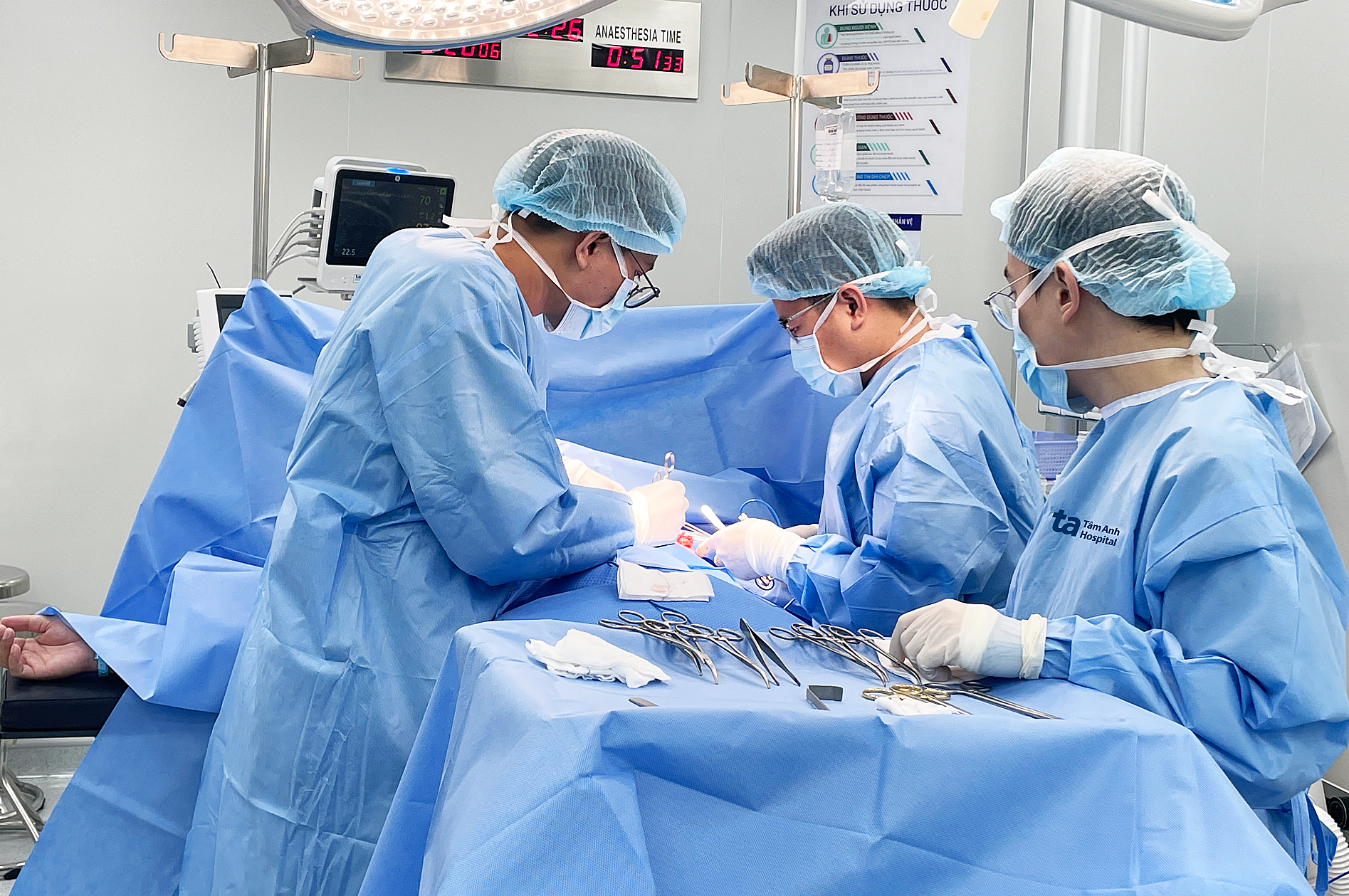 |
Dr. Huy (center) performs breast glandular tissue dissection surgery for Tim. Photo: Tam Anh General Hospital |
Dr. Huy (center) performs breast glandular tissue dissection surgery for Tim. Photo: Tam Anh General Hospital
Dr. Huy also noted that common causes of gynecomastia include medication side effects, bodybuilding hormone injections, hypogonadism, chronic liver disease, kidney failure, and hemodialysis. Furthermore, it can be a warning sign for underlying conditions such as testicular tumors, adrenal or pituitary tumors, hyperthyroidism, or other hormonal disorders.
Men who notice their breasts developing and increasing in size beyond normal should seek examination at reputable hospitals for early diagnosis and treatment.
Dinh Lam
*Names have been changed.