The patient, a 48-year-old woman, had previously undergone combined chemotherapy, radiation therapy, and surgery for rectal cancer. During her chemotherapy, a subcutaneous venous port (Port-a-Cath) was placed via her right subclavian vein for chemical infusions. After completing her treatment, she was not advised to remove the catheter and kept it in her body for three years, despite no longer needing it.
During a routine check-up at a private medical facility, a chest CT scan revealed a foreign object in her heart, stretching across the bifurcation of her pulmonary artery. A subsequent chest X-ray confirmed that the catheter had broken; the port chamber remained under her right collarbone, while the distal segment had migrated into her heart and pulmonary artery. The patient was then transferred to Hospital 175 for treatment.
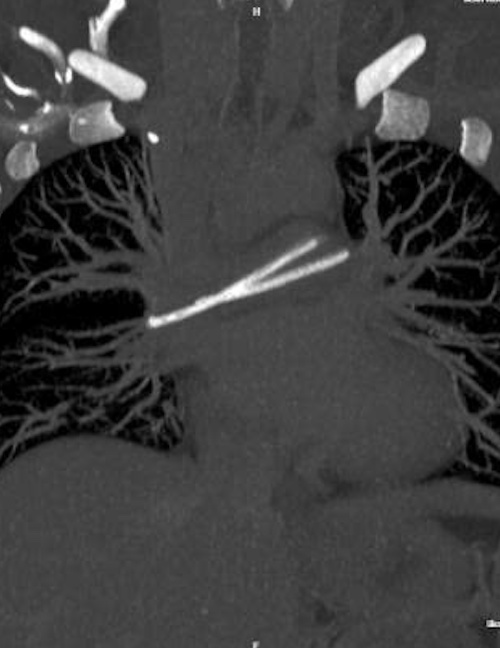 |
Image of the foreign object on the CT scan. Photo: Hospital provided |
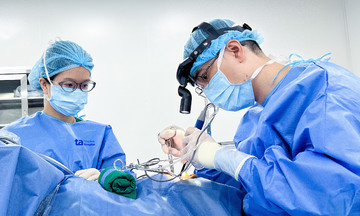
On 26/12, Doctor Hoang Hai Anh, a Master of Science and physician in the Department of Interventional Cardiology at Hospital 175, stated that this was a rare case. The foreign object had drifted deep into the pulmonary artery, which is the most difficult location to access for intravascular foreign bodies. The medical team successfully retrieved the catheter segment via the femoral vein, avoiding open-chest surgery.
Doctor Anh emphasized the importance of timely intervention. He explained, "Without prompt intervention, the foreign object could cause pulmonary embolism, cardiac arrhythmia, or sudden death." He added that while the technique itself was not overly complex, the foreign object's rare and deep location, close to the pulmonary artery bifurcation, made access challenging. Thanks to the minimally invasive technique, the patient was conscious immediately after the procedure and recovered well.
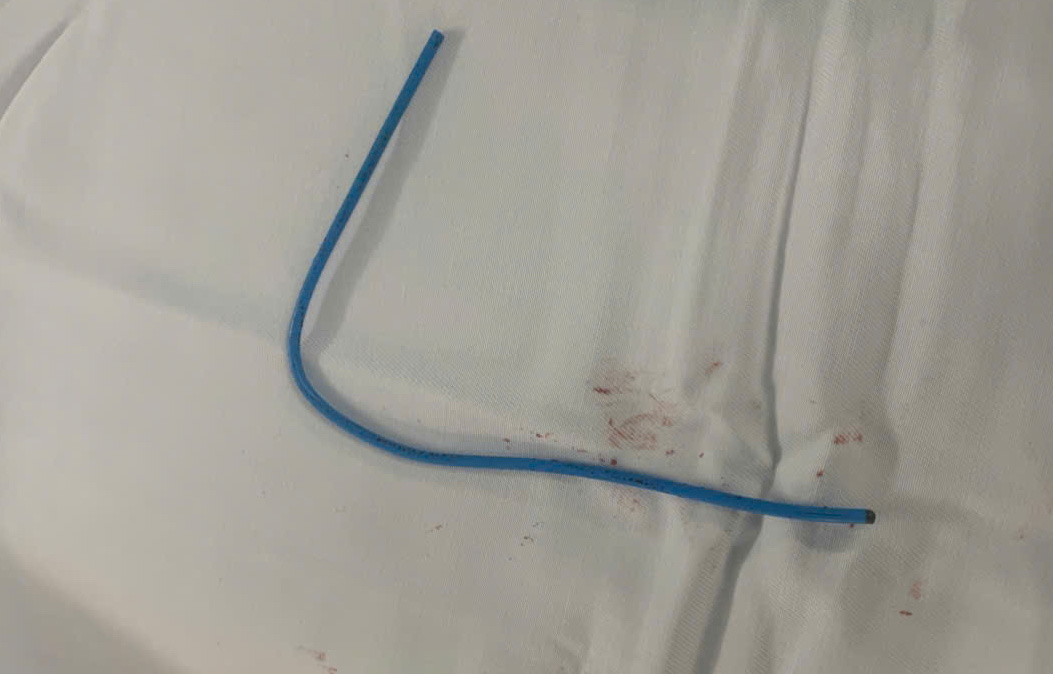 |
The foreign object was retrieved. Photo: Hospital provided |
A Port-a-Cath should be removed when it is no longer indicated for use. Leaving a catheter in place for too long can lead to wear, cracking, or breakage, especially when positioned where it can be compressed between the collarbone and a rib. Patients should attend regular follow-up appointments and seek medical attention promptly if they experience pain, swelling, or difficulty with infusion at the port site, to ensure early detection and management of potential complications.
Le Phuong