The story begins in Luocheng town, the country's only "medical special zone." In a sun-drenched ward of the West China Luocheng Hospital, affiliated with Sichuan University, a woman in her 50s with early-stage lung cancer waits. SCMP described her steady gaze as a nurse administered an injection of LK101, a personalized messenger RNA (mRNA) vaccine designed to reduce the risk of cancer recurrence.
A decade ago, personalized immunotherapy was considered a luxury gamble, with estimated costs reaching up to one million USD per patient. However, in Luocheng, that financial barrier is being dismantled. Likang Life Sciences' LK101 vaccine is currently being trialed at a price of approximately 150,000 yuan (21,000 USD), a modest figure compared to equivalent gene or immune therapies in the US and Europe.
Cancer vaccines help the immune system recognize and attack cancer cells. There are two main groups: first, cancer prevention vaccines, such as human papillomavirus (HPV) vaccine and hepatitis B vaccine, which prevent viral infections that can lead to cervical or liver cancer. Second are cancer treatment vaccines, used for individuals already diagnosed with the disease. For this group, doctors collect tumor and blood samples, sequence genes, use artificial intelligence (AI) to identify mutations found only in cancer cells, and then design "tailored" vaccines for each patient.
Upon injection, the immune system is "trained" to precisely recognize and attack malignant cells, helping to reduce the risk of tumor progression or recurrence after surgery, chemotherapy, or radiation therapy. Many international trials show that combining personalized vaccines with immunotherapy drugs can significantly reduce the risk of recurrence in some cancer types, but most are still in research phases and have not yet become standard treatments.
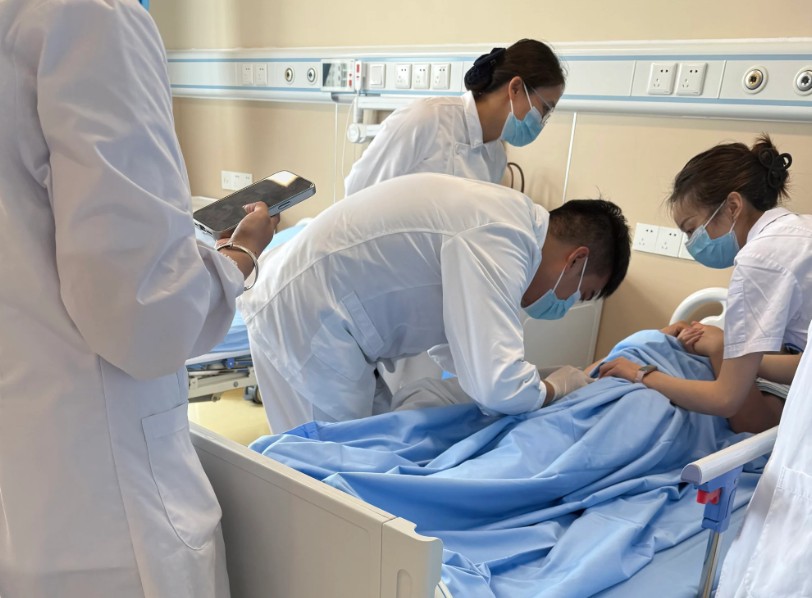 |
The first patient to receive a cancer vaccine at a hospital in Luocheng town. Photo: Handout |
Patients in Luocheng benefit from the unique mechanism of this region, which allows for the controlled use of advanced drugs and medical devices not yet widely approved for circulation. Doctor Wang Yongsheng, director of the Oncology Center at West China Hospital, who directly supervises the treatment process, emphasized that this is a lifeline for desperate patients.
In a context where the World Health Organization (WHO) reported that China accounted for nearly 24% of new global cancer cases in 2022 (approximately 4,8 million cases), the demand for effective and affordable therapies has become more urgent than ever. Collecting real world data from these vaccinations plays a pivotal role in supporting the National Medical Products Administration (NMPA) to accelerate the approval process.
Scientifically, LK101 operates on a precise "tailored" mechanism. Instead of attacking indiscriminately like chemotherapy, this vaccine uses artificial intelligence algorithms to analyze and identify neoantigens – unique mutations on each patient's cancer cells. High-throughput gene sequencing technology allows LK101 to train the immune system to precisely recognize and destroy malignant cells without harming healthy ones. Likang's therapy received a nod from the US Food and Drug Administration (FDA) for its Investigational New Drug application in February, marking the first milestone for a Chinese neoantigen mRNA vaccine in the world's most stringent market.
A key factor boosting China's confidence in the race to lower costs lies in its ability to optimize processes and its infrastructure advantages. Cheng Xudong, founder of ZSky – another biotech company also developing cancer vaccines – estimates their product could cost under 14,000 USD for a 6-dose regimen. This significant cost reduction stems from mastering mRNA raw material sources, improving neoantigen conversion methods, and leveraging clinical trial costs that are much lower than in the West.
While Moderna and Merck of the US are making waves with promising skin cancer vaccine trial results (a 44% reduction in recurrence or death risk), Chinese companies like Likang and ZSky are quietly catching up with encouraging data. A small-scale trial on 24 liver cancer patients initiated by Likang in 2018 showed a 5-year survival rate of 100% in the vaccinated group, an impressive figure that needs verification through broader trial phases.
Chen Li, founder of Likang, confidently positions his company third in the global race, right after the two giants Moderna and BioNTech, SCMP said. Both Chinese companies have completed phase I trials and are moving into phase II, with expectations to commercialize their products around 2027 – coinciding with the projected timeline of their Western counterparts. However, rapid development also comes with concerns about safety and standardization. Xu Juncai, a clinical research expert, warned about the necessity of clearer definitions for "new biomedical technologies" to avoid legal and medical risks.
In Luocheng, considered a "sandbox" for medical innovation, pressure weighs heavily on the pioneers. Doctor Wang Yongsheng admitted that the screening process must be extremely rigorous, as they cannot afford errors. The ultimate goal is not just to treat a few individuals, but to establish a standardized model that can be scaled, transforming cancer vaccines from a luxurious dream into a common tool in the fight against the deadly disease.
Binh Minh (According to SCMP, Beijing Economic-Technological Development Area)