Hong reported using a moisturizing cream purchased online, advertised to "brighten quickly in 7 days, suitable for all skin types". After about one week of use, her skin felt slightly warm and itchy, which she initially dismissed as normal. After about three weeks, her skin turned red, tight, and dry, especially around her cheekbones and nostrils. She stopped using the cream, but her skin then became grayish-brown and darkened, spreading across almost her entire face. She visited a spa for a "whitening mask" and microneedling, undergoing a regimen of six sessions, but her skin became even darker and more irritable.
Master Doctor Vu Thi Thuy Trang, a specialist in dermatology and aesthetic dermatology at Tam Anh General Hospital, TP HCM, diagnosed Hong with a cosmetic allergy leading to diffuse facial hyperpigmentation and thickened skin. This condition, Riehl's melanosis, is a form of hyperpigmented contact dermatitis on the face, characterized by diffuse or reticulated brown or black patches, especially on the forehead and cheekbones, and is difficult to treat.
The primary cause of Riehl's melanosis is chemicals in cosmetics or skincare products that trigger allergic reactions and hyperpigmentation. Unlike typical post-inflammatory hyperpigmentation, which causes mild redness, slight irritation, and occasional peeling, Riehl's melanosis results in deep, persistent pigment accumulation. The darkened areas become progressively darker, spread, and make the skin noticeably rough and dull. If detected late, the condition is very challenging to reverse, potentially causing prolonged skin sensitivity to skincare products.
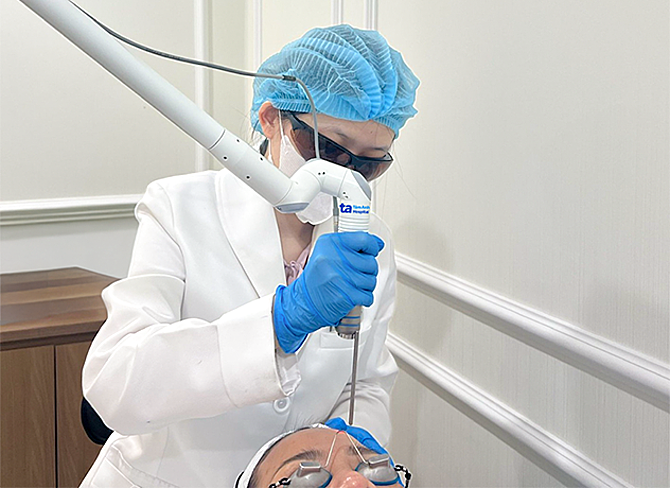 |
The doctor uses pico laser to reduce skin hyperpigmentation for Hong. *Photo: Tam Anh General Hospital* |
The doctor prescribed Hong a treatment regimen including topical medication to reduce inflammation, combined with short-pulse pico laser to break down excess pigment, and hyaluronic acid (HA) injections to improve skin structure, enhance elasticity, and even out skin tone. She also underwent chemical peels with appropriate concentrations, performed alternately to promote skin surface regeneration, thin the thickened stratum corneum, and increase brightening efficacy. The treatment course lasted 8-12 months.
According to Doctor Trang, the pico laser directly targets excess melanin, breaking down pigment particles without damaging the epidermis. The laser waves simultaneously stimulate collagen and elastin production, making the skin soft, smooth, and naturally radiant.
After nearly one year of treatment, Hong's skin showed significant improvement; the darkened areas faded considerably, and her skin became rosier.
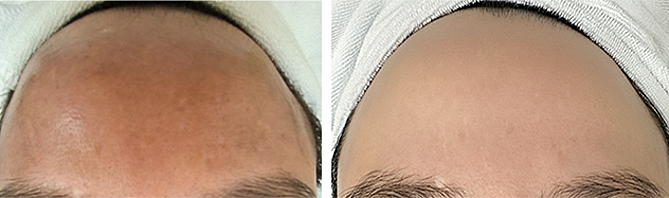 |
After one year of treatment, Hong's darkened skin areas are evenly brightened and rosier (right). *Photo: Tam Anh General Hospital* |
Doctor Trang noted that treating post-allergy skin darkening or Riehl's melanosis requires a long duration, a combination of methods, and strict home care. Patients should moisturize daily with products containing ceramide or hyaluronic acid, practice diligent sun protection, limit cosmetics with common allergens, and avoid rubbing the skin. Adequate hydration, a diet rich in green vegetables, and limiting alcohol and tobacco contribute to maintaining an even skin tone. Adhering to the correct treatment protocol helps monitor progress and adjust laser energy as needed.
If skin exhibits prolonged redness, irritation, dryness, peeling, or uneven tone, discontinue using the suspected product. Do not self-treat or continue using cosmetics, as this can lead to severe hyperpigmentation that is difficult to reverse. In such cases, patients should consult a dermatologist and aesthetic dermatologist to determine the cause and receive appropriate treatment.
Minh Huong
*Character's name has been changed