Dr. Chu Tan Si, 61, head of the Department of Neurosurgery - Spine at the Neuroscience Center, Tam Anh General Hospital TP HCM, vividly recalls witnessing an AI robot-assisted brain surgery in the US nearly 10 years ago. He was surprised by the robot's flexible arm and advanced neural navigation, which displayed diffusion tensor imaging (DTI) of nerve bundles on screen during the procedure. This surgery left a profound impression on Dr. Si because, after more than 30 years of performing brain surgeries, he had always pondered why some patients with the same type of brain tumor and technique maintained motor and language functions post-operation, while others suffered severe complications.
Brain surgery, particularly tumor removal, is one of the most complex interventions in neurosurgery. Surgeons operate near areas controlling movement, language, cognition, and other vital functions. This carries a high risk of complications such as neurological disorders, weakness, motor and language impairments, and seizures. "That's why my colleagues and I always wanted to find a 'solution' for safer neurosurgery for patients," Dr. Si stated.
During that robot-assisted brain surgery, Dr. Si could visualize the nerve fiber bundles in the human brain, structures previously only conceptualized through anatomical theory. "I believed I had found the answer to how to minimize complications in brain surgery," he shared. He explained that clearly displayed nerve conduction pathways help surgeons precisely define the boundary between the lesion and functional areas. This allows surgeons to avoid invading structures critical for the patient's vision, hearing, touch, movement, or language functions.
 |
In neurosurgery, damage to any brain region or nerve conduction pathway means the patient will permanently lose related functions. Traditionally, surgeons relied entirely on experience and visual examination of anatomical images, which resulted in a high rate of post-operative complications.
At that time, robot-assisted surgical technology had only emerged about two years prior, and only a few centers in the US utilized it. During his trips to the US in 2017 and early 2018, Dr. Si only accessed the technology at a laboratory level, observing how the system rendered images and simulated procedures, but could not enter the operating room for direct observation. Upon returning, he sought an opportunity to go back, arranging for a brain tumor patient from Vietnam to undergo surgery in the US, on the condition that he could participate in the operating room as an interpreter. This request was approved.
The patient was a middle-aged businessman who, after an examination in Vietnam, was found to have a brain tumor located near important functional areas, posing a high risk to motor and language functions. He wished to access the most advanced surgical method. Dr. Si advised him to travel to the US for an AI robot-assisted brain surgery using the Modus V Synaptive system with an "awake" anesthesia method. During that brain surgery, the patient remained largely conscious throughout the procedure. Doctors asked the patient to speak or move their limbs corresponding to each intervention site, to control the tumor boundary and directly assess motor function, helping preserve healthy brain structures and reduce the risk of paralysis, language disorders, and promote faster post-surgical recovery.
"The surgery in the US cost nearly 200,000 USD. At that time, this method was still very new in the US and European countries, and not yet available in Vietnam," Dr. Si said. This patient recovered well and was discharged one day after surgery.
Subsequently, Dr. Si underwent intensive training in the US and Switzerland from 2017 to 2019, before bringing the Modus V Synaptive AI robot system for neurosurgery to Vietnam.
In 2019, the first robot system was piloted at Nhan Dan 115 Hospital TP HCM. There, Dr. Si performed the first AI-integrated robot-assisted brain tumor surgery for a 67-year-old female patient from Tay Ninh. The surgery was later confirmed by Professor Amin Kassam, Vice Chairman of the Aurora Neuroscience Institute (US), as the first successful AI robot-assisted brain surgery in Asia.
The Covid-19 pandemic caused all pilot activities to halt. In 2020, due to various objective factors, the system could not continue operating and had to be returned to the manufacturer. "At one point, I thought I would no longer have the opportunity to pursue robot-assisted surgery," Dr. Si recalled.
 |
Two years later, Tam Anh General Hospital TP HCM invested in and applied this Modus V Synaptive AI robot system, receiving licensing from the Ministry of Health. Dr. Si and the hospital's neurosurgical team performed many major surgeries, including cases once considered "impossible to intervene". For example, a young girl who had been weak and paralyzed for six years due to a brainstem tumor, facing a high risk of death or permanent disability after surgery, can now walk almost normally after robot-assisted surgery. A five-year-old child with a tumor located 8 cm deep in the brain underwent robot-assisted surgery to remove most of the tumor, preserving developing neurological functions.
AI robots also assist in emergency surgeries for many stroke patients with hemorrhagic brain bleeds who arrive late, past the "golden hour", and face a high risk of death, enabling them to recover motor and cognitive functions.
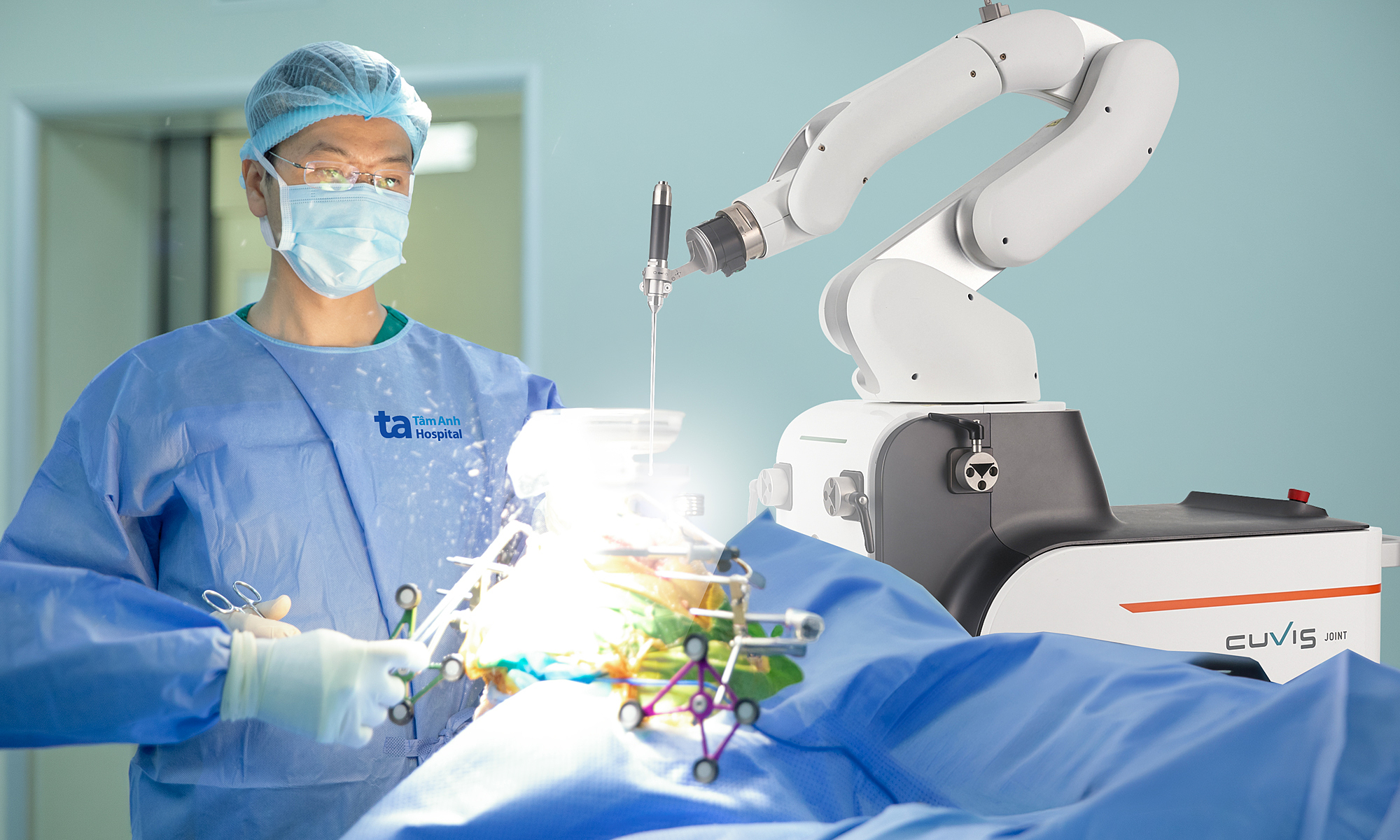
According to Dr. Si, this capability is due to the AI robot allowing integration and fusion of CT, MRI, DTI, DSA data even before surgery. This enables surgeons to simulate the procedure on software, actively choosing the shortest and most precise approach while avoiding invasion of healthy brain tissue. During surgery, doctors make a very small cranial opening, only one-fifth the size of classic surgical methods. Each of the surgeon's movements is precisely controlled by the robot, accurate to the millimeter in real-time, minimizing potential deviations that could lead to permanent complications. This limits patient injury, reduces blood loss, decreases pain, promotes faster recovery, and maximally preserves functions.
 |
AI robots in brain and spinal cord surgery increase the success rate to over 95%, reduce blood loss during surgery by 79%, and shorten hospital stays by 40%. Simultaneously, treatment costs are tens of times lower compared to performing the same technology in the US. The recovery rate for patients after robot-assisted surgery at Tam Anh Hospital is recorded at nearly 100% without severe complications.
To date, Tam Anh General Hospital TP HCM has successfully performed over 200 AI robot-assisted brain and spinal cord surgeries. This achievement was recently recognized with Vietnam and Asia records during an announcement ceremony on 26/2.
"The value lies not in the records, but in the opportunity for life and the quality of treatment for patients," Dr. Si said, adding that the goal is to build a modern neurosurgical ecosystem where domestic patients can access advanced and safe brain surgery technology at reasonable costs. In the near future, he expects Vietnam to become a regional hub for robot-assisted neurosurgery.
Trong Nghia
Photo: Tam Anh General Hospital